How Much Water Do Chickens Drink in a Day? Heat Changes It
Plan on about 200–300 mL (7–10 fl oz) of clean drinker water per adult hen on a mild day. For a hot backyard afternoon, I’d budget roughly 400–600 mL (14–20 fl oz) per hen, then check your flock instead of treating that allowance as a promise.
Those are planning bands for a handful of backyard hens, not a laboratory reading. Water that disappears from a drinker may have been swallowed, spilled, evaporated, splashed into litter, or spoiled by dirt. Around the upper 80s°F, or about 30°C, especially with high humidity, I increase the checking schedule rather than pretend one temperature fits every flock.
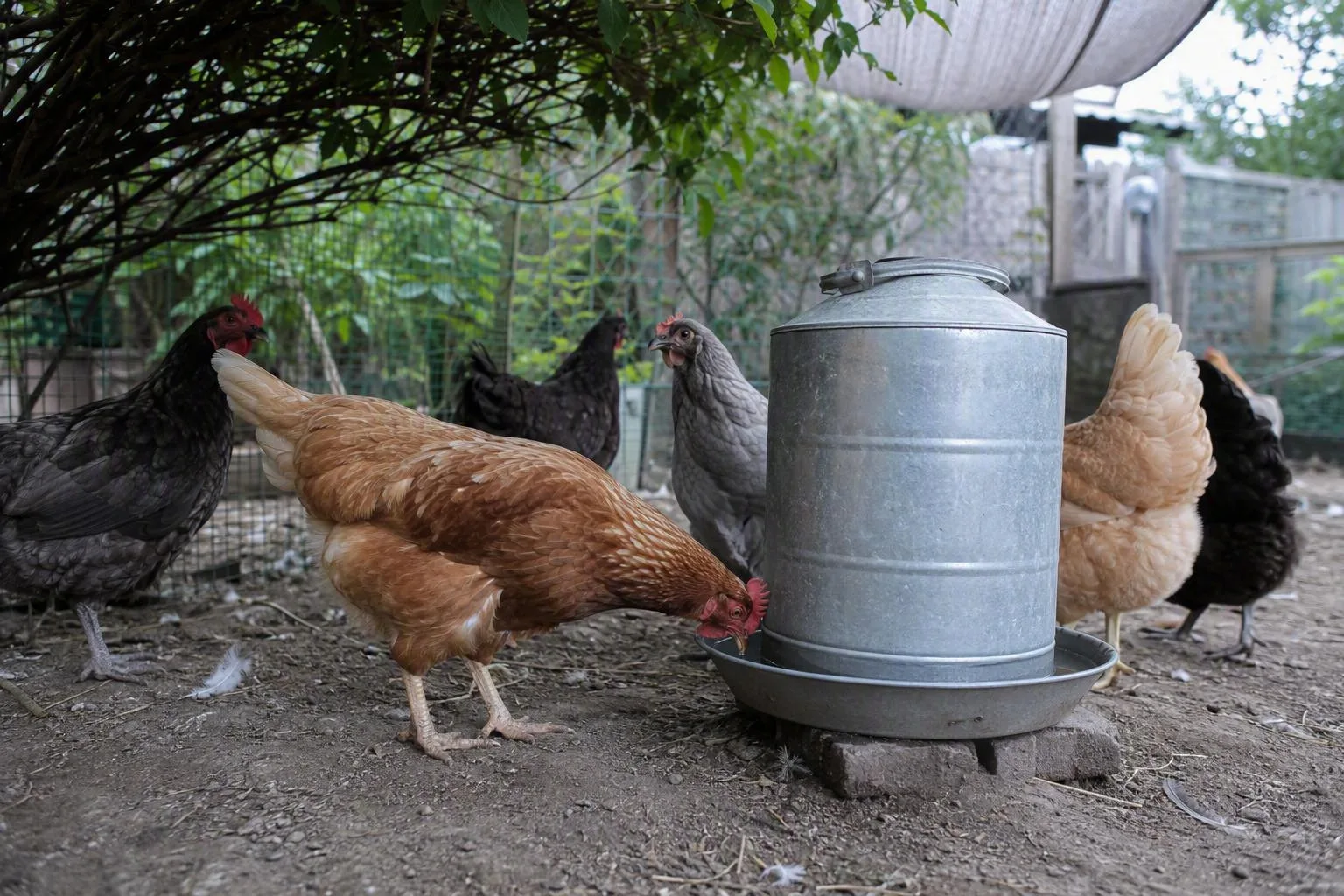
Start with this number: 200–300 mL per hen, then double the hot-day allowance
The useful starting point for an adult hen is the drinker, not the water bowl you hope she used. In mild weather, I’d plan 200–300 mL per bird per day. The lower end suits a small, shaded flock eating dry feed in moderate conditions. The upper end gives you more room when birds are active, laying, or eating less moisture-rich food.
For hot-weather planning, I use roughly twice that allowance: 400–600 mL per hen. That does not mean every bird will drink 600 mL, and it isn’t a universal heat-stress cutoff. It’s a stocking and refill number. A hen standing in a breezy shaded run may use less. A hen panting through a humid afternoon may use more, while a tipped drinker may make the container look empty for an entirely different reason.
Keep one distinction clear: water added to the drinker is not automatically water consumed by your birds. If you want your flock’s real number, measure it under your own conditions.
Turn flock size into litres before you buy a drinker
Multiply the per-hen allowance by the number of adult birds. Here’s the practical planning math for three common backyard flock sizes.
| Adult hens | Mild day | Hot-day allowance | Approximate US volume |
|---|---|---|---|
| 3 | 0.6–0.9 L | 1.2–1.8 L | 20–30 fl oz; 0.16–0.24 gal mild >41–61 fl oz; 0.32–0.48 gal hot |
| 6 | 1.2–1.8 L | 2.4–3.6 L | 41–61 fl oz; 0.32–0.48 gal mild >81–122 fl oz; 0.63–0.95 gal hot |
| 12 | 2.4–3.6 L | 4.8–7.2 L | 81–122 fl oz; 0.63–0.95 gal mild >162–243 fl oz; 1.27–1.90 gal hot |
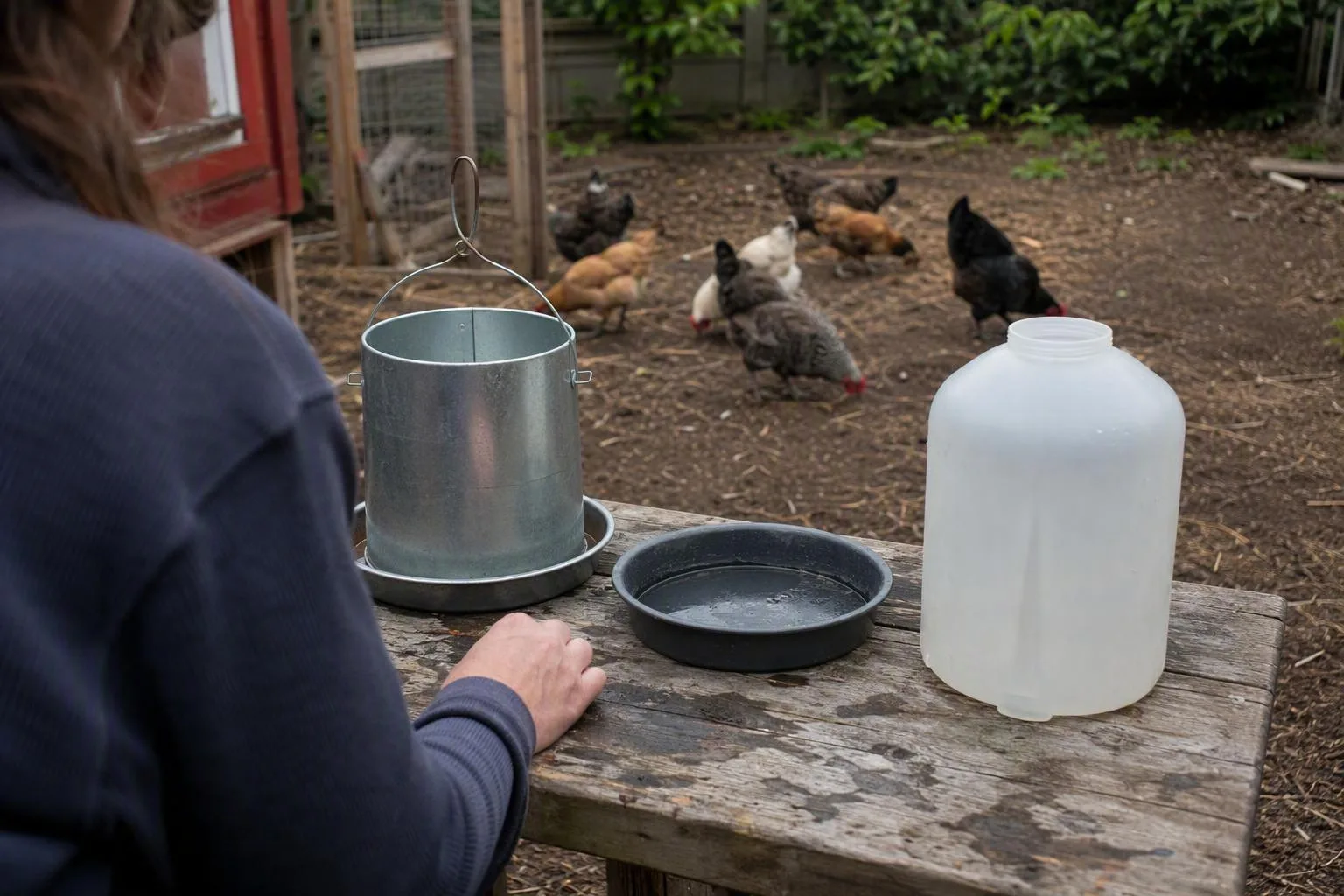
Use the table as a shopping check, not a drinking promise. I’d multiply the maximum hot-day estimate by 1.5 when choosing combined usable capacity. That gives about 2.7 L for three hens, 5.4 L for six, and 10.8 L for 12. The extra space covers a spill or a delayed refill. It doesn’t excuse leaving a dirty, empty, or overheated drinker unchecked.
Read a waterer’s capacity with some caution. A container labelled 5 L may not offer 5 L of practical access if the drinker stops working before the bottom, sits crooked, or is too high for the smallest bird. Capacity is useful only when your birds can reach it.
Heat is only one lever: humidity, laying, feed, and age
Heat changes water use through panting. A chicken has limited ways to shed body heat, so hot birds may breathe faster and lose more moisture through evaporation. Humidity matters because damp air gives that evaporative cooling less help. That’s why a humid day deserves closer checks even if the thermometer reading looks familiar.
Active laying can also move a hen above your flock’s mild-weather baseline. So can a larger, more active bird compared with a small, quiet bird. These differences are reasons to watch a range rather than compare your flock with a neighbour’s exact refill amount.
Feed changes the picture too. Dry pellets or mash bring less moisture into the bird than watery vegetables or soaked feed. A wet treat may reduce what you see disappearing from the drinker for a while, but it isn’t a dependable water system. Your birds still need a clean supply they can reach whenever they want it. For the feed side of the budget, pair this calculation with how much feed per chicken per day for laying hens.
Chicks are a separate calculation. A chick drinks less per bird than an adult hen because it is smaller, but it still needs shallow, clean access throughout the day. Don’t size chick drinkers by pouring the adult 200–300 mL figure into a brooder. A chick can drown in a container that looks harmless to an adult bird, and spilled water quickly chills or mats brooder litter.
A water station that survives a 95°F afternoon
Build for availability, not just volume. Put the drinker in full shade, with air able to move around it. A covered run roof or shade cloth works better than a dark container sitting in direct sun. Keep the vessel stable, and place it where scratching birds aren’t constantly throwing litter into the drinking surface.
For height, I aim for the lower edge of the drinking area to sit around the smaller bird’s back height, then adjust after watching the flock. Too low invites bedding and manure. Too high makes short birds stretch, spill water, or give up on the station.
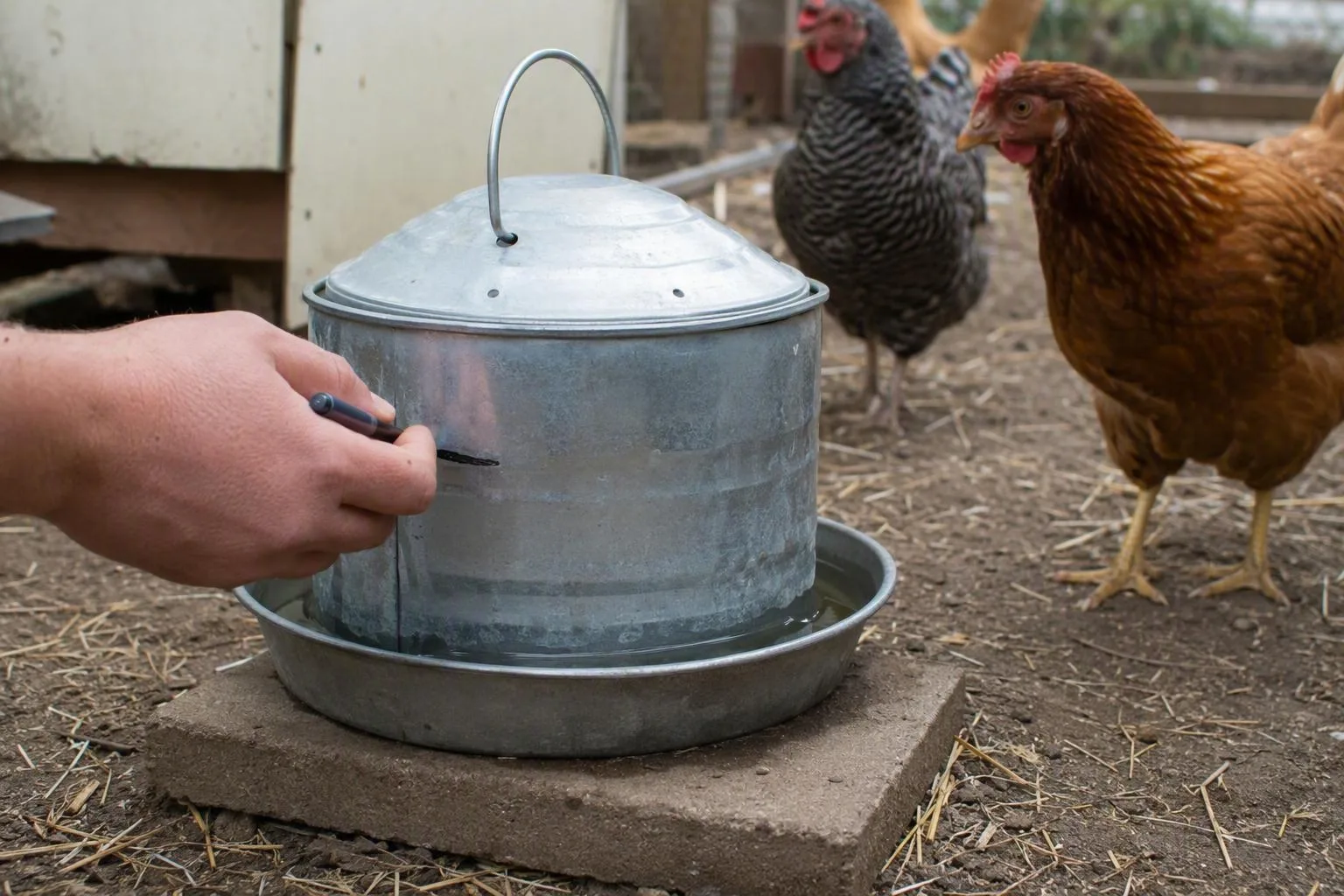
My practical habit is to mark a fill line on a 5-L container with a permanent marker before a hot spell. I keep a second drinker ready instead of trusting one large vessel. The 5-L size isn’t right for every flock; the useful part is the visible fill line and the backup. If a valve clogs or a bird tips the first drinker, your birds still have a clean route to water.
For six to 12 birds, I recommend two separated drinker points. Put them far enough apart that a dominant hen can’t guard both. Even with three birds, set out a backup if you’ll be away for the day. Two small points also make a failure easier to spot than one oversized tub hidden under a perch.
Check in the morning and again in the late afternoon. Add a midday check during extreme heat, especially if the forecast is near 95°F or the run is humid and still. Look at the water itself, not only the level. If you see algae, slime, litter, or droppings, empty and scrub the drinker before refilling it. Review your chicken coop ventilation as part of the same heat check. A clean chicken dust bath can also give birds a cooler place to manage their feathers, but it does not replace drinking water.
The seven-day measuring method for your actual flock
A seven-day record turns a generic allowance into a useful local baseline. Use one graduated container or a waterer with a clear mark. Keep the same setup if you can. Changing from a nipple drinker to a bowl halfway through makes the record harder to interpret.
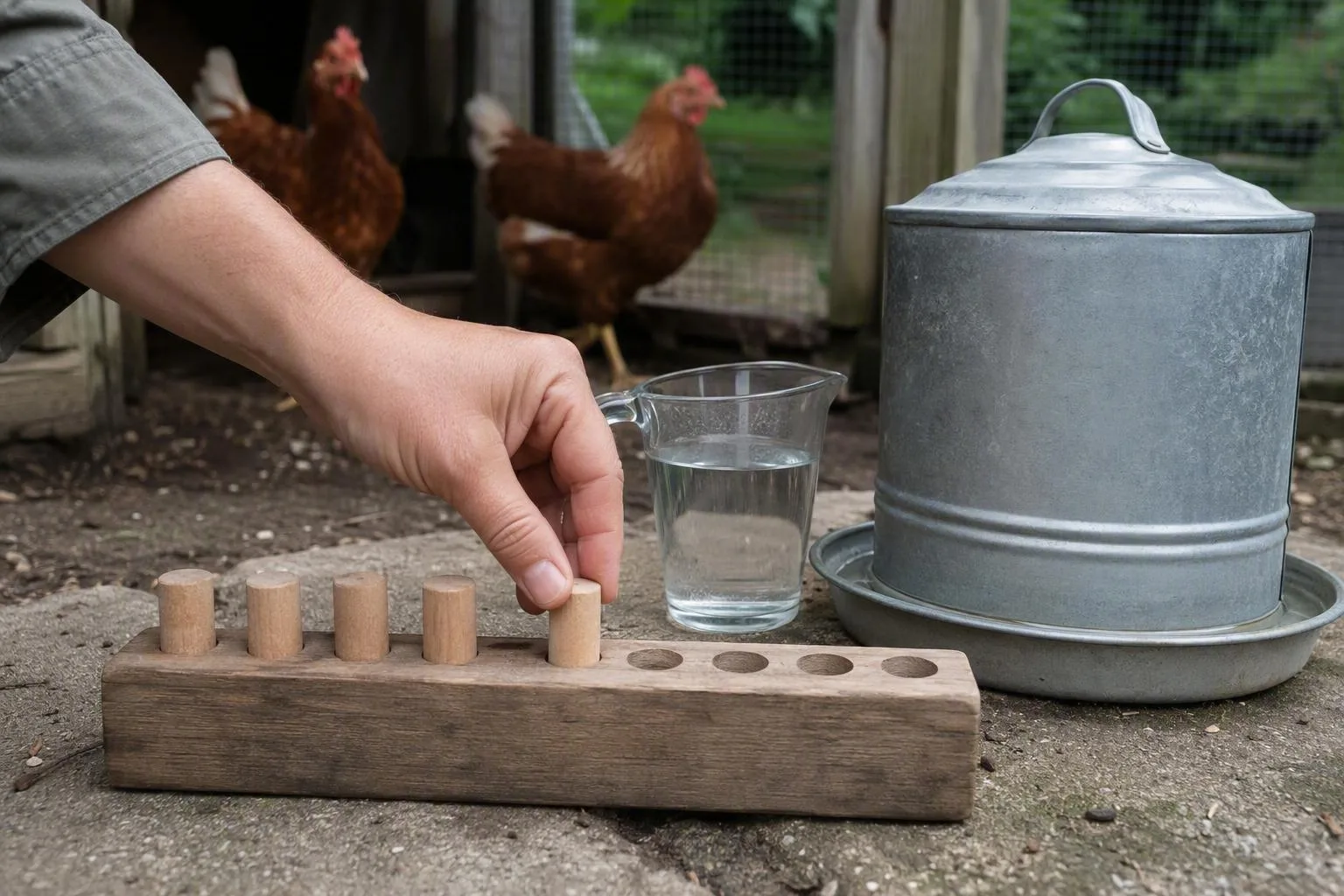
A seven-day record turns a generic allowance into something you can compare with your own weather and routine. Follow this order:
- Write down the opening volume each morning.
- Record every refill, including partial refills.
- Note the closing volume before the evening check.
- Write down visible spills, rain, unusual treats, and the day’s temperature and humidity if available.
- Record the number of birds that had access. If one hen was isolated, note that too.
The calculation is: opening water plus all refills, minus closing water, minus known spills, divided by the number of birds. If you can’t estimate a spill, call the result apparent drinker use rather than true intake.
Here’s a worked example. Six hens start a mild day with 4.0 L. You add 1.0 L, and 3.4 L remains at the end. The drinker lost 1.6 L. If 0.1 L was visibly spilled, the rough drinker-use estimate is 1.5 L, or 250 mL per hen.
On a hot day, the same six hens start with 5.0 L, receive 3.0 L more, and finish with 4.8 L. After allowing for a visible 0.2 L spill, the estimate is 3.0 L, or 500 mL per hen. Those figures illustrate the calculation; they are not a promise about what your flock will do.
A full drinker can still hide a problem
I use a roughly twofold rise over your flock’s normal measured use for 24 hours as a troubleshooting flag, provided there hasn’t been a comparable heat, feed, or treat change. It’s a screening rule, not a diagnosis. First check the simple physical causes.
- Wet ground under the drinker: inspect the valve, stand, and fittings for a leak or a tipped container.
- More water gone but no matching wet patch: consider evaporation, a wild animal, or a bird carrying water out of the drinker.
- A recent feed change: unusually salty feed can increase thirst, while spoiled feed can change appetite and drinking. Remove questionable feed and offer fresh feed.
- One bird returning to the drinker repeatedly: watch that bird separately. A flock average can hide one bird’s abnormal behaviour.
Wet droppings can also make a floor look as though more water was spilled. Check the texture and location of the wet area before you conclude that the drinker is leaking. This is especially useful when a drinker sits over litter that is already damp.
Persistent thirst deserves more than a larger waterer if it comes with reduced appetite, weight loss, a drop in eggs, abnormal droppings, weakness, or breathing trouble. Breathing trouble, collapse, or an inability to stand is not a wait-and-see waterer problem. Contact a poultry veterinarian promptly. If one bird or several birds remain abnormal for 24–48 hours after heat and other conditions return to normal, contact a poultry veterinarian or local extension office for guidance.
Plain water first; electrolytes are a narrow tool
Plain, clean water is my default on warm days. Electrolyte products may have a place during acute heat stress, transport, or another situation covered by the product label or veterinary advice. They are not a substitute for shade, airflow, cooling, or a full supply of fresh water.
Don’t improvise a concentrated salt mixture or pour a human sports drink into the flock’s waterer. If you choose a poultry-labelled product, mix it, replace it, and discard it exactly as the label directs. Product instructions differ. Keep plain water available unless a veterinarian or the label specifically says otherwise.
For a technical second opinion on the environment around the drinker, compare your setup with University extension guidance on poultry heat stress, humidity, ventilation, and water access. If one bird’s thirst remains abnormal, Merck Veterinary Manual guidance on dehydration, heat stress, and excessive drinking in chickens is a useful prompt to seek professional help rather than keep adjusting the container.
Your 3-, 6-, or 12-hen summer water plan
The finished plan is deliberately boring: water stays shaded, clean, reachable, and easy for you to inspect.
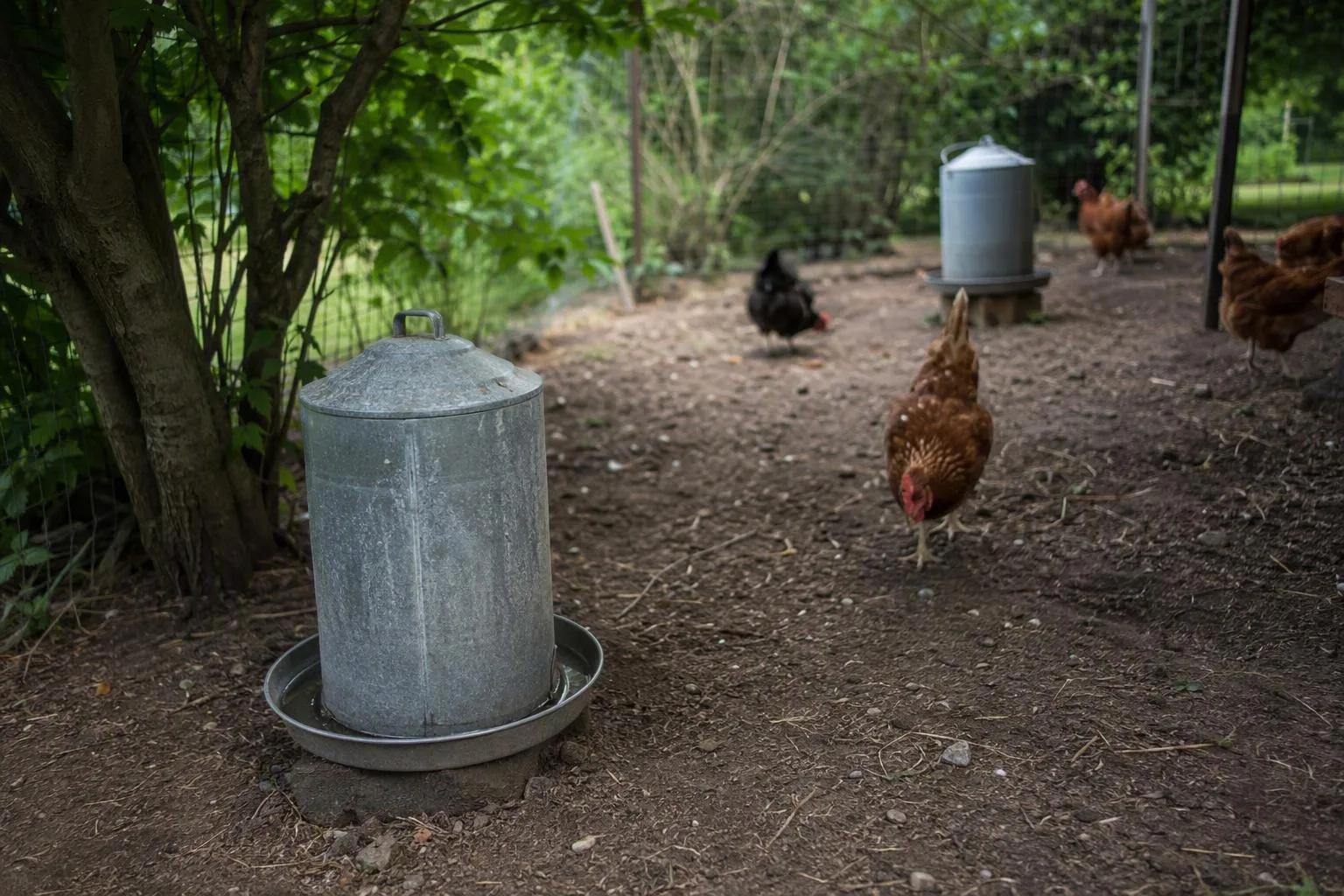
- Three hens: plan for 1.2–1.8 L on a hot day. With the 1.5 capacity margin, choose about 2–3 L of usable capacity. Add a backup drinker if you’ll be away.
- Six hens: plan for 2.4–3.6 L. A combined 5–6 L gives you room above the calculated maximum, split between two stations rather than one guarded container.
- Twelve hens: plan for 4.8–7.2 L. Choose about 8–11 L of combined usable capacity, divided across at least two separated stations.
For the next week, mark your current waterer, record opening volume and every refill for seven days, and add shade before the next hot spell. If your result is consistently near the upper end, buy capacity from that measured number rather than from a generic label. Then pair the water log with how much feed per chicken per day for laying hens so your summer budget covers both daily inputs.
Do chickens need access to water overnight?
Chickens generally roost rather than drink through the dark hours. I don’t deliberately withhold water, though. Make sure your birds can drink before roosting and at first light, and keep access reliable during hot weather or unusually long warm days. A covered run and a secure drinker are safer than leaving a bowl where it can be fouled overnight.
Can chickens drink rainwater?
Collected rainwater can pick up roof debris, bird droppings, algae, or other contaminants. Clean, potable water is the safer default. If you collect rainwater, use a covered, clean container and follow local water-treatment guidance rather than assuming clear water is safe water.
Can I put ice in chicken water during a heat wave?
Ice or a frozen bottle can cool water for a while, but it doesn’t replace shade, airflow, or refilling. Use it only if your birds continue drinking and the container stays clean. Still check the water in the morning and late afternoon, with a midday check during extreme heat.
Your next action: fill a marked container today, write down the starting volume, and begin the seven-day log. By the next hot spell, you’ll have a flock-specific number and a water station sized around what your birds actually use.
Frequently Asked Questions
Do chickens need access to water overnight?
Chickens generally roost rather than drink through the dark hours, but you should not deliberately withhold water. Make sure birds can drink before roosting and at first light, and keep access reliable during hot weather or unusually long warm days.
Can chickens drink rainwater?
Collected rainwater can carry roof debris, bird droppings, algae, or contaminants. Clean, potable water is the safer default; any rainwater system should use a covered, clean container and follow local water-treatment guidance.
Can I put ice in chicken water during a heat wave?
Ice or frozen bottles can cool water temporarily, but they do not replace shade, airflow, and refilling. Use them only if birds continue drinking and the container stays clean, and still check the water at least morning and late afternoon.