Black Soldier Fly Larvae for Chickens: How Much Is Safe?
For a healthy, standard-size adult hen, start with one level tablespoon of dried black soldier fly larvae or about two level tablespoons of live larvae. Offer that portion two or three times during the first week, not from a feeder your birds can visit all day.
That is a cautious starting point, not a universal dose. Your hen’s size, the product’s moisture, her complete-feed intake, and the other treats in the run all change the answer.
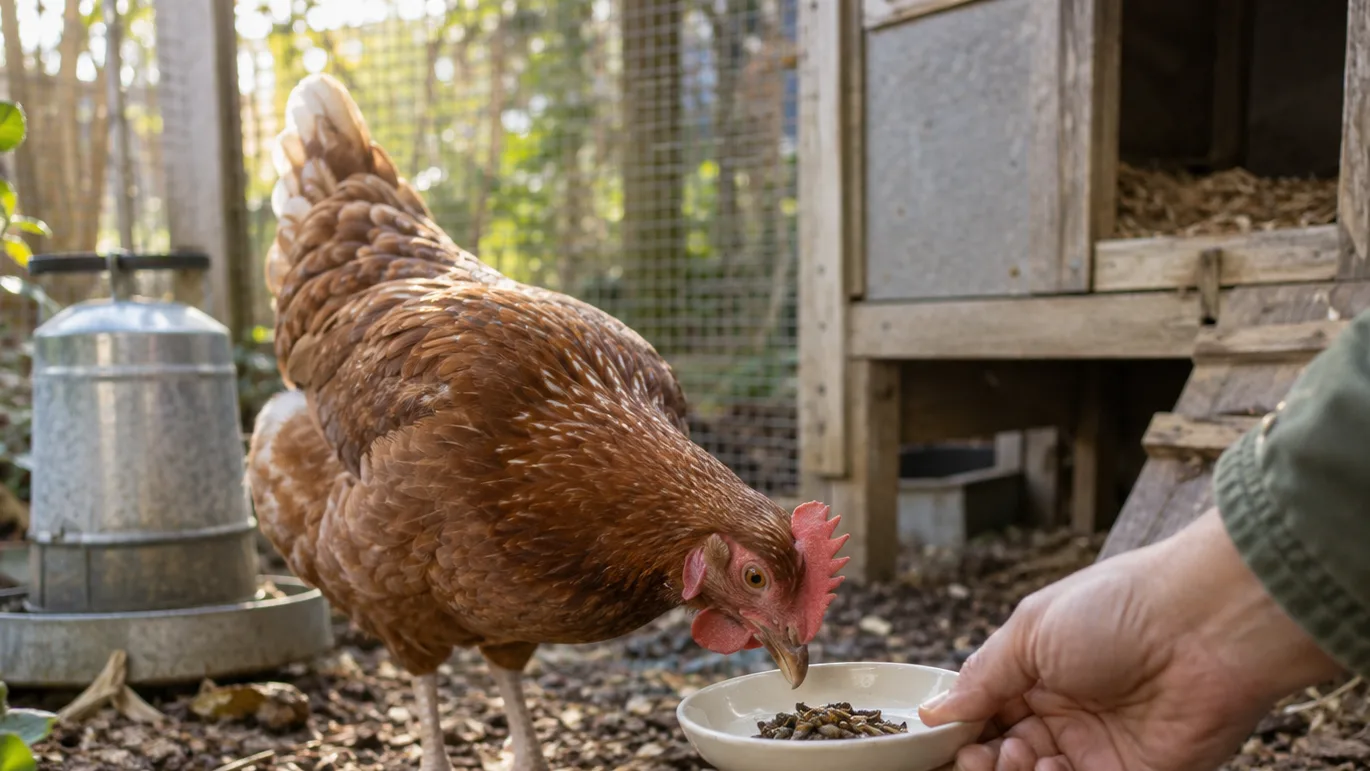
A safe starting point for an adult hen: one level tablespoon of dried larvae
Black soldier fly larvae, or BSFL, belong in the treat portion of your feeding plan. They should not replace complete layer feed. Your main ration supplies the wider balance of nutrients your birds need; larvae are an extra item added around that foundation.
I use a conservative ceiling of roughly 10% of daily intake for all treats combined. That includes BSFL, scratch, fruit, vegetables, kitchen leftovers, and anything else that is not part of the complete ration. If a hen is already getting a handful of scratch, her BSFL portion needs to come down.
The one-tablespoon starting point fits a healthy adult hen of ordinary body size. A large hen may handle a little more within the overall treat limit. A bantam, a small pullet, or a bird that is eating poorly needs less. Free-ranging also changes the calculation because grass, insects, spilled grain, and household feeding can all add to what she consumes outside the feeder.
Do not turn the first serving into a free-choice test. A hen can keep eating a tasty treat after she has had enough variety for the day, and a flock can empty a dish before you notice that the complete feed is being left behind. The safest number is not a count of larvae. It is the amount of complete feed your birds still finish.
Dried, live, or home-raised? The product changes the portion
A tablespoon of dried larvae is not a live-larvae tablespoon. Dried BSFL have had much of their water removed, so a small scoop contains more dry material than the same scoop of live larvae. That makes dried product more concentrated by volume and easier to over-serve casually.
Live larvae are bulky and moist. Fresh or home-raised larvae may also spoil faster if they sit warm or wet. Their condition can change during storage, so use the package’s handling directions rather than assuming that live insects can be kept like a bag of dry feed. If the label calls for refrigeration, follow it.
Do not convert live and dried larvae gram-for-gram as though they were the same food. A kitchen scale is useful when you are trying to stay under a treat allowance, but the label and the product form still matter. Start with a level tablespoon for dried larvae, keep the scoop level, and note how much the product weighs on your scale. Repeat that check if you change brands.
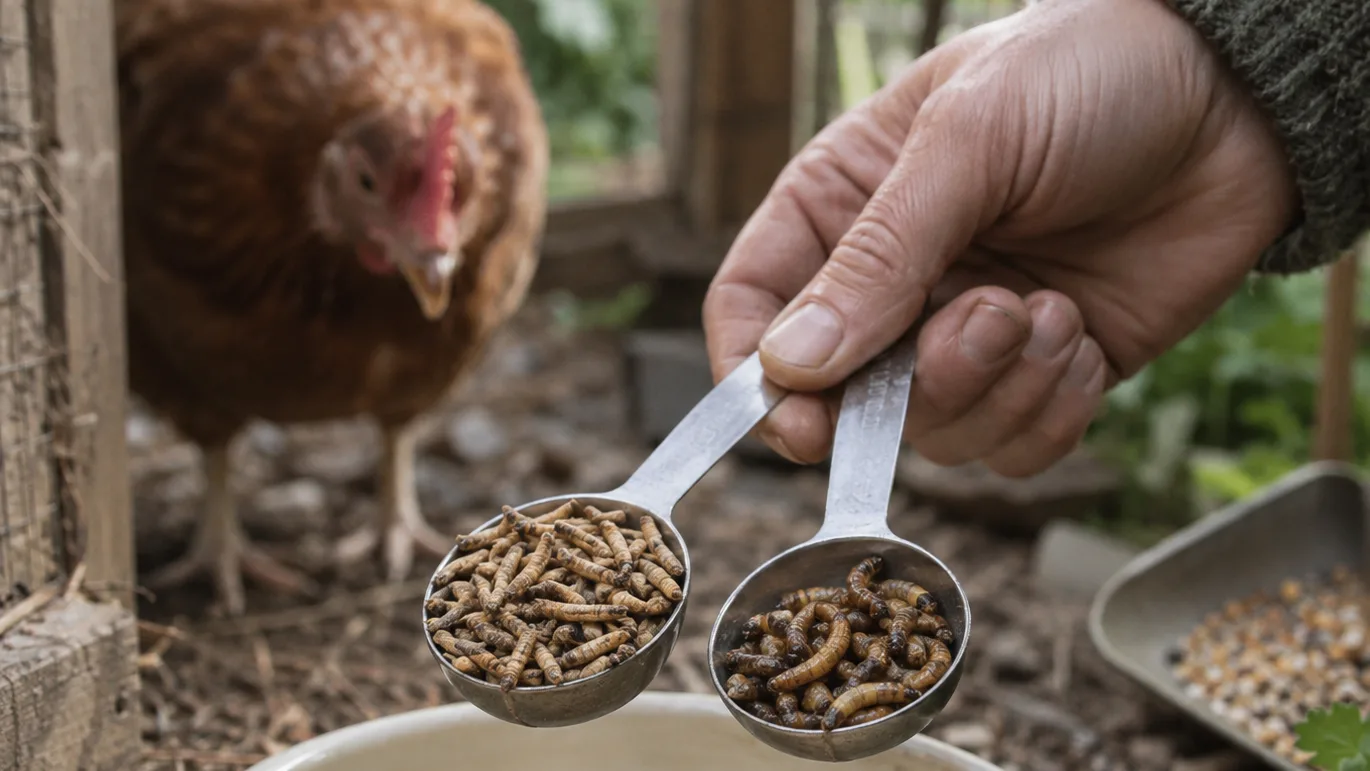
There is also no honest universal answer to “how many BSFL per chicken?” Larvae vary in size, and a product may be whole, broken, very dry, or partly moist. Volume is practical for a small flock, but a scale gives you a better ceiling when the product is dense or the birds are small.
Do the flock math before you fill the feeder
For planning, I use roughly 90 to 120 grams of complete feed per adult hen per day. Treat that as a starting range to test against your own flock, not as a catalog promise. The useful calculation is:
Daily treat room = complete feed eaten per day × 0.10, minus other treats already given.
Using that planning range, three hens eating 270 to 360 grams of complete feed have about 27 to 36 grams of total treat room for the day. Six hens eating 540 to 720 grams have about 54 to 72 grams. Twelve hens eating 1,080 to 1,440 grams have about 108 to 144 grams. Those are flock totals, not allowances for BSFL alone.
Here is the more useful worked example. Suppose six hens actually eat about 600 grams of complete feed in a day. Ten percent gives you a rough 60-gram ceiling for all extras. If 30 grams of that allowance has already gone to scratch and another 10 grams to fruit, only about 20 grams remains for BSFL that day. Weighing the larvae is sensible here because one brand’s tablespoon may not match another brand’s.
If you need a baseline first, use how much feed per chicken per day as your starting question. For birds with pasture access, your own answer to how much feed per chicken per day free range should come from what they actually consume in your yard, not from a printed number alone. Offer a known amount, collect or estimate leftovers, and repeat the check for three days. That average is more useful when your birds spill feed, roam widely, or receive irregular scraps.
Use the same subtraction for every extra. A treat allowance already spent on scratch is not available again for larvae. This is why a small flock can get into trouble with a “healthy” treat: several modest handfuls become one large extra by the end of the day.
Chicks, bantams, layers, and molting hens do not share one dose
For chicks, my guardrail is simple: keep birds under roughly six weeks on complete chick starter rather than making larvae a routine part of the menu. Once a chick is eating starter reliably and growing normally, you can introduce only a few pieces as a novelty. A chick should not fill up on insect treats before it has eaten the ration designed for that stage.
Pullets and bantams need smaller portions than a standard adult hen. A one-tablespoon adult serving is not automatically appropriate for a 1.5- to 2-pound bantam. Start with a few pieces or a fraction of a tablespoon, then watch whether the bird returns to complete feed. The smaller the bird, the easier it is for a treat to occupy a meaningful share of the day’s intake.
Laying hens, broody hens, roosters, and birds in molt still need their appropriate complete ration first. BSFL can add variety, but I would not promise that they will increase egg production, repair feathers faster, or solve a bird’s poor appetite. A broody hen may accept larvae readily, but that does not mean the treat is meeting all her nutritional needs.
If a bird is already thin, lethargic, off feed, or recovering from illness, use the symptom to guide your next step rather than trying to fix it with more treats. A vet is the right person to assess an unwell bird.
The label and the substrate matter as much as the scoop
Choose a product sold for animal feed with a clear ingredient statement or substrate history. You want to know what the larvae were raised on. I would not feed larvae raised on manure, pet waste, treated wood, pesticide-contaminated material, or unknown compost. “Home-raised” describes the production method, not the safety of the substrate.
Read the substrate and ingredient information before you portion.
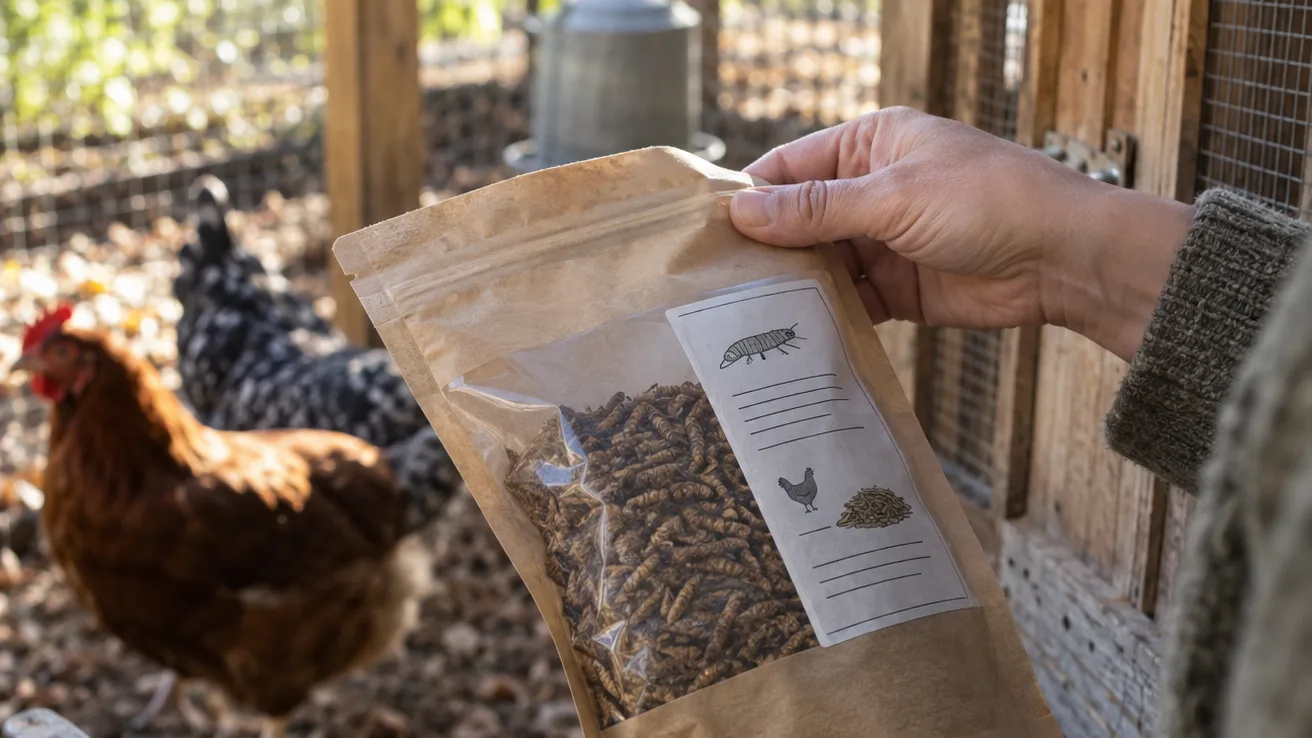
BSFL calcium content can vary between products, so do not assume that a larva serving replaces the calcium plan for laying hens. It also does not replace insoluble grit when birds eat whole grains, grass, or other fibrous material. Oyster shell supplies a calcium option; grit supports mechanical grinding. They solve different problems. For a second reference, compare your plan with university extension guidance on poultry treats and maintaining a complete ration, and check veterinary nutrition guidance on layer-feed calcium, oyster shell, and grit before changing a layer ration.
Keep dried larvae sealed in a cool, dry place. Live larvae should be handled according to the package directions, including any refrigeration instruction. Discard product that has visible mold, unexpected moisture, insects, or an off odor. Do not try to rescue questionable feed by mixing it into a larger bucket.
If you are deciding what else belongs in the run, use what not to feed chickens as a separate safety check. BSFL may be suitable as a measured treat, but that does not make every insect product, compost source, or kitchen scrap suitable.
Use the first week as a measured feeding trial
A new treat deserves a quiet introduction. You are checking whether your birds tolerate it and whether it displaces the ration, not trying to see how much they can eat.
- Day 1: Offer half of the adult starting portion. For a bantam or young bird, use only a few pieces.
- Day 2: Do not add more larvae. Check that the flock is eating its complete feed and that droppings have returned to their usual appearance.
- Day 3: If appetite and droppings are normal, repeat the half portion.
- Day 5: You can move toward the full starting portion for an adult bird, still keeping the dish limited rather than refilling it.
- Day 7: Decide whether BSFL fits your routine two or three times per week. Recheck the total treat allowance whenever you add scratch or other extras.
Watch complete-feed intake, droppings, the morning crop, body condition, and flock access. Dominant hens may monopolize a scattered treat. In my own small-flock routine, I use a shallow dish beside the regular feeder. When I first treated larvae like scratch, the dominant hens reached the patch first and the quieter bird got no fair share. I changed to a measured dish, watched until every bird had access, and removed it instead of topping it up. That is a practical management choice, not a promise of a measured health result.
Stop the trial if a bird develops persistent diarrhea, refuses its regular feed, becomes lethargic, loses weight, or was already unwell before the larvae were offered. If the problem does not settle promptly after the treat is removed, or if more than one bird is affected, contact a poultry veterinarian or local extension office instead of adjusting the snack again.
Do BSFL replace oyster shell or grit?
No. BSFL may contribute nutrients, but they are not a measured calcium replacement for laying hens. They are also not a substitute for insoluble grit when birds eat whole grains, grass, or other material that needs mechanical grinding.
Are black soldier fly larvae better than mealworms?
Neither is automatically better for every backyard flock. Compare the product’s protein and fat analysis, moisture, price, sourcing, and storage requirements, then keep either insect treat inside the same overall treat allowance.
Can you raise black soldier fly larvae at home?
You can only make a sensible safety decision when the substrate is controlled and free from manure, pet waste, chemicals, treated materials, and unknown contaminants. A labeled feed-grade product is easier to audit for a small flock.
This week, weigh the complete feed your flock uses over three days, subtract the other treats you give, and set aside the remaining allowance before you buy or pour the larvae. That simple number will also make your own how much feed per chicken per day calculation more useful for the rest of your feed budget.
Frequently Asked Questions
Do black soldier fly larvae replace oyster shell or grit for chickens?
No. BSFL may contribute some nutrients, but they are not a measured calcium replacement for laying hens or a substitute for insoluble grit when birds eat whole grains, grass, or other fibrous material.
Are black soldier fly larvae better than mealworms for chickens?
Neither is universally better. Compare the product's protein, fat, moisture, price, sourcing, and storage, then keep either insect treat within the same overall treat allowance.
Can you raise black soldier fly larvae at home for chickens?
Only when the larvae's substrate is controlled and free from manure, pet waste, chemicals, treated materials, and unknown contaminants. A labeled feed-grade product is easier to audit for backyard use.