What Not to Feed Chickens: Safe Treats vs. Real No-Gos
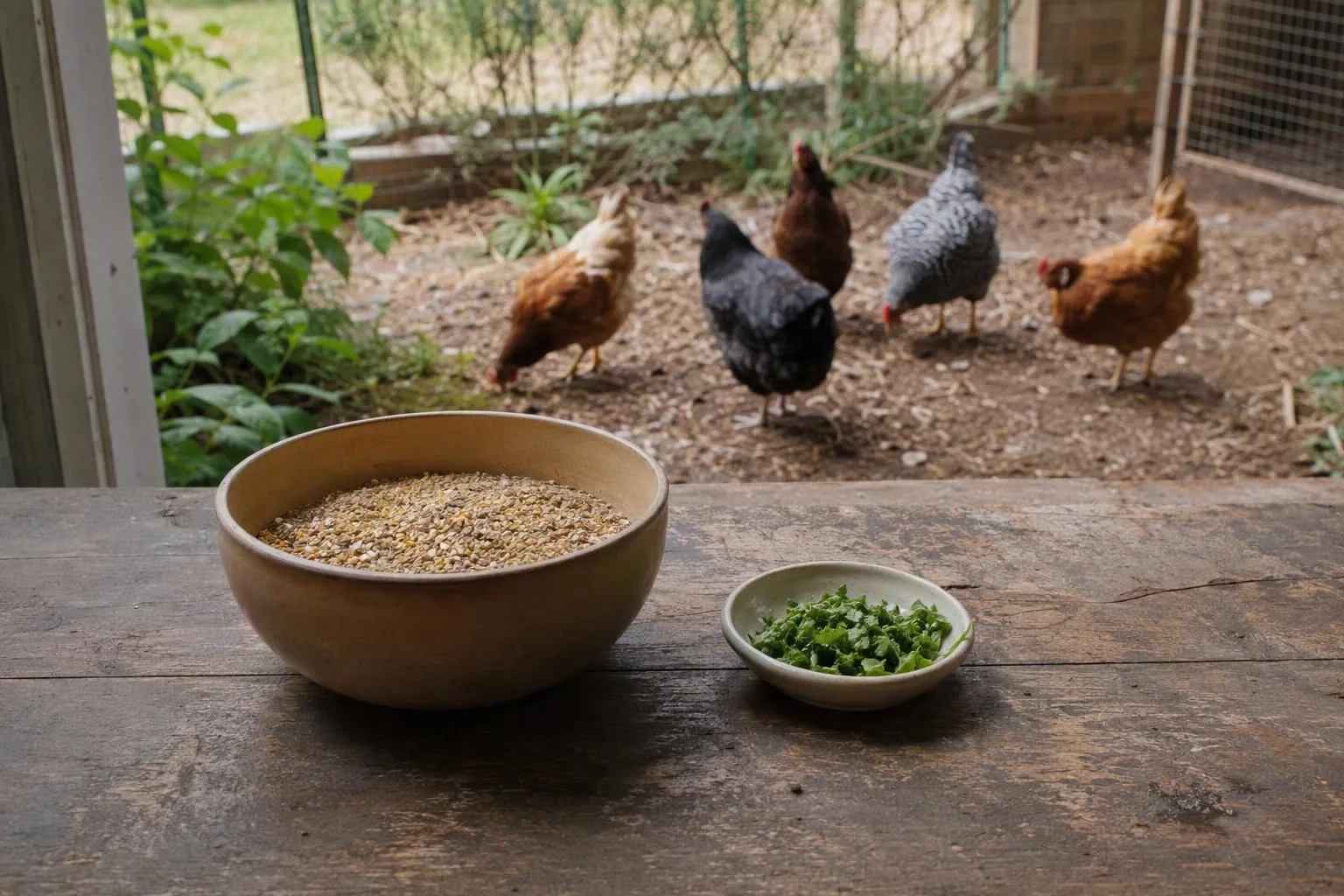
One adult hen may eat roughly 100–120 g of complete feed in a day, but that does not give you 100–120 g of treats. For most small backyard flocks, keep complete starter, grower, or layer feed at about 90% or more of the diet and treat scraps as the remaining garnish.
That rule answers most of the question about what not to feed chickens. The danger isn't just a poisonous food. A large bowl of safe scraps can still crowd out the ration your birds need for muscle, feathers, eggs, and steady body condition.
The 90% rule: complete feed stays in charge
Use complete feed as the foundation. A complete ration is made to cover the main nutrient needs of your birds at a particular age or stage. Starter is for chicks, grower feed suits developing birds, and layer feed is intended for laying hens. Kitchen scraps don't offer that same predictable balance.
A common planning bracket for an adult hen is 100–120 g of complete feed per day. A smaller breed, a bird eating pasture, mild weather, a pause in laying, or a lower activity level can pull intake down. A large active hen, cold weather, growth, or a strong laying rate can push it up. Treat the bracket as a starting point, not a target that every bird must hit.
If your flock is eating much less of its normal ration because it is waiting for corn, bread, or fruit, cut treats first. For a broader baseline, start with how much feed per chicken per day and then compare the amount left in the feeder with body condition and laying performance.
The useful kitchen-scale habit is simple. Put a bowl on the scale, press tare, and portion the calorie-dense treats before you carry them to the run. Write the flock size and the day's limit on a piece of tape beside the feed bin. Poultry extension guidance on complete rations is helpful for checking that the base feed matches your birds' age.
Good scraps are a garnish, not a ration. That is the judgment call that keeps the rest of this list useful.
Use this five-question screen before any scrap goes in
Before a scrap reaches the run, ask five quick questions. This screen won't identify every toxic plant, but it catches the everyday mistakes that are easiest to prevent.
- Is it fresh? If it smells sour, feels slimy, shows mold, or is starting to rot, discard it. Don't give spoiled food to your birds simply because they seem willing to eat it.
- Is the food or plant part a known no-go? If you cannot identify it, leave it out. An unknown ingredient is not a safe ingredient.
- Could it contain chemicals or medication? Skip produce treated with an unknown lawn or garden product, and don't share food containing human medicines.
- Could a bird choke on it? Hard pits, large bones, tough rinds, long stringy pieces, and oversized chunks need to be removed, cut, or avoided.
- Is it heavily salted, sweetened, greasy, or seasoned? If the ingredient list is unclear, the safest answer is no.
Notice that only one question asks whether a food is poisonous. Freshness, preparation, and portion size cause many of the practical problems at a backyard run gate.
A safe-treat menu for adult hens
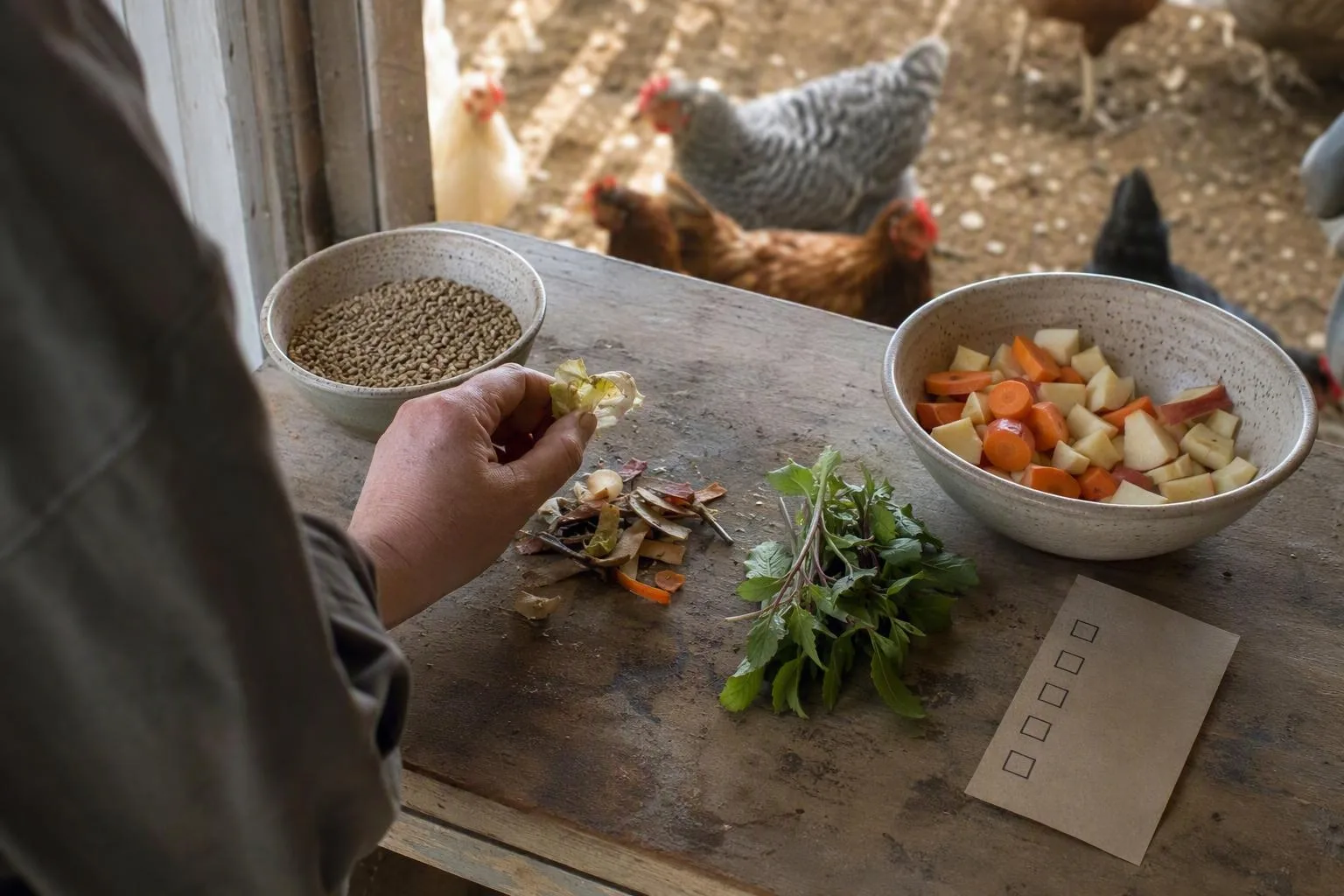
You don't need a fifty-item list taped to the refrigerator. Group foods by what they are, keep them plain, and offer a small amount after your birds have had access to their complete feed.
- Leafy greens and vegetables: clean lettuce, kale, chard, peas, corn, cucumber, squash, and pumpkin are useful choices in small, bite-sized pieces. Hang a firm cabbage or scatter peas if you want your birds to work for the treat, but don't turn enrichment into an all-day buffet.
- Fruit: berries, melon, and other clean, ripe fruit can be offered occasionally. Remove hard pits and large seeds. Fruit is easy to overdo because the sugar makes it popular, so use a few pieces rather than a full serving bowl.
- Plain cooked vegetables: cooled carrots, sweet potato, pumpkin, and other unseasoned vegetables fit the occasional-treat category. Keep butter, salty cooking water, sauces, and spice mixes out of the dish.
- Small amounts of plain grains: cooked rice, pasta, oats, or a little plain bread are treats, not a substitute for feed. A few bites are enough for a small flock.
- Occasional protein: commercially produced mealworms, a little cooked egg, or a small portion of plain cooked meat can work when fully cooked and unseasoned. Use protein treats as an occasional supplement, not as a way to repair a weak ration.
Fresh, plain, chemical-free, and manageable in size is the standard. Serve treats in a separate dish so you can see how much went out and how much came back.
The hard no-go list: foods to leave out entirely
Some foods deserve a firm no rather than a debate about portion size. The list below is deliberately conservative for a small flock, where you may not know exactly which bird ate which piece.
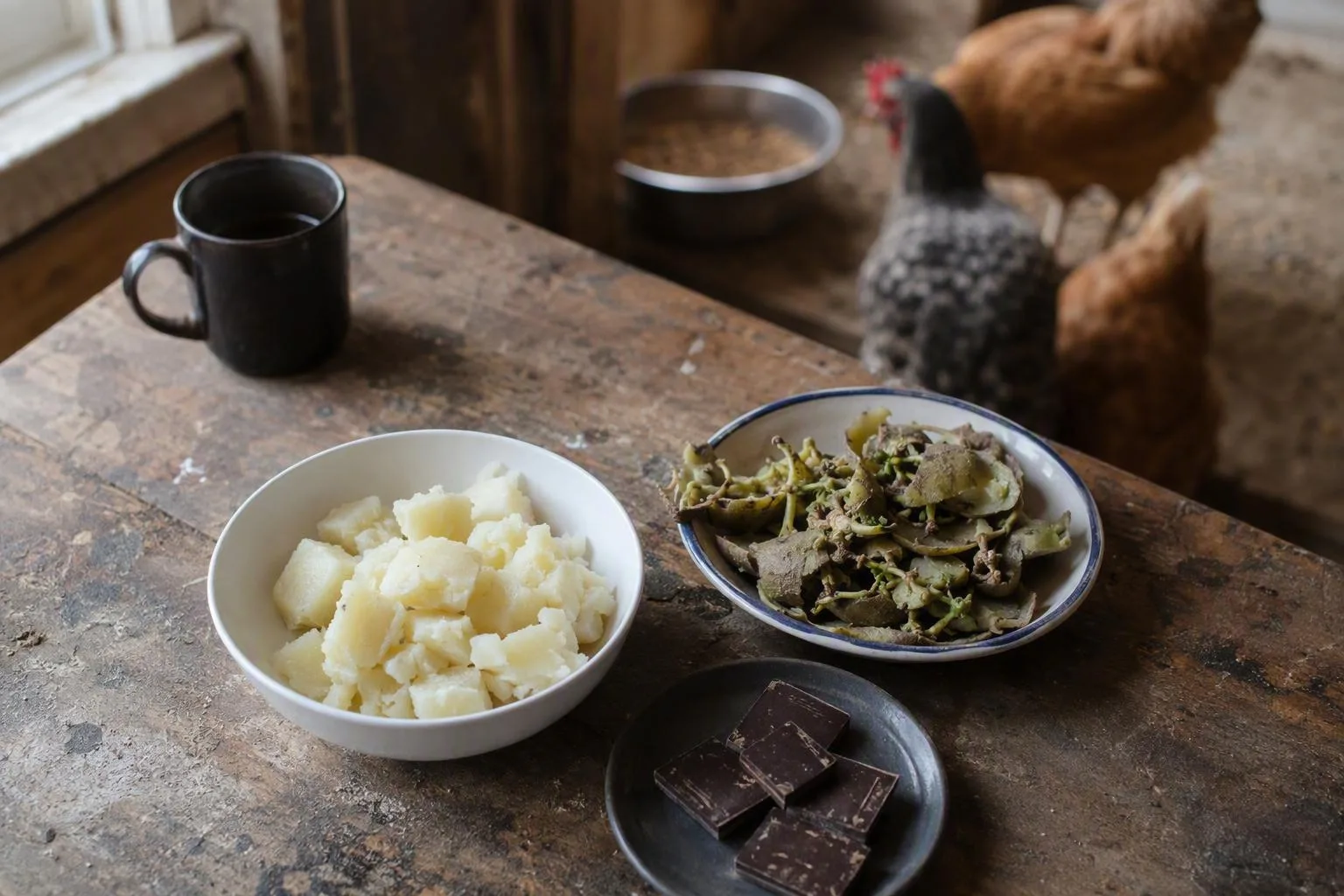
- Chocolate and caffeinated drinks: leave them out entirely. Stimulant compounds in these foods are a poor risk for your birds, and drinks can deliver an unknown amount quickly.
- Avocado: it belongs in the no-go bucket because of persin exposure and the difficulty of judging the amount in mixed kitchen scraps. Do not sort a questionable avocado dish into a safe pile by eye.
- Raw or dried beans: this is a preparation problem, not a reason to serve a handful of dry beans. Raw and dried beans can contain lectin compounds that are reduced by thorough cooking. Plain, fully cooked beans are a different category and still belong only in small portions.
- Green or sprouted potato parts: green skins, sprouts, and visibly green potato pieces should go in the bin. Potato glycoalkaloids are the reason this preparation matters. A plain cooked piece of ordinary potato flesh is not the same thing as a green peel, but it remains a starchy extra rather than a feed replacement.
- Green tomato plant material and unripe green tomatoes: skip them. Ripe tomato flesh is a separate case from the leaves, stems, and unripe green parts, but tomato scraps are unnecessary enough that removing all plant material is the simpler household rule.
- Alcohol: beer, wine, spirits, and alcohol-containing mixtures have no useful place in a chicken treat dish. Keep them away from the run.
- Raw yeast dough: don't offer it. Fermentation and expansion can continue after the dough is swallowed, which creates a risk that is avoided by serving only fully baked, plain bread in small amounts.
- Moldy or rotting food: discard the entire questionable portion. Scraping visible mold from one side does not give you a dependable way to judge what remains, and mold may involve mycotoxins.
When you want to investigate a less familiar plant or ingredient, look for veterinary toxicology references on avian exposures rather than relying on a social-media food chart. If the ingredient is uncertain, skipping one scrap costs less than guessing.
Grey areas, not automatic poison: bread, dairy, citrus, alliums, and leftovers
Not every poor treat is a poison. Some foods are simply too dilute, too rich, too messy, or too easy to serve in excess. That distinction matters because it lets you stay calm without turning every human food into a recommended chicken food.
Plain baked bread, pasta, and rice are usually best treated as occasional filler. They supply energy and bulk, but compared with complete feed they bring less of the balanced protein, minerals, and vitamins your birds need. A few plain bites are one thing. A daily bowl is a feeding mistake.
Dairy is another caution area. A tiny amount of plain unsweetened yogurt may be tolerated by some birds, while a larger or richer serving can loosen droppings. If droppings change after a treat, remove that item and return to the normal ration.
Citrus does not need to be treated as a universal poison. It is also not necessary in a backyard flock's menu. The acidity, peel, seeds, and mess make it an easy food to skip, especially when your birds already have safer produce choices.
Large or repeated amounts of onion and garlic should stay off the regular treat menu. A trace of allium in an otherwise plain cooked bite is not the same as serving a bowl of seasoned scraps, but the line is hard to monitor when several birds share one dish. Avoiding deliberate, repeated servings is the cleaner rule.
Human leftovers become poor treats when salt, grease, seasoning, or an unknown sauce is doing most of the work. Pull out a plain vegetable before you season dinner. Don't pass the finished casserole to your birds and call it recycling.
Kitchen scraps need preparation, timing, and a clean serving spot
Prepare scraps as food, not as rubbish tossed into bedding. A repeatable routine prevents the same small errors from becoming part of every feeding.
- Rinse produce and remove anything with an unknown chemical history.
- Take out hard pits, large cores, tough stems, and pieces that a bird cannot reasonably break apart.
- Cut soft food into manageable pieces. You are aiming for easy pecking, not a pile of large slippery chunks.
- Cook beans thoroughly. Cool hot food before serving it. Warm food spoils faster in a dish and can be uncomfortable to eat.
- Use a clean bowl or shallow pan away from the sleeping area. Do not bury scraps in litter, where you cannot see what remains.
- Check the dish again after feeding. Treat 20–30 minutes as a rough household guideline, not a fixed rule. On a hot, humid day, remove wet food sooner. In cooler, dry conditions, a clean dry scrap may last longer, but a rodent-attracting dish is still a problem.
Wash the dish when it is dirty. Remove leftovers before they ferment, mold, or attract rodents. The clean serving spot is as much a part of food safety as the ingredient itself.
Chicks and special situations change the answer
Chicks need chick starter as their nutritional base. They are growing quickly, so a treat that seems harmless beside an adult hen's ration can take up a meaningful share of a chick's small intake. Once a chick is eating starter confidently, a tiny taste of a suitable treat may be offered occasionally, but it should not become the reason the chick ignores feed.
If chicks eat anything beyond complete starter, provide age-appropriate insoluble poultry grit according to the product guidance. Grit and oyster shell are not interchangeable. Grit helps process material in the gizzard; oyster shell is a calcium source for laying hens.
For layers, keep a complete layer ration available and offer oyster shell free-choice as a calcium option. The companion guide on how much feed per chicken per day for laying hens can help you compare normal intake with your own flock's feeder use.
Molting, winter weather, broodiness, and illness are not reasons to replace balanced feed with scraps. During those periods, check water, shelter, parasite control, and the suitability of the base ration first. Extra treats can make a bird look interested without fixing the problem that changed its condition.
For chick-specific portions and timing, use feeding baby chicks as the starting point rather than applying an adult hen's treat habit to a brooder.
Translate the 10% rule into a flock-sized portion
The arithmetic is simple; the food isn't. If you assume 100–120 g of complete feed per adult hen per day, then a rough 10% planning proxy gives 10–12 g of calorie-dense treats per bird. It is a useful ceiling for measuring rich foods. It is not a laboratory conversion for every leaf, melon, or cucumber.
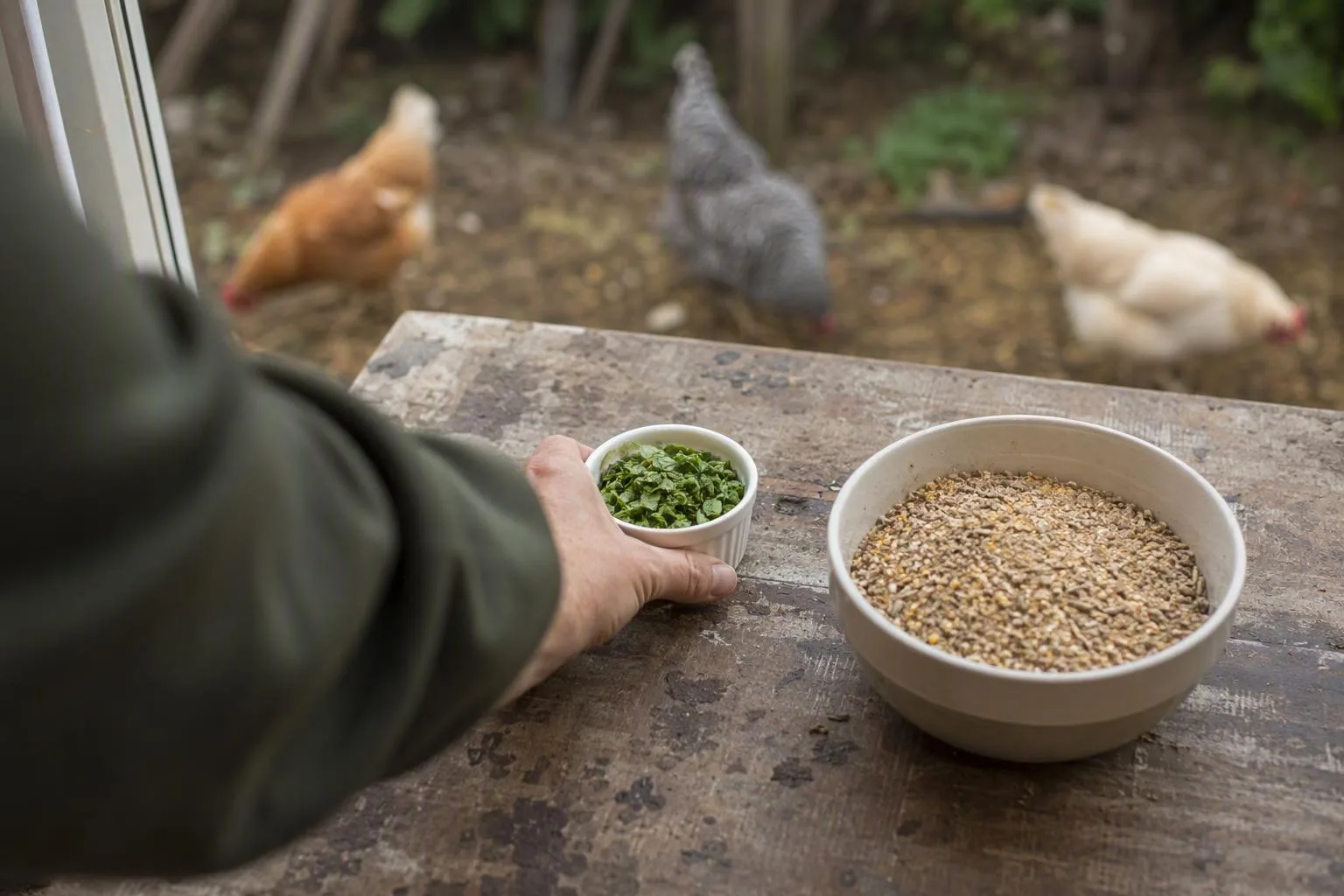
Take a six-hen flock. Six hens at 100–120 g each represent about 600–720 g of complete feed across a day. Ten percent of that planning bracket gives 60–72 g of dense treats. Put an empty bowl on a kitchen scale, tare it, and stop filling when you reach the portion you meant to serve.
- Three hens: about 30–36 g of calorie-dense treats as a rough daily planning ceiling.
- Six hens: about 60–72 g.
- Twelve hens: about 120–144 g.
These figures are a proxy because food weight is not food energy. Ten grams of mealworms and ten grams of cucumber do not make the same contribution. Watery produce weighs more for the amount of energy it supplies, while seeds, grains, and dried insects are denser. Use smaller portions for dense treats and don't try to spend the whole allowance simply because the scale permits it.
Cut back if normal feed intake falls, droppings become persistently abnormal, or body condition changes. Also check whether one dominant hen is taking most of a shared treat bowl. A treat limit for the flock is only useful if the quieter birds still reach their complete feed.
After a suspected bad bite: what to do in the next hour
If you know or suspect that a bird ate a no-go food, stay methodical. Do not wait for a dramatic symptom before recording what happened.
- Remove the suspected food and any dish that contains it.
- Write down the ingredient, the approximate amount, the time, and how many birds had access.
- Keep the usual clean water available. Offer the normal complete feed rather than adding another treat or supplement.
- Save the packaging, ingredient list, plant sample, or a photograph if one is available. That information can shorten a veterinary consultation.
- Call an avian or poultry veterinarian for advice when the food is a known no-go, the amount may be substantial, or the bird is acting abnormal.
Do not induce vomiting, force oil or milk, or try a home antidote unless a veterinarian specifically directs you. A home intervention can add aspiration or digestive trouble and can make the original exposure harder to assess.
Tremors, seizures, breathing difficulty, collapse, inability to stand, severe weakness, persistent diarrhea, or several affected birds are escalation signs. Contact a veterinarian promptly rather than monitoring casually. Where available, regional animal poison-control services may also provide exposure guidance, but follow the instructions for your area and species.
These signs do not prove that a particular food caused poisoning. They do show that the situation has moved beyond a treat-list decision. Several birds becoming unwell after sharing one scrap also raises the urgency because the exposure may be common to the flock.
Make a coop-door list you can use without guessing
Keep the final rule short enough to use with cold hands and a hungry flock.
- Potentially suitable: plain, fresh, chemical-free, bite-sized food in a small portion, offered after complete feed.
- Leave out: moldy or rotting food, chocolate, caffeinated drinks, alcohol, avocado, raw or dried beans, green or sprouted potato parts, green tomato plant material, and raw yeast dough.
- Pause and check: anything salty, greasy, heavily seasoned, unusually rich, chemically treated, or carrying an ingredient list you cannot identify.
Do chickens need grit when they eat treats?
Birds eating whole grains, grass, or produce generally need age-appropriate insoluble poultry grit available free-choice. Oyster shell supplies calcium; it is not a substitute for grit. Birds eating only complete pellets may not need added grit, so match the decision to what your birds actually swallow.
Can chickens eat grass clippings?
Avoid handing out long, wet piles. They can mat together and create a crop hazard. Clean clippings from an untreated lawn are a safer option when offered in a small, scattered amount, but letting birds peck short grass is simpler than carrying armfuls into the run.
Can chickens eat eggshells or do they need oyster shell?
Rinsed, fully dried, finely crushed eggshells can provide calcium. Free-choice oyster shell is usually the more consistent household option because it is easy to keep available and does not depend on collecting, drying, and crushing enough shells. Do not routinely add extra calcium to chick feed without age-appropriate guidance.
Is plain cooked meat a safe protein treat?
Plain, fully cooked meat can be used as an occasional protein treat if it is unseasoned, free of sauce, and cut into manageable pieces. Keep the portion small and never use scraps to replace a complete ration. Fatty, salty, spiced, or spoiled meat belongs in the no-go pile.
This week, measure one normal portion of calorie-dense treats with a kitchen scale, label a small no-go container for questionable scraps, and tape this checklist beside the run. Then compare your measured treat habit with how much feed per chicken per day your flock normally consumes. That one check turns a vague feeding rule into a routine you can adjust.
Frequently Asked Questions
Do chickens need grit when they eat treats?
Birds eating whole grains, grass, or produce generally need age-appropriate insoluble poultry grit available free-choice; oyster shell supplies calcium and is not a substitute. Birds eating only complete pellets may not need added grit.
Can chickens eat grass clippings?
Avoid handing out long, wet piles because they can mat and create a crop hazard. A clean untreated lawn is safer, or offer only short, chemical-free clippings in a small scattered amount.
Can chickens eat eggshells?
Rinsed, fully dried, finely crushed shells can provide calcium, but free-choice oyster shell is more consistent for laying hens. Do not give extra calcium routinely to chicks without age-appropriate guidance.