How Much Feed Per Chicken Per Day for Laying Hens? Step by Step
An adult laying hen will often start around 100–120 grams of complete layer feed per day. That is about 3.5–4.2 ounces, or 0.22–0.26 pounds. For eight hens, a useful first target is 880 grams daily if you choose the midpoint of 110 grams per bird.
That range assumes adult hens eating a complete commercial layer ration in moderate weather, with easy access to a dry feeder and clean water. Bantams, large breeds, cold snaps, heat, molt, forage, and wasted feed can all move the real figure.
Start with the range, then audit your own flock for seven days. A feeder that empties 900 grams has measured disappearance, not measured eating.
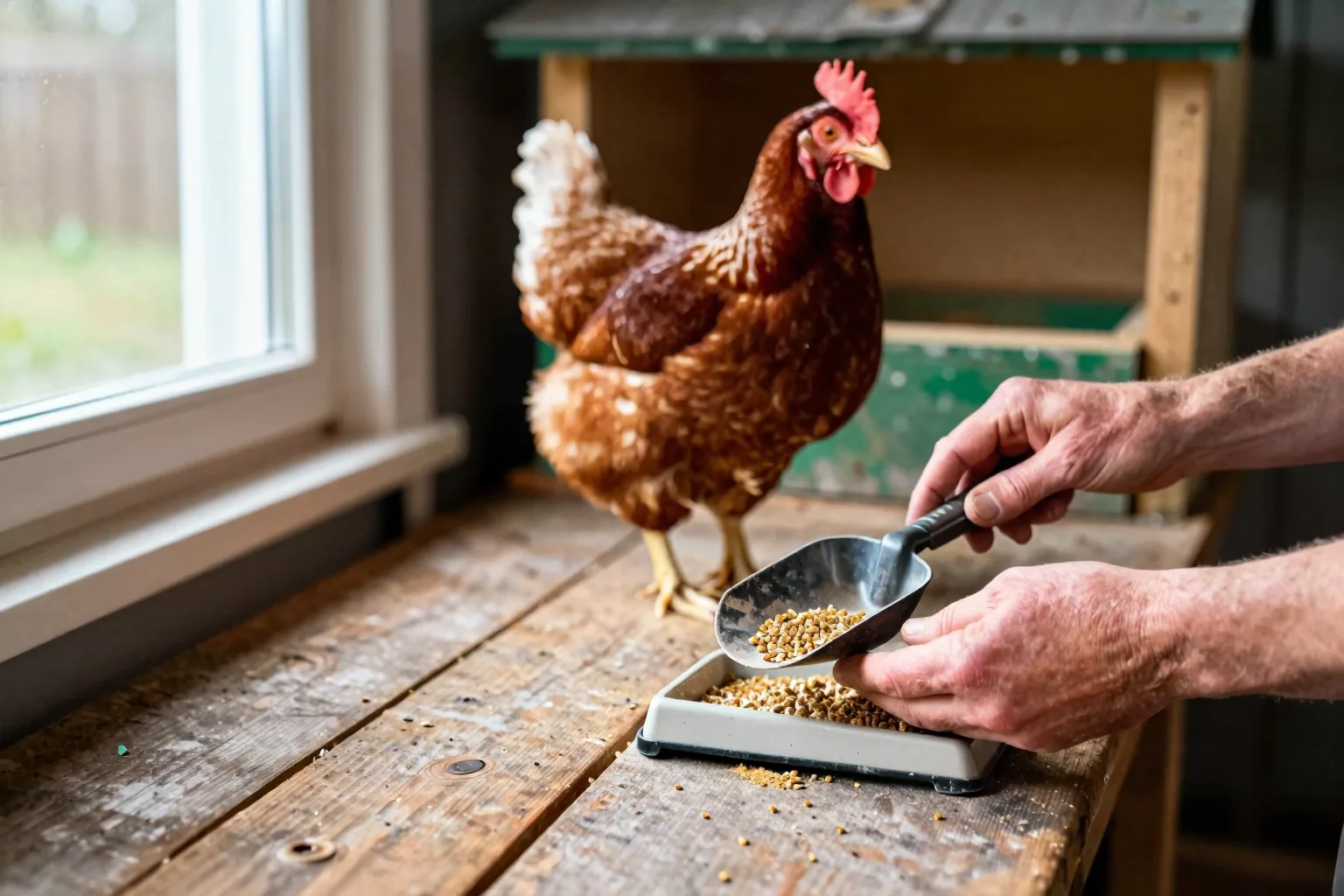
Your starting answer: 100–120 grams per laying hen per day
Use 100–120 grams as a starting range, not a fixed prescription. A small, lightly built hen may land near the lower end. A large, active hen may need the upper end. Weather and access can matter as much as breed.
The base of the diet should be a feed labelled as a complete layer ration for adult laying hens. Scratch grain, kitchen scraps, and grass may be useful extras, but they don't reliably replace the protein, energy, vitamins, and minerals supplied by a complete ration. If extras displace too much feed, a hen can feel full without receiving a balanced daily diet.
A scoop is a poor measuring tool. Pellets and crumbles don't occupy a scoop in exactly the same way, and a heaped scoop changes with the person holding it. Grams give you a repeatable starting point.
What this baseline means in a real backyard flock
The number is easiest to use as a planning figure. It tells you how much feed to put through the system, not how much every hen must consume in one sitting.
For a small egg flock, free-choice feeding is a practical approach, rather than trying to serve an exact meal. Keep a complete layer ration available during the birds' normal feeding hours, then check the feeder and the floor for waste. Rationing a flock to a neat daily scoop can leave a shy hen short if a dominant bird controls the best feeding spot.
The bag label and guaranteed analysis describe the product. Your seven-day record describes your backyard. University extension guidance on layer-hen feed intake, complete rations, and free-choice feeding can provide a useful second check when a label or feeding plan is unclear.
Set the ration with the bag label and a kitchen scale
Set up the measurement before changing the feeder. A digital kitchen scale that reads grams, an empty container, a notebook, and the feed bag are enough.
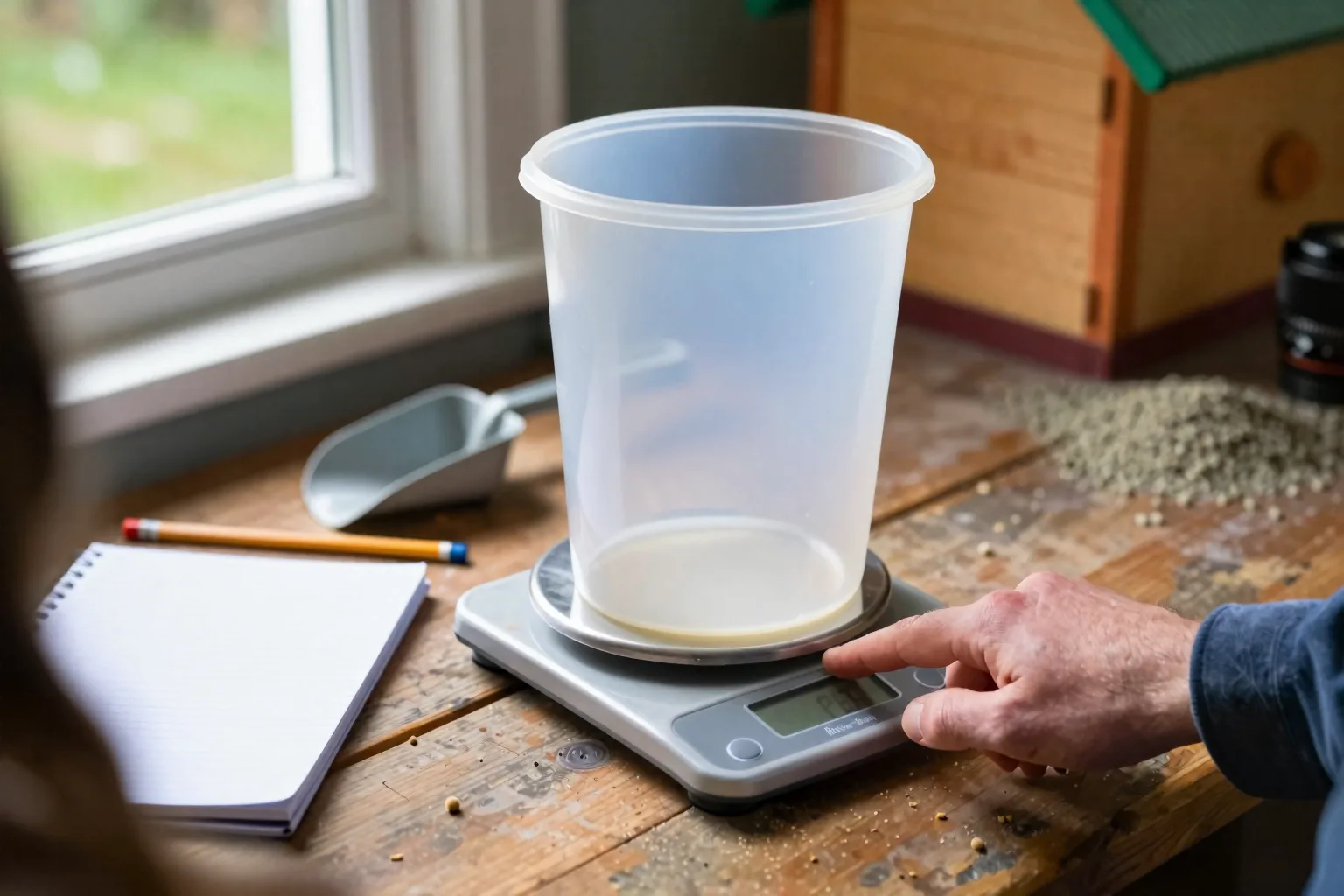
- Read the bag first. Confirm that the product is a complete layer feed and that its directions match adult laying hens. Don't assume a grower, chick starter, scratch mix, or treat blend can serve as the same base.
- Tare the container. Put the empty container on the scale and press tare, or write down its empty weight. Add feed until the display shows the chosen target.
- Multiply for the flock. Multiply your starting grams per hen by the number of hens present. Eight hens at 110 grams each need 880 grams as the initial daily planning figure.
- Offer it in a feeder that stays dry. Split the amount between feeders if one bird can block access. Keep the container stable and low enough for the birds to eat comfortably, but not so low that litter is kicked into it.
Don't treat 880 grams as a meal that must be eaten before bedtime. It is a reference point for setting up the flock and comparing one day with the next. If the birds finish it early, check for spills and access problems before automatically adding a large extra scoop.
The seven-day audit that replaces guesswork
One day can be misleading. A cold morning, a wet afternoon, a full day on pasture, or a feeder knocked sideways can change the number. A seven-day audit gives those odd days less power over the conclusion.
Run the audit at roughly the same time each day:
- Start with a clean, dry feeder. Remove old feed that is wet, caked, stale, or contaminated.
- Weigh every addition before it goes into the feeder. Record the number, even if it is only a small top-up.
- Record how many hens are present that day. A missing hen changes the hen-day calculation.
- At the next check, weigh usable leftovers in the feeder. Use the same container and scale each time.
- Look below and around the feeder. Note spilled feed, feed mixed into bedding, rodent activity, and wild-bird access.
- Record weather, unusual free-ranging, treats, egg production, and any bird that seems off.
The basic calculation is:
Feeder disappearance = total feed added − usable feed left over.
To compare days fairly, use:
Hen-day average = total feeder disappearance ÷ total number of hen-days.
If eight hens are present for seven days, that is 56 hen-days. The result is feed that disappeared per hen-day. It is not automatically feed swallowed by the hens, because some may be under the feeder, in the litter, in a rodent's stomach, or in a wild bird's crop.
Here is a worked example. Over seven days, an eight-hen flock receives 6,340 grams. The usable leftovers total 399 grams, so feeder disappearance is 5,941 grams. Divided by 56 hen-days, that is about 106.1 grams per hen-day. If the keeper separately finds 96 grams of clean, identifiable feed spilled below the feeder, the rough remainder is 5,845 grams, or about 104.4 grams per hen-day.
That difference is why the line under the feeder matters. A flock average also can't tell you whether one subordinate hen is being pushed away. Watch the birds at feeding time. A full feeder doesn't prove equal access.
Four reasons the number changes
Weather changes appetite before it changes your spreadsheet. Use the audit to see what changed, then adjust for a clear reason rather than chasing every small fluctuation.
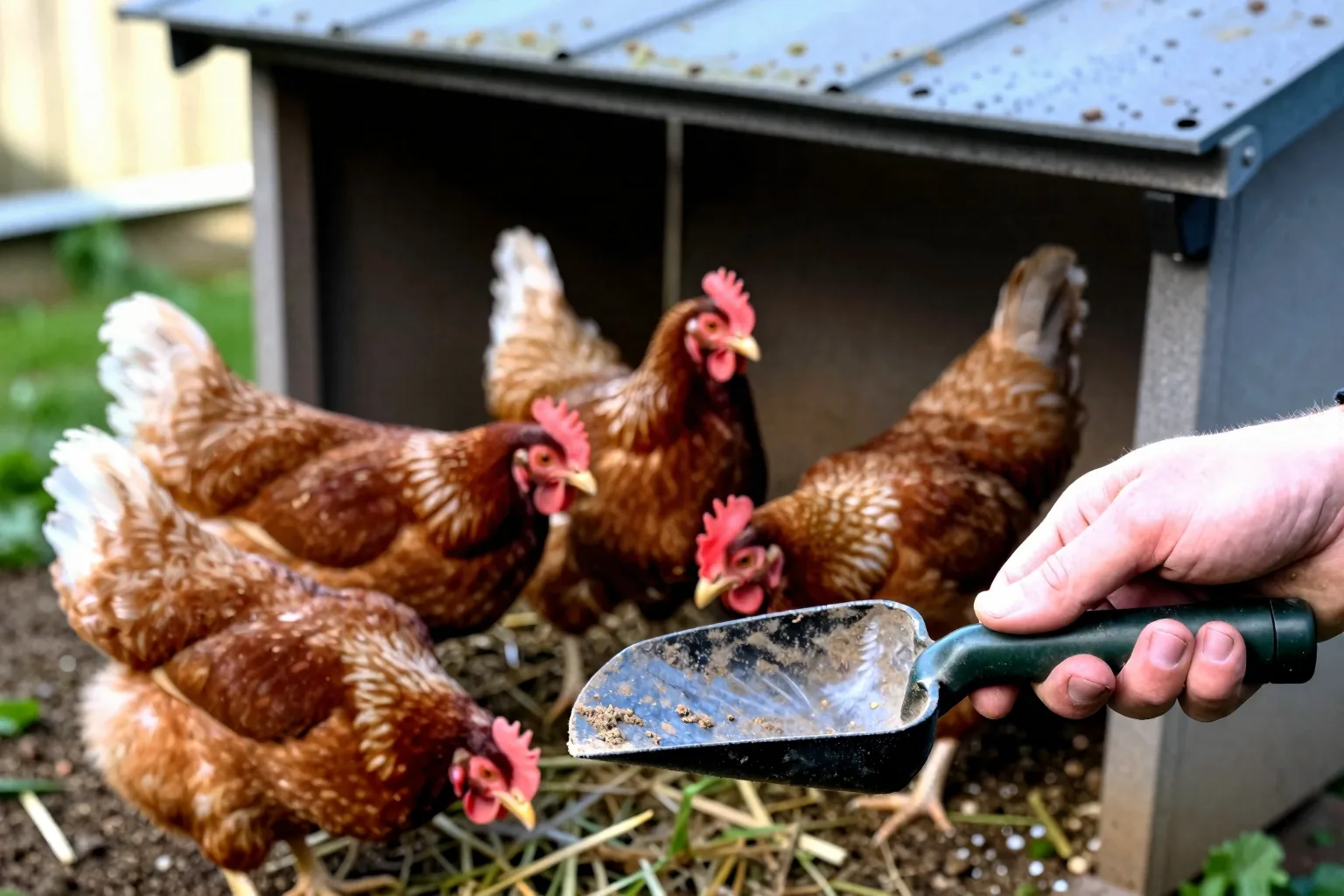
1. Body size and activity
Bantams generally fit nearer the lower end of a broad per-hen range, while large-bodied or highly active hens can fit nearer the upper end. Breed name alone is a weak adjustment tool. Actual body size, movement, and body condition are more useful.
2. Cold and heat
Cold weather increases the energy cost of maintaining body temperature. A flock may therefore use more feed during a sustained cold period, especially in an exposed coop or run. Hot weather can work in the opposite direction by reducing appetite. Shade, airflow, and reliable water deserve attention before simply piling more feed into the feeder.
Seasonal feed changes need their own plan. What to Feed Laying Hens During Winter and Molt covers the broader winter and feather-growing decisions without relying on one number for every climate.
3. Laying, molt, and broodiness
High production, feather regrowth during molt, and reduced activity during broodiness can change how a hen uses and seeks feed. Egg count alone isn't a good reason to add feed. Check body condition, access, water, the feed label, and the trend in the seven-day record.
4. Forage and treats
Free-ranging may reduce bag-feed disappearance because hens find insects, seeds, and tender plant material. It doesn't guarantee that they have collected a balanced ration. The same caution applies to scratch and scraps.
A conservative working ceiling for regular extras is roughly 10–15 grams per hen on an ordinary day. For six hens, that is only 60–90 grams across the flock. Treats should be measured against the complete ration, not poured into the run until the birds lose interest. Safe Treats for Chickens: How Much Is Too Much? is the useful companion calculation.
The adjustment path is simple: begin near 110 grams, audit disappearance, inspect waste and access, then move the planning figure only when body condition, weather, activity, forage, or feed quality gives you a reason.
Turn grams into a weekly and monthly shopping plan
Buying enough feed is easier once the daily target is written as a flock total. Use these formulas:
- Daily flock need: target grams per hen × number of hens.
- Seven-day need: daily flock need × 7, then divide by 1,000 for kilograms.
- 30-day need: daily flock need × 30, then divide by 1,000 for kilograms.
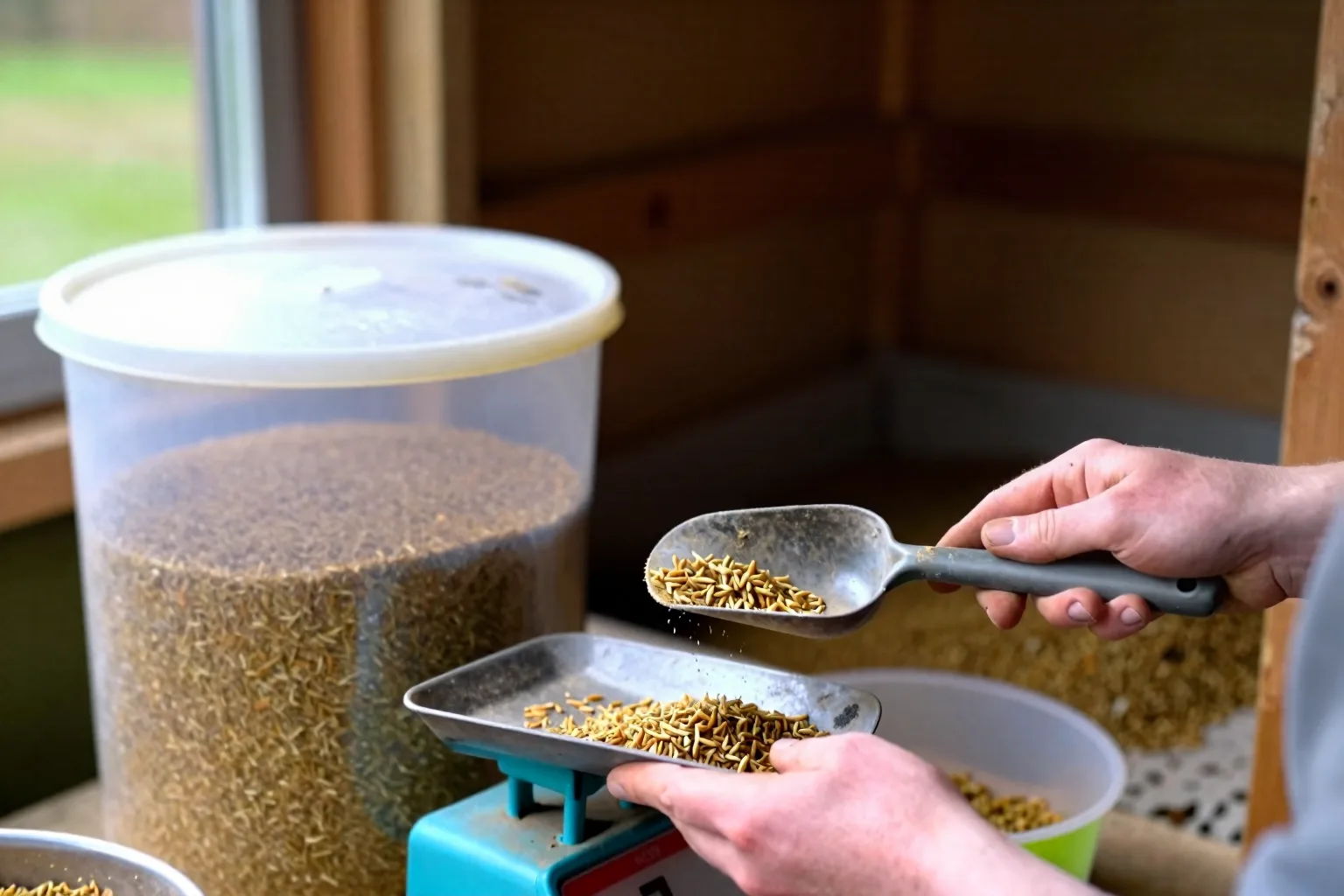
| Hens | At 110 g each per day | Seven days | 30 days |
|---|---|---|---|
| 3 | 330 g | 2.31 kg | 9.9 kg |
| 6 | 660 g | 4.62 kg | 19.8 kg |
| 12 | 1.32 kg | 9.24 kg | 39.6 kg |
Those totals describe the planned ration before your measured waste is added. If your audit shows 96 grams of waste in a week, add that observed loss to the shopping estimate instead of using a universal waste percentage. If your six-hen flock needs 19.8 kilograms before waste, a bag labelled 20 kilograms leaves almost no room for spillage. A larger bag may be more convenient, but compare the net weight, freshness date, storage space, and current local price per kilogram.
Monthly feed cost is:
kilograms required × current local price per kilogram = estimated monthly feed cost.
For arithmetic only, if feed is hypothetically priced at $0.80 per kilogram, 19.8 kilograms would cost $15.84 before measured waste. Replace that example with the current price at your local feed store. Prices vary by region, brand, bag size, and season. Pair this calculation with How Much Does It Cost to Feed 6 Chickens Per Month? for the rest of a small-flock budget.
Keep the feeder routine honest
Free-choice feeding works best when the feeder, not the scoop, controls access. Keep complete layer feed available, but don't create a deep, dirty reservoir that sits for days. Fill a manageable amount, check its condition, and weigh top-ups.
For an eight-hen flock, two separate feeding positions can be a sensible practical choice if one hen guards the feeder. The goal isn't to give every bird a private bowl. It is to stop one bird from controlling the only easy access point.
Reduce the gap between disappearance and eating by keeping feed dry, correcting cracks, and positioning the feeder so scratching birds can't rake large amounts into litter. A feeder with a rain leak can make a flock appear hungry because feed is being thrown away or spoiled. How to Stop Chickens From Wasting Feed in a Feeder works through those hardware fixes in detail.
Store the unopened feed in a clean, dry, pest-resistant container. Don't mix a new bag into old feed before checking the older feed for dampness, clumps, unusual odour, or visible mold. Government or extension guidance on poultry-feed storage, mold, and rodent contamination is a useful reference for local storage conditions.
If intake changes suddenly, inspect before you adjust
A sudden increase in disappearance deserves a feeder inspection first. Check for a cracked trough, a loose base, wet clumps, feed scattered into bedding, rodents, or wild birds. Also check whether a new feeder is allowing birds to bill out more feed than before.
A sudden decrease calls for a different check. Look at heat, stale or moldy feed, an abrupt change in texture or brand, poor access, and bullying. Check water at the same time. A blocked nipple, empty drinker, or frozen line can change feeding behaviour quickly.
Don't try to solve weight loss, refusal to eat or drink, marked lethargy, persistent diarrhea, breathing difficulty, or a sudden flock-wide change by adding an extra scoop. Separate an unwell bird if it can be done safely, and contact a poultry veterinarian or local extension office for guidance. A feed calculation is useful, but it isn't a diagnosis.
Keep one short line per day in a notebook: feed added, leftovers, estimated waste, hens present, water check, eggs, weather, and any bird that looked different. After two or three weeks, that record can show whether a change followed a heat wave, a feed switch, a new feeder, or a health problem.
Questions that come up at the feeder
Should laying hens have access to layer feed all day?
For healthy adult layers, access to a complete layer ration during normal feeding hours is a practical default. It avoids turning a flock average into a race for the first few mouthfuls. If obesity or a special health problem is suspected, correct feeder design and seek veterinary or nutrition guidance rather than cutting feed arbitrarily.
Do hens need grit if they eat commercial layer pellets or crumbles?
Hens eating only a complete commercial ration generally aren't the first birds that need supplemental insoluble grit. If they eat whole grains, grass, or other fibrous forage, appropriately sized insoluble grit is a sensible separate offering. Grit helps with physical grinding; oyster shell supplies calcium. Oyster shell does not replace grit, and grit does not replace a calcium source for laying hens.
Can a rooster eat layer feed in a mixed flock?
Occasional access is different from making layer feed a rooster's long-term diet. A common mixed-flock approach is an all-flock ration with separate oyster shell offered so laying hens can take calcium as needed. Follow the product label, and ask a poultry veterinarian about a rooster with a health concern or a flock with unusual nutritional needs. Veterinary poultry nutrition references covering calcium, grit, and feeding mixed-sex flocks can provide useful background.
Your next step this week: tomorrow, weigh one day's ration into a clean container, write down the number of hens, and put a seven-day audit line beside the feeder. At the end of the week, calculate hen-day disappearance before changing the amount. That one small record will tell you more than a scoop marked by eye.
Frequently Asked Questions
How much water does a laying hen need each day?
Explain that water intake varies with heat, feed moisture, body size, and production, so constant access to clean water is more useful than rationing a fixed volume; note that a sudden change in drinking or dehydration signs needs investigation.
Can roosters or growing pullets eat layer feed?
Cover the mixed-flock problem: layer feed is formulated for laying hens and its calcium level is not ideal as the only ration for growing birds; suggest an all-flock approach with separate calcium access and checking the feed label.
How much will it cost to feed six laying hens each month?
Show the cost method without asserting a universal local price: multiply the flock’s estimated monthly kilograms, add a waste allowance, divide the current bag price by bag kilograms, and check local feed prices before budgeting.