What Makes Egg Yolks Orange? The Real Role of Chicken Feed
Orange yolks usually begin in the feeder, not the nest box. What makes egg yolks orange is mainly carotenoid pigment from a hen’s recent feed and forage, especially yellow-orange xanthophyll pigments. It isn’t a reliable freshness score, and it doesn’t require a special breed.
If you change the ration today, don’t expect the very next egg to tell the whole story. A few eggs may show a shift first. A consistent change across a small flock commonly takes roughly 7–14 days, depending on how much the diet actually changed and how steadily your hens eat it.
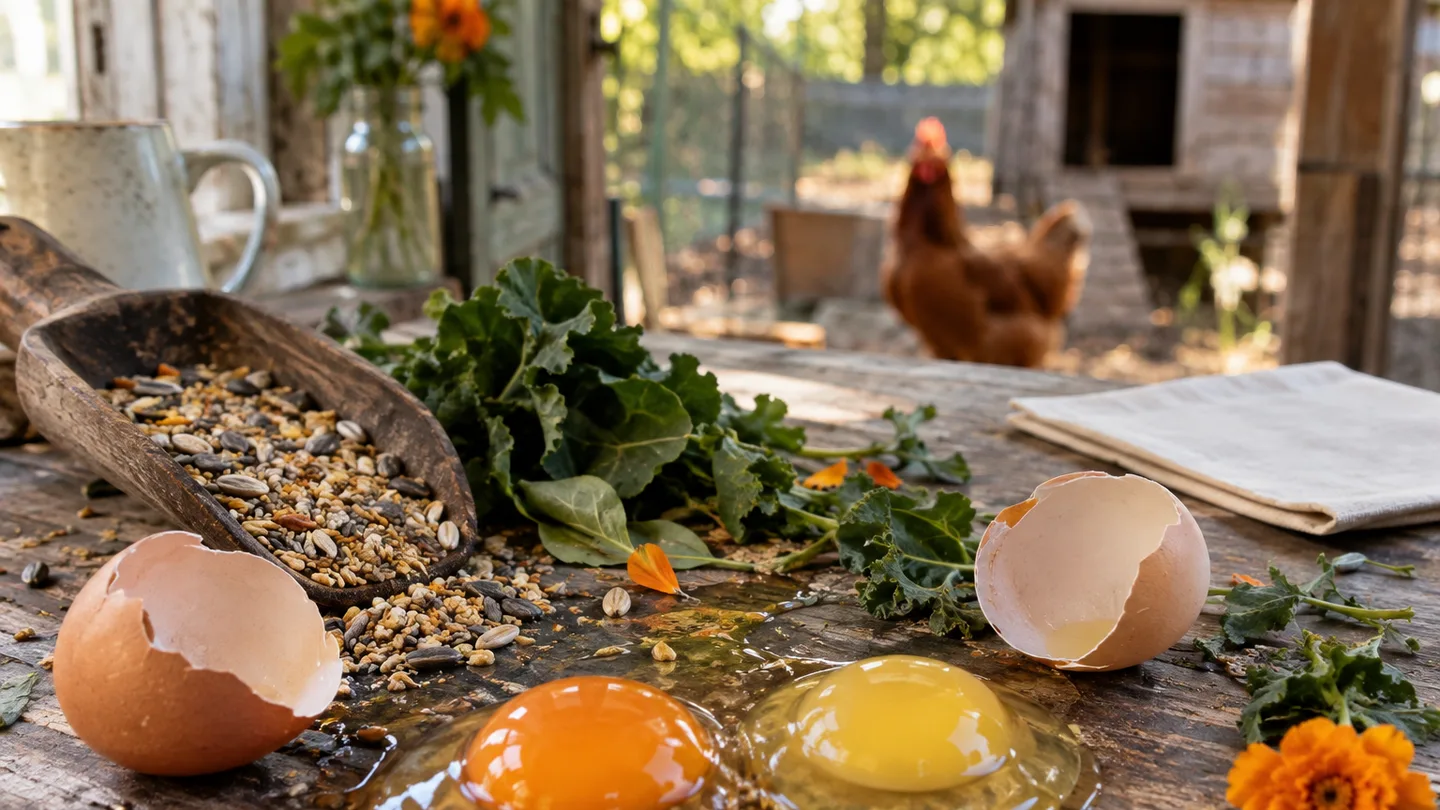
The short answer: orange yolks come from carotenoid pigments in your hen’s recent diet
Egg yolk color is best understood as a pigment record. Yellow, gold and orange shades come largely from carotenoids: plant pigments that enter the hen’s diet through feed, greens, weeds and other forage. Xanthophylls are especially relevant because they can be carried into the developing yolk and show up as warmer color.
That makes the answer to what makes egg yolks orange fairly practical. Look first at what your hen has eaten over the past week or two. Look at the base ration, the amount of scratch grain, access to green plants, and whether weather has changed how much she consumes.
Color can move in either direction. A flock given more leafy forage may lay warmer-looking yolks. The same flock may produce paler eggs after a spell of dry pasture, heavy rain, hot weather or a change to a lower-pigment feed. That does not mean the hens have suddenly become unhealthy. It means the pigment supply reaching the ovary has changed.
Breed and individual biology still matter. Two hens on the same ration can produce slightly different shades. Even so, feed and forage are the first place I’d look before blaming the breed or assuming that a pale yolk signals poor quality.
From feeder to yolk: how xanthophylls are absorbed and deposited
The route from feed to yolk is simple enough to use as a troubleshooting map. Your hen eats a pigment-containing ingredient. Digestion releases usable compounds. Those compounds are absorbed, carried through the bloodstream and made available to tissues, including the ovary. As a yolk develops, some of the circulating pigment is deposited into it.
That is why the word recent matters. A hen doesn’t permanently store one yolk color for her whole laying life. The shade reflects the balance of ingredients and intake during the period when the egg was being formed. A diet change needs time to work through that process, so one unusually pale or orange egg is weak evidence by itself.
A laying hen may eat roughly 90–150 grams of feed per day as a planning range. Smaller birds, mild weather and good forage can pull actual layer-feed use toward the lower end. Larger birds, cold weather, higher production or more activity can push it upward. Heat, illness, poor feed quality and wet or wasted feed can move intake in the other direction.
That range is not a command to feed every hen the same measured amount. It is a way to see why treats can matter. If six hens each receive 25 grams of scratch, that is 150 grams of scratch across the flock. It may displace a meaningful portion of the complete ration, even though the bowl of grain looked small.
This is the mechanism behind a common backyard mistake: adding more and more scratch while wondering why the eggs have not changed. Scratch grain may bring some pigment, but it can also dilute the amino acids, minerals and vitamins supplied by a complete layer ration. The related guide on how much feed per chicken per day for laying hens is useful for separating feed offered from feed actually eaten.
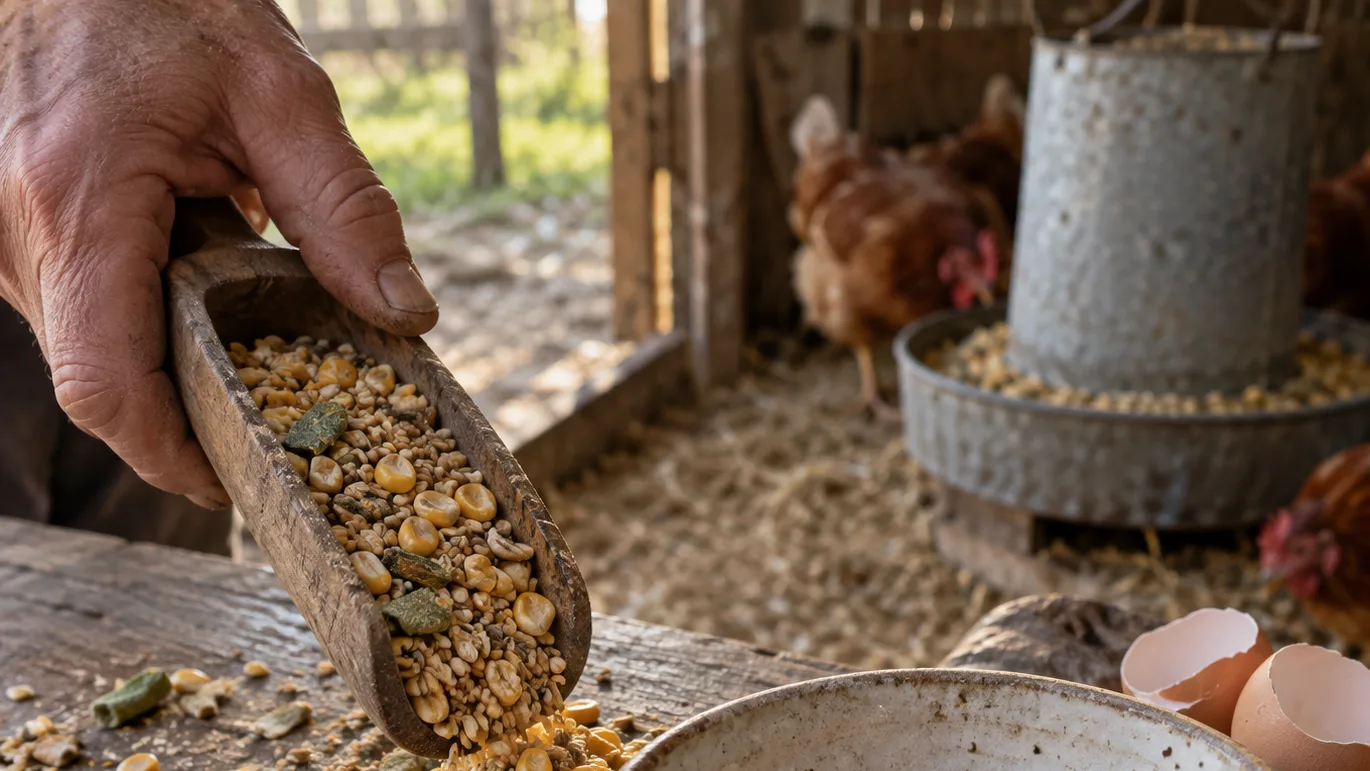
The feed ingredients that deepen color—and the ones that mostly dilute it
Yellow corn can contribute to warmer yolks because it carries yellow carotenoid pigments. It is not a guaranteed orange-yolk ingredient. The result depends on the corn, the rest of the ration, how much is included and what the hen eats instead.
Alfalfa and other leafy green forage can also contribute pigments. Fresh leaves, garden weeds and pasture plants vary widely, though. A lush patch of leafy growth is not equivalent to a handful of dry grass, and hens may ignore plants that look green to you if they have better choices nearby.
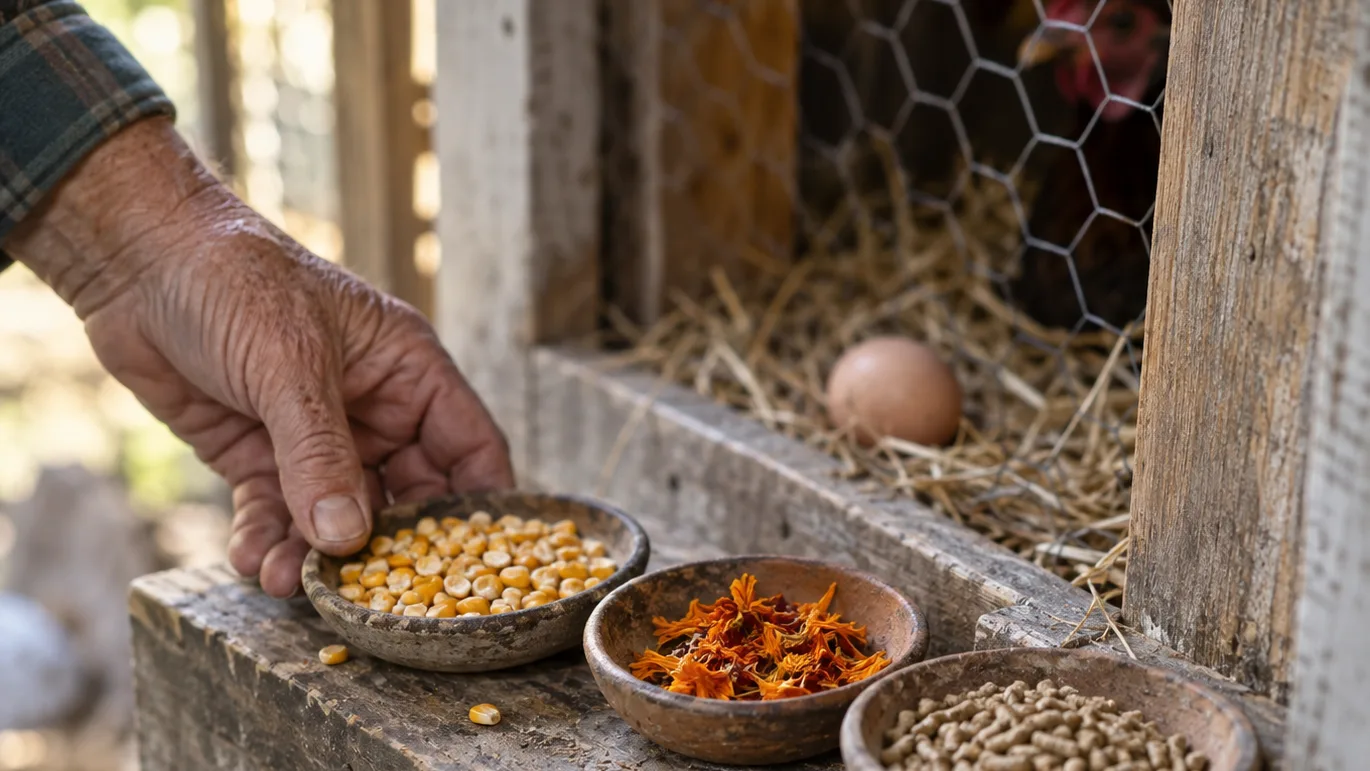
Some commercial feeds use concentrated pigment sources, including marigold- or paprika-derived products. These can be useful tools in a formulated ration, but the ingredient name alone doesn’t tell you the strength or inclusion rate. A small amount in one product may not behave like the same scoop in another.
There is no universal scoop of corn, marigold or paprika that guarantees a particular shade. Pigment intensity varies with the ingredient, processing, storage and the rest of the feed. Concentrated products should be used according to the product label rather than improvised as a color recipe.
For treats, I use a 90/10 guardrail: roughly 90% of what the flock eats should come from a complete ration, leaving about 10% for scratch, greens and other extras. I treat that as a management rule, not a biological law. The point is to protect the main diet while still allowing the birds to forage and giving you room to test a change.
In my own small backyard setup, I once put out a separate bowl of cracked corn because I wanted richer-looking yolks. The hens went for the corn first, and by late afternoon the remaining pellet intake was harder to interpret. I removed the extra bowl, kept the complete feed available and used scratch as a smaller add-on instead. The useful lesson wasn’t that corn was bad. It was that chasing yolk color had made the ration less predictable.
Same flock, different shade: breed, age, laying stage and individual variation
Two hens can eat from the same feeder and still lay eggs with different yolks. The reason is that color depends not only on pigment entering the body, but also on how an individual bird absorbs, transports and deposits it.
Breed may influence the baseline shade you tend to see in a flock, but breed is not a simple color switch. Individual hens within the same breed can vary. A pullet beginning to lay may not produce exactly the same shade as an older hen on the same feed, and a bird changing production pace may show more egg-to-egg variation.
Stress can matter indirectly when it changes intake, water use or the regularity of feeding. A hot spell may leave feed in the trough while the hens drink more and eat less. A sudden move, predator pressure or a change in flock order can also alter who gets access to the feeder. In those situations, a paler egg may be a sign to inspect the routine, not proof that the egg itself is inferior.
A darker yolk is not proof that one hen is healthier. It is also not proof that the egg is fresher, safer, higher in protein or nutritionally superior overall. Color tells you something about pigment intake and deposition. It does not tell you everything you might want to know about the bird or the egg.
Pasture and seasons can push the color up or down
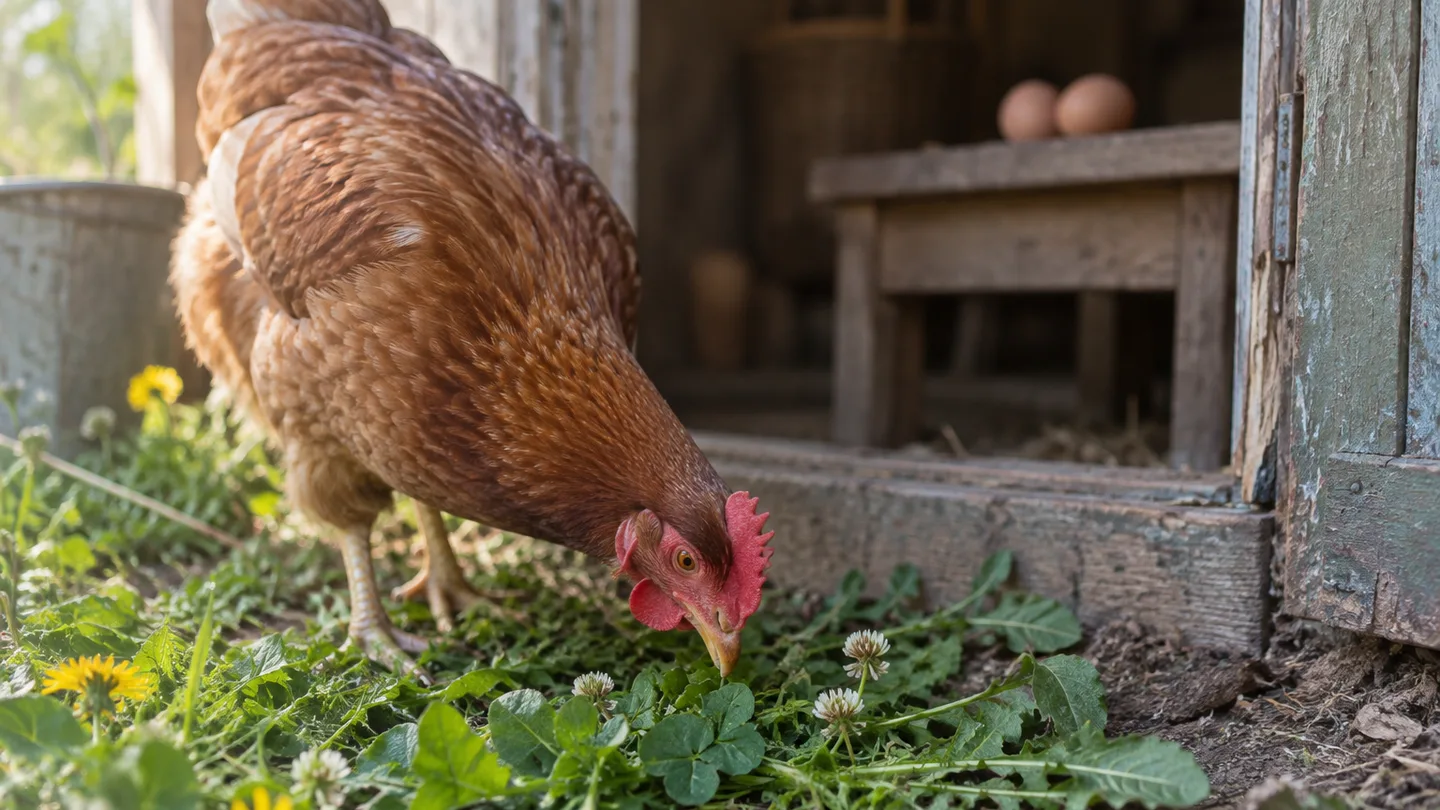
Fresh forage can deepen yolk color when your hens actually eat enough pigment-rich plant material. That last part is the catch. Free-ranging does not guarantee orange yolks because pasture quality, plant species, weather and access all change through the year.
In spring, hens may find tender leafy growth around the yard. In midsummer, the same space may be dry or trampled. Autumn leaves are not the same as fresh green forage, and winter grass may be sparse even when the ground looks green from a distance. A hen that spends hours outside may still get most of her useful nutrition from the feeder.
Garden greens and kitchen scraps can supplement the ration, but they should not replace it. A large bucket of low-protein scraps may fill crops without supplying the balanced nutrients a laying hen needs. The practical question is not whether a food is natural. It is whether the extra food is helping the flock eat a complete diet or quietly crowding it out.
If you move birds onto a new patch of pasture, expect the eggs to tell the story gradually. A few eggs may change within several days. A flock-level pattern is easier to judge after about one to two weeks of fairly consistent access and intake.
Orange is not a freshness or nutrition score
Dark orange yolks are visually appealing, but appearance and quality are different questions. A yolk can be orange because the hen ate more pigment. That does not establish that it is fresher or safer than a paler yolk from the same yard.
Nor does the shade alone prove higher protein or more omega-3 fat. Those qualities depend on the whole diet and on how the egg was handled after laying. A ration designed to change fatty-acid content may not produce a dramatic color change, while a strongly pigmented ration may produce orange yolks without changing every other nutritional feature you care about.
For freshness, use the information that color cannot provide: when the egg was collected, how it was stored, whether the shell is clean and intact, and whether it has an unusual smell or appearance when cracked. The practical guide on how to store fresh eggs belongs alongside this topic, because storage can matter more to your eating decision than the shade of the yolk.
If you want to compare your notes with broader reference material, look for University extension guidance on dietary carotenoids and egg-yolk pigmentation. For handling questions, check current USDA guidance on egg handling, storage and freshness. Keep those references focused on the question they can answer: pigment and handling, not a promise that one shade is automatically better.
A 7-to-14-day backyard feed check for darker yolks
You can test the feed connection without turning your flock into a laboratory project. The goal is not to force an orange yolk. It is to find out whether a clear change in pigment intake changes the eggs while the complete ration stays protected.
- Set a baseline. For two or three days, photograph a cracked egg under the same kitchen light. Use the same plate if you can. Write down the layer feed, scratch, greens and pasture access. Don’t compare a yolk photographed in bright window light with one photographed under a warm bulb.
- Measure the flock’s actual feed use. For six hens, the rough 90–150 gram planning range works out to about 540–900 grams per day before wastage and leftovers. Offer the normal ration, weigh what goes in and what remains, and record the difference. This gives you a better starting point than guessing from the size of the feeder.
- Keep the complete layer feed as the main food. If you are already giving generous scratch or scraps, reduce that variable before adding a concentrated pigment product. The cleanest test is often removing dilution, not piling on another ingredient.
- Change one thing. You might make leafy forage more consistently available, switch to a different complete feed, or follow the label for a formulated pigment product. Don’t change the feed, pasture, treats and lighting all at once. If the yolks shift, you want a reasonable explanation.
- Check at day 7, then day 14. Compare several eggs rather than one. If the flock’s intake and access have stayed steady, a consistent color change should be easier to see by the second check. If nothing changes, that is useful information too: the pigment source may be weak, the hens may not be eating much of it, or another part of the ration may be dominating the result.
My strongest practical opinion is this: treat yolk color as an output, not the target. If an orange yolk requires letting treats crowd out layer feed, it is a poor trade for a backyard flock. A balanced ration, reliable water and steady intake matter more than winning a color contest.
This week, take the baseline photos, record one full day of feed offered and leftovers, and write down every extra your six hens receive. After the first seven-day check, use a how much feed per chicken per day calculator to turn your measured intake into a monthly estimate. That number will tell you more about the real cost of the color experiment than the yolk shade alone.