Diatomaceous Earth for Chickens: Safe Uses and Real Risks
Edited by Sam, Backyard Flock Field Guide
>Hands-on-experience attestation: Sam’s keeping experience is limited to small backyard flocks, with direct work involving bedding, roosts, product labels, parasite checks, and seasonal coop care.
One white scoop can turn a quiet coop task into a dust problem. If you’re holding diatomaceous earth for chickens, start with the label—not an internet teaspoon: the product grade, permitted use, and amount of airborne dust decide whether the bag belongs near your birds.
Short answer: a correctly identified product may have a narrow, dry, targeted housekeeping use. It is not a universal mite cure, wormer, feed additive, or reason to coat every roost and bird. The word ‘natural’ describes origin, not inhalation risk.
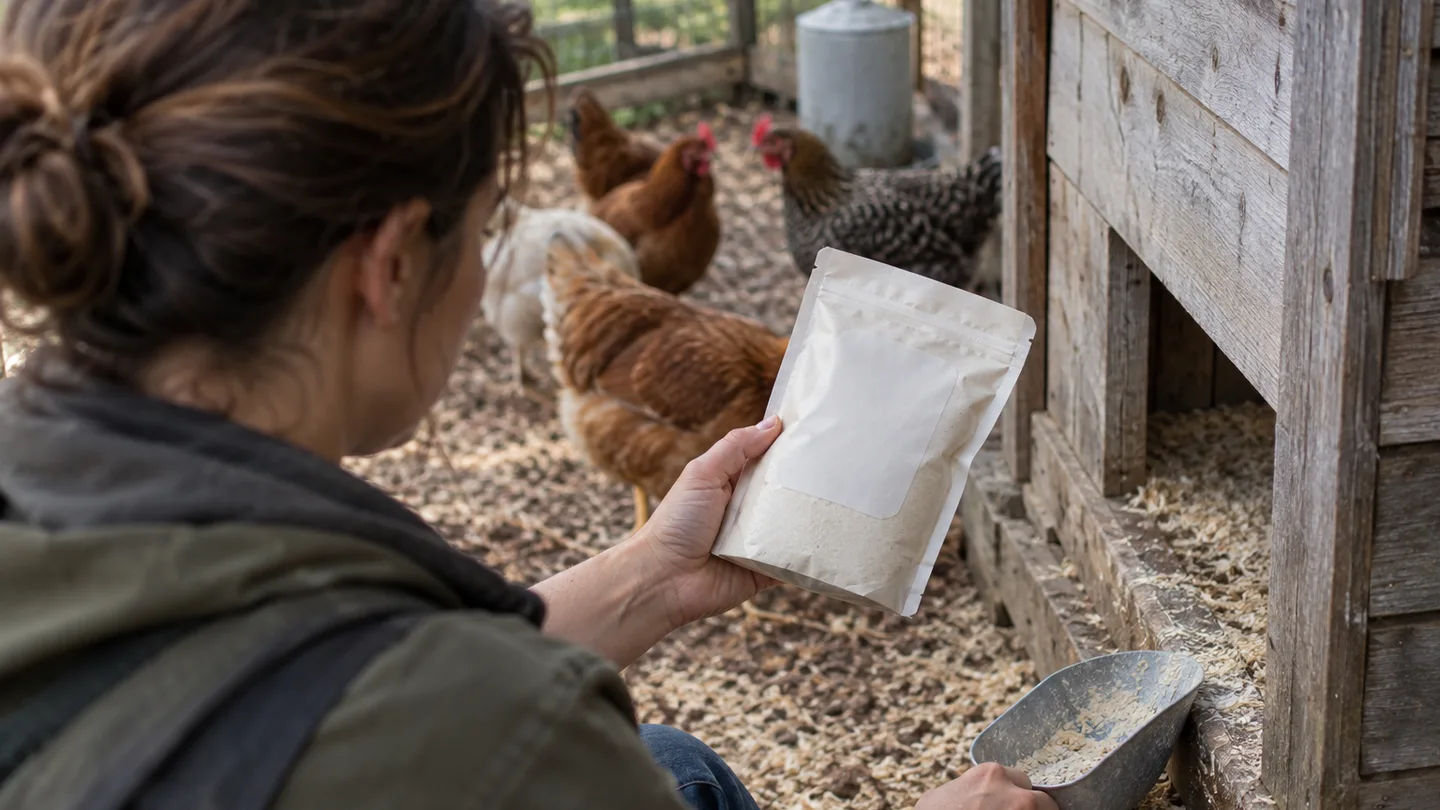
Start with the label: food-grade, pool-grade, and the word “inert” are not interchangeable
Before you open the bag, check both the front and the active-use or directions panel. For a backyard flock, I want three gates to line up:
- The product is clearly identified as the grade intended for the proposed use.
- The label permits that use around poultry or in the relevant housing area.
- You can apply it without making a visible cloud around the birds, feeders, drinkers, or your own face.
Food-grade diatomaceous earth is often the product people mean in chicken-keeping conversations. That does not make every food-grade bag suitable for every poultry use. A product can be relatively pure and still be dusty, poorly labeled for your intended application, or used in a place where birds will breathe or eat it.
Pool- or filter-grade material is a separate decision. Some products in that category are processed with heat or other methods that can change the form of silica in the finished dust. That is why I would not substitute a filter product because the bag looks similar or because an online post calls all DE the same.
The word ‘inert’ is not a complete answer either. It does not tell you that the particles are harmless to inhale, that the product belongs in feed, or that direct application to a bird is appropriate. Treat the intended-use statement as a boundary, not as small print to skip.
Composite field note: In a clearly marked backyard case, I had a half-used white powder bag beside a small coop and a hen that was scratching more than usual. I photographed the front and directions panel before opening it. The product was identified for filtration, not poultry use, so I sealed it and set it aside. After dark, I checked the underside of the roost, the end joints, and a nest-box seam with a flashlight. I found small moving specks in one crack. The actual next step was removing the litter, cleaning and drying those joints, and choosing a poultry-appropriate parasite plan. I did not scatter the powder and call the diagnosis finished.
There is no responsible universal teaspoon-per-bird or tablespoon-per-coop recipe. Application area, product label, ventilation, litter condition, and the problem you are trying to solve all change the answer. If a recipe ignores those details, it is skipping the part that matters.
The safe-use boundary is dry, targeted, and low-dust—not a powder bath for the whole flock
The safest boundary I use for diatomaceous earth for chickens is narrow: label-permitted, dry, targeted, and low-dust. Even inside that boundary, I treat DE as an optional environmental aid, not a treatment plan by itself.
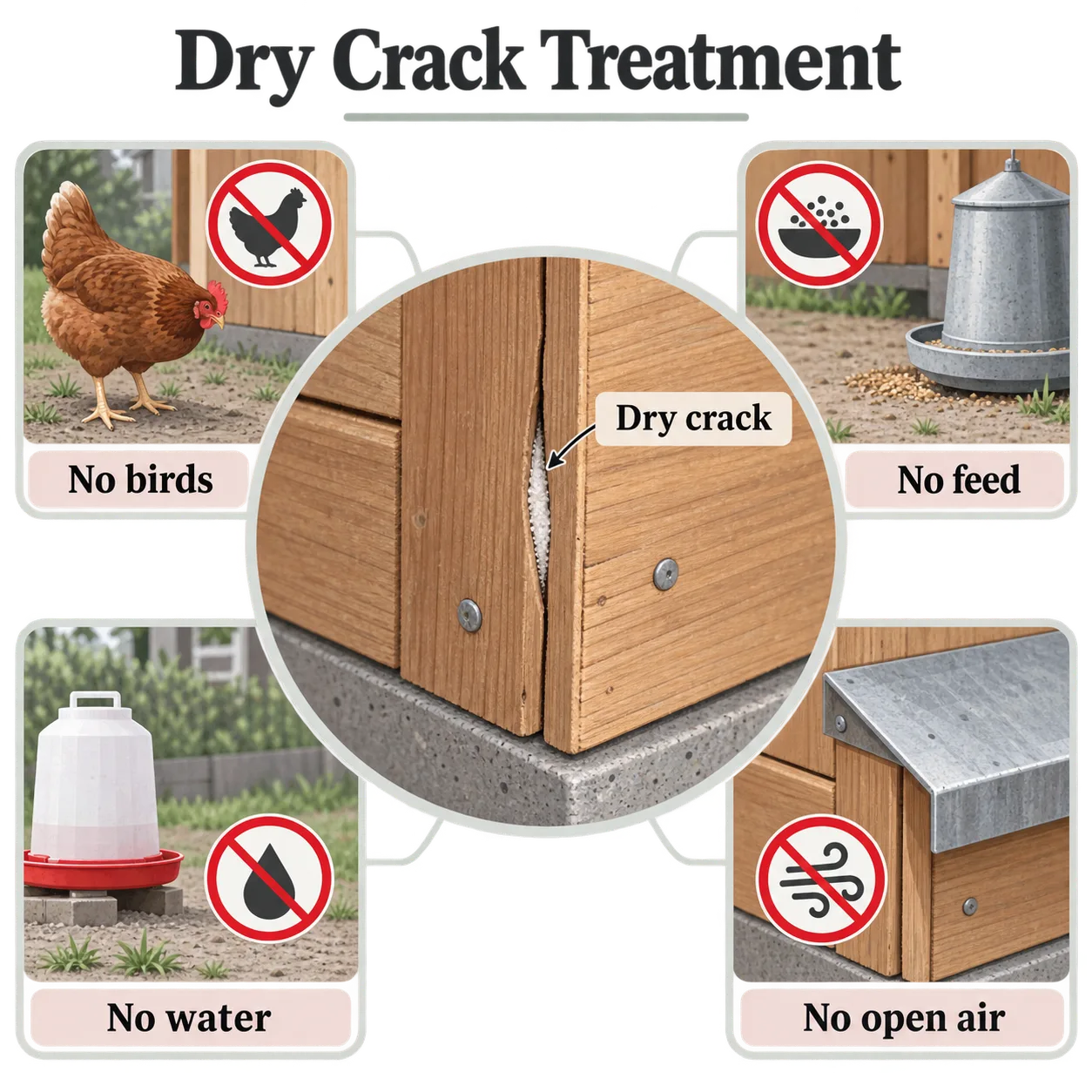
The safest-use boundary is dry, targeted, and low-dust because the proposed action depends on dry particles reaching an exposed surface. A settled application in a dry crack is a different job from broadcasting powder through litter while hens scratch.
- Cracks and crevices: If the label permits the use, a small, controlled application to a dry hiding place is easier to contain than a broad dusting.
- Litter: Use caution. Birds disturb litter constantly, and a powder that was settled in the morning can become airborne after scratching.
- Feeders and drinkers: Keep loose powder out of them and away from places where it can fall into feed or water.
- Eyes and nostrils: Do not aim dust at a bird’s face or apply it where normal head movement can push particles into the air.
- Direct bird application: Do not copy a social-media dusting routine unless the product label specifically permits that route and gives directions for it.
I would not mix DE into feed from an internet recipe. Feed use is a different exposure route from a dry crack treatment, and a claim that a product is food-grade does not automatically create a feeding direction. The same caution applies to dust baths. A chicken dust bath can be built with suitable dry materials without turning the bathing area into a permanent powder cloud.
Moisture changes the equation. Rain, damp bedding, and a leaky drinker can reduce the usefulness of a dry-particle mechanism. Adding more powder to compensate may leave a heavier residue that birds stir up later. If you can see a drifting plume, stop the application and let the dust settle before deciding what to do next.
What DE can—and cannot—do for mites, lice, worms, and coop odour
Mechanism matters more than the promise on the bag. Dry mineral particles may affect exposed crawling insects by abrading or drying their outer surface. That requires contact. It does not reach every parasite, every life stage, or every hiding place in a working coop.
| Problem | What DE may contribute | What it does not replace |
|---|---|---|
| Exposed crawling insects | A dry, label-permitted environmental aid where particles can contact the insect. | Cleaning, monitoring, or a labeled treatment when the problem continues. |
| Mites hiding in roost joints | Possible contact in a dry crack if the product is permitted for that use. | After-dark inspection, crack cleaning, and a broader plan for recurring mites. |
| Lice on a bird | It may be discussed as an environmental aid, but the bird and feather shafts still need inspection. | A species-appropriate treatment plan and attention to every affected bird. |
| Internal worms | No useful shortcut from sprinkling powder in the coop. | Fecal evaluation, veterinary advice, or a poultry-labeled internal parasite product. |
| Odour or flies | Some keepers report improvement, but that is anecdotal and condition-dependent. | Dry bedding, manure management, ventilation, and source control. |
That is why I do not call DE a stand-alone treatment for an established mite or lice problem. Red mites can spend part of their time away from the bird, inside seams and joints. Lice live on the bird, where casual environmental dusting may miss the main problem. Eggs, deep litter, damp surfaces, and incomplete cleaning all change the result.
Internal worms are a separate problem. Powder placed in a coop does not become a veterinarian-directed deworming plan. If birds are losing condition, repeatedly passing abnormal droppings, or showing persistent weakness, move from household experiments to testing and species-appropriate treatment advice.
A symptom-to-action decision tree before you reach for the bag
Use the bird, the coop, and the clock. A white patch on litter tells you very little by itself, but a short inspection sequence can tell you whether DE is even aimed at the right problem.
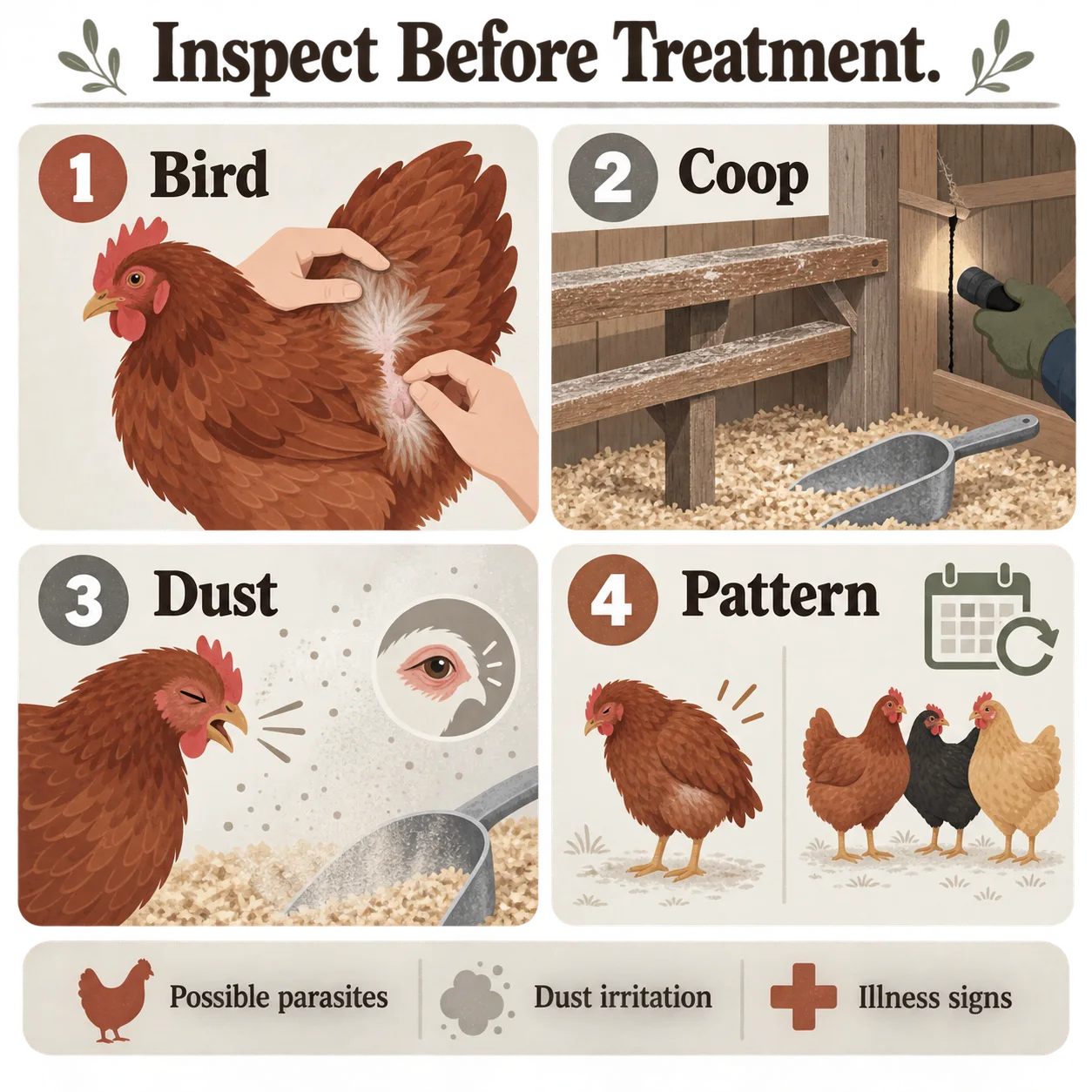
Start with the bird, not the product. Look around the vent feathers, under the wings, and along the feather shafts. You are looking for moving insects, attached clusters, damaged feathers, excessive scratching, or a change from that bird’s normal condition.
- One bird, otherwise bright: Inspect that bird in good light and compare it with another flock member. A targeted check may be enough to decide whether you are dealing with an external parasite, a skin problem, or ordinary grooming.
- Several birds, or the problem keeps returning: Inspect the coop after dark. Check roost ends, underside joints, nest-box seams, and cracks where daylight inspection can miss moving parasites. Recurrence means the housing and treatment plan need attention together.
- Scratching plus respiratory irritation: Stop adding dust. Sneezing, watery eyes, laboured breathing, or open-mouth breathing shifts the priority toward clean air and veterinary advice, not a stronger application.
- Pale combs, marked weakness, weight loss, or a sharp laying change: Treat these as reasons to seek a poultry veterinarian or qualified local extension help. They are not a cue to keep increasing DE.
If you find a few visible insects in a dry coop crack and the birds are otherwise well, a label-directed environmental step and close monitoring may be reasonable. If several birds are affected, signs recur after cleaning, or the birds are deteriorating, DE is no longer the main decision. A broader poultry parasite plan is.
When to stop experimenting—and what to use instead
DE earns a place only when its narrow benefit is worth the dust it introduces. Once the risk or uncertainty is higher than that benefit, switch to basic coop work and a product or diagnosis designed for the actual problem.
- Remove the birds before dusty work and bag contaminated bedding rather than shaking it through the run.
- Scrape manure from roost joints, nest-box seams, and cracks. Clean the surfaces, then let them dry fully.
- Review chicken coop ventilation so normal scratching and cleaning do not leave dust hanging in the birds’ breathing zone.
- Choose a poultry-labeled parasite product according to its label, or ask a veterinarian when signs are persistent, flock-wide, or severe.
Avoid breathing the powder. Follow the package directions for eye and skin protection, and keep birds away while dusty work is under way. The EPA pesticide label pages are worth checking for what the label wording actually requires. The NIOSH respirable silica guidance is another useful reference to keep beside your dust-control plan.
Your action this week is simple: photograph the front and back of the DE bag, then inspect the coop after dark if mites are suspected. If the label does not clearly cover your intended poultry use, do not improvise a dose. Use how to clean a chicken coop as the reset plan, and compare the signs with chicken mites treatment before choosing a product. A bag of powder is an option. It is not a diagnosis.