How to Tell if a Chick Is a Rooster: 5 Signs to Watch
At six weeks, a cockerel can begin to look unmistakably male, while a same-age pullet may still have you squinting at her comb. If you’re asking how to tell if a chick is a rooster, start with the honest answer: most ordinary chicks don’t give you a reliable hatch-day verdict. Five clues become useful at different ages, and the order matters more than any single dramatic feature.
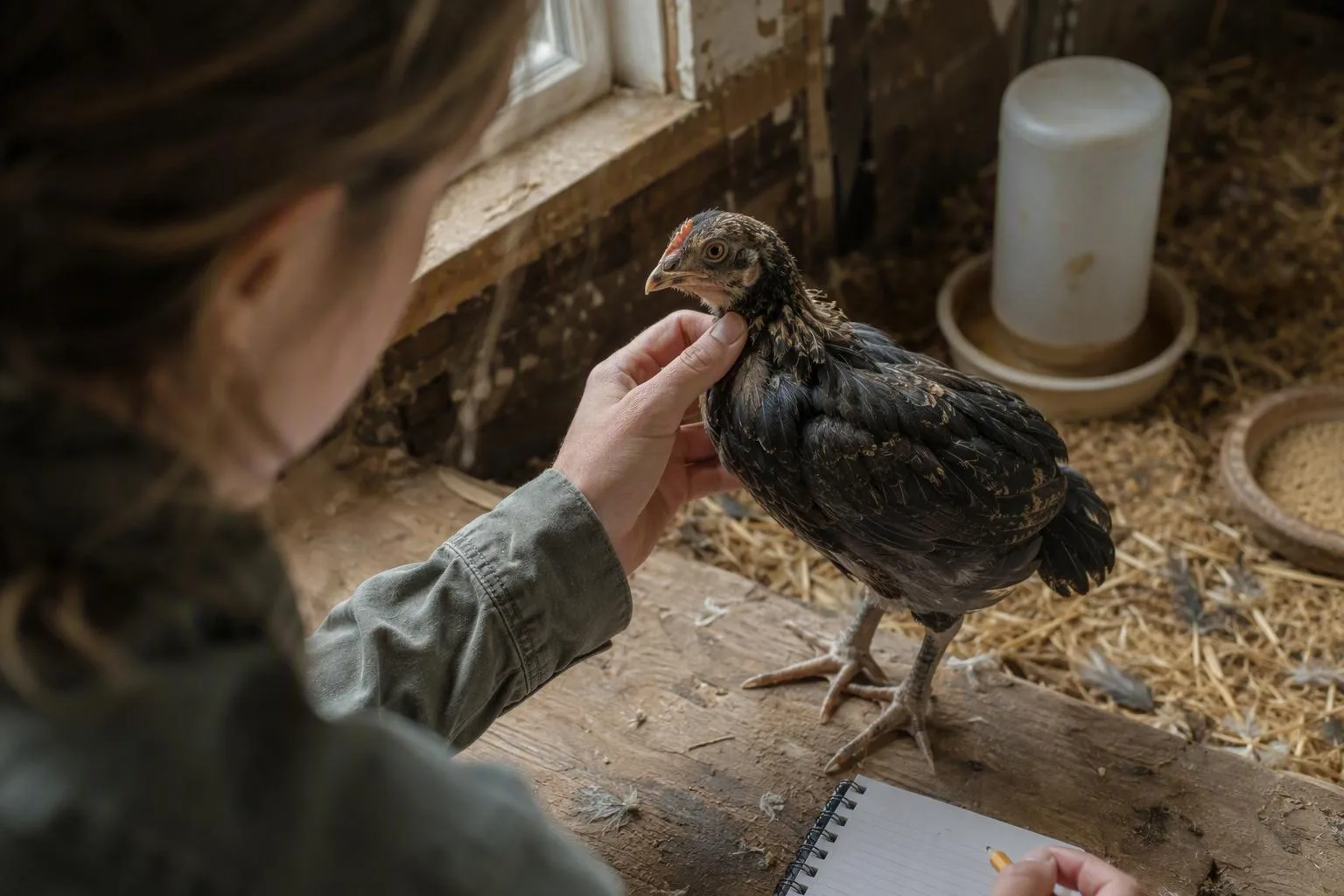
Start with the age-and-breed reality check
First, get the labels straight. A juvenile male is a cockerel, and a juvenile female is a pullet. Rooster and hen are the adult terms you’ll use later. That distinction matters because a chick can be genetically male long before its adult plumage arrives.
On an ordinary mixed hatch, visual sexing at birth is often a guess. Breed, parent pairing, comb type, health and age all change what you can see. A black, yellow or red chick isn’t automatically female, and a bold chick isn’t automatically male. If keeping or rehoming a bird depends on the answer, don’t let one sign make that decision.
My working calendar is simple: use any known hatch-day marker first, inspect wing feathers around day 1 to 3 only if the line is suitable, compare combs through roughly weeks 3 to 8, then wait for hackle and saddle feathers to clarify the picture around weeks 12 to 20. Those are recheck windows, not promises.
In my own small backyard flock, I once marked a barred chick as a possible cockerel because it was bolder and its comb looked a shade warmer. I was wrong to treat that note as a decision. I kept the note, took same-angle photos, and waited for the neck feathers to give me firmer evidence. That habit stopped me rearranging the flock around a hunch.
Sign 1: Hatch-day down patterns work only in true sex-linked crosses
The useful distinction is a known parent pairing, not a pretty colour label. In a genuine sex-linked or autosexing line, the breeder uses a genetic combination that makes male and female chicks visibly different at hatch. The marker might involve down colour, a head spot, a stripe or barring. Which appearance points to which sex depends on the exact cross.
That is why colour sexing doesn’t transfer from one flock to another. A yellow chick isn’t a universal pullet marker. A black chick isn’t a universal cockerel marker. Barred chicks aren’t automatically male either. Barring can be part of a useful sex-linked cross, but a barred breed or mixed hatch without known parentage doesn’t give you that certainty.
Ask the breeder what the sire and dam were, and whether the chicks came from an advertised sex-link or autosexing line. If the answer is simply that the chicks looked different in the shipping box, record the pattern as a clue only. Write the cross on your flock card. Without that information, the down pattern is decoration, not a sex test.
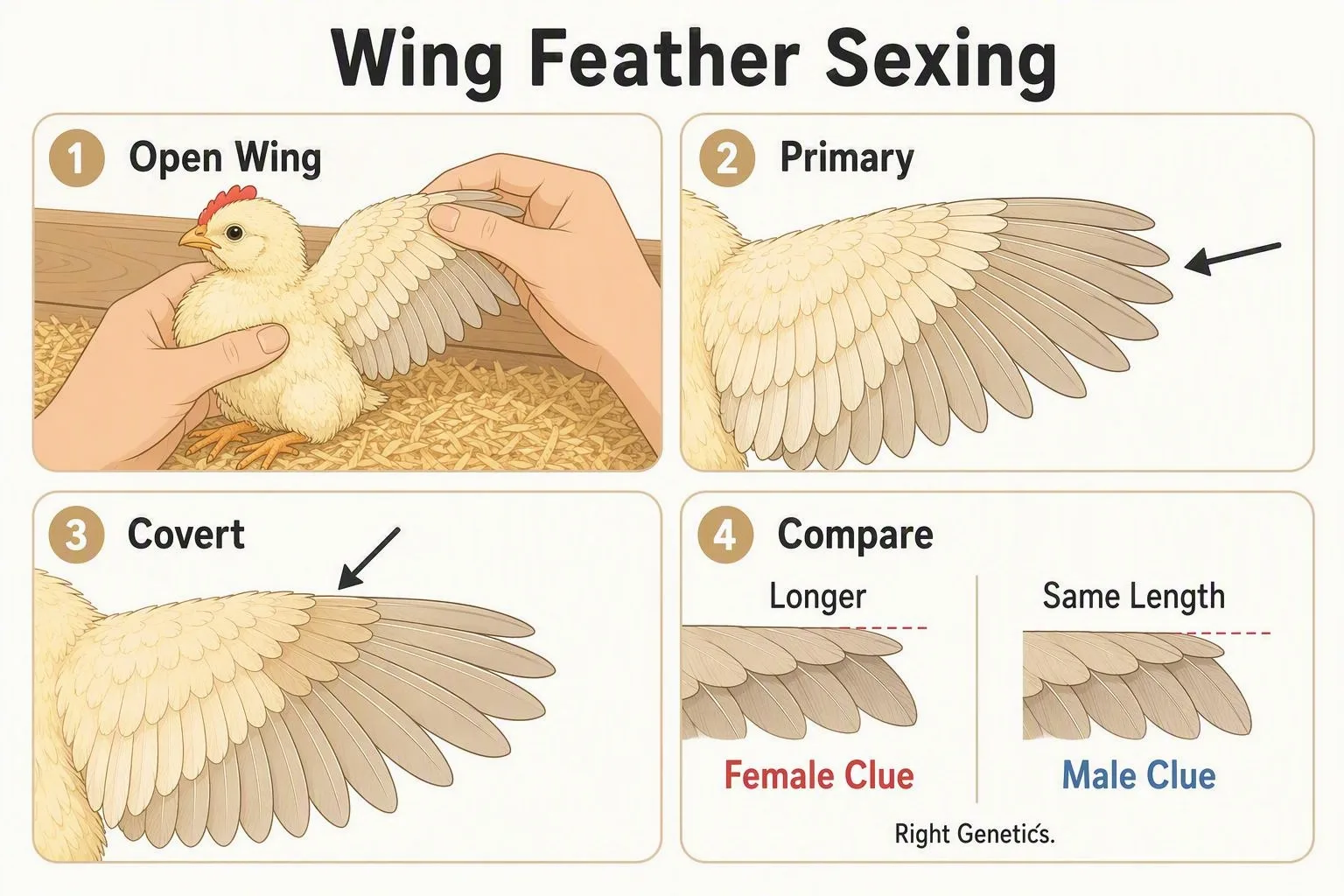
Sign 2: Wing feathers can help at day 1, but ordinary chicks defeat the test
Wing-feather sexing is real in the right genetic line, but the internet version is often too broad. In a feather-sexable line, primary flight feathers and the shorter covert feathers can grow at different rates in male and female chicks during the first few days. The difference is linked to the line’s feathering genetics, not to a chick being generally healthy or active.
Use this check gently:
- Confirm that the breeder says the chicks are feather-sexable. If the parent pairing is unknown, stop before inspecting.
- Support the chick’s breast and feet over a clean, non-slip surface. Extend one wing only as far as it moves comfortably.
- Look at the relative length and arrangement of the primary and covert feathers. Compare both wings and, if you have several chicks from the same line, compare them under the same light.
- Take a quick photograph, release the wing and return the chick to warmth.
Don’t pull, bend or spread developing feathers hard. With an ordinary mixed or unknown line, I would not call a chick male or female from one wing. By two or three weeks, you may see growth differences, but I treat those as a prompt for another check rather than a final answer.
Sign 3: An early red, prominent comb is a clue from 3 to 8 weeks
Comb development is where many keepers get their first useful separation between same-breed chicks. If one chick develops a noticeably larger, wider or redder comb ahead of its flockmates, I move cockerel higher on my list. The clue is strongest when the birds are the same breed and age and have been raised under the same conditions.
Make the comparison fair. Check birds at the same time of day, from the same side and under the same light. Bright sunlight can make a pale comb look red. Heat, stress or poor general health can also change how a bird looks. A chick that is growing slowly for another reason shouldn’t be labelled from colour alone.
Comb type changes the view. A single comb is usually easier to compare than a rose or pea comb. Some pullets redden early. Some cockerels develop slowly. A small, pale comb lowers my confidence, but it doesn’t rule out a late-developing cockerel.
By this stage, a weekly same-angle photo is more useful than a one-day judgment. Put a ruler or the same familiar object beside the brooder only for scale, not as a sex test. A red comb is a smoke alarm, not a verdict: it tells you to inspect the other signs.
Sign 4: Thick legs and spur buds support a guess from 4 to 12 weeks
Legs can support your guess, but they’re weak evidence on their own. A large breed, a fast-growing pullet, a heavily feathered foot or simple family genetics can make a female chick look sturdy. Nutrition and individual growth also change leg thickness and stance.
| Clue | How I use it | What to discard |
|---|---|---|
| Thicker shanks | Keep as supporting evidence beside comb and feather changes. | Do not call a bird male from legs alone. |
| Larger feet | Compare only with same-breed, same-age birds. | Do not treat foot size as a universal male marker. |
| Upright stance | Use it to prompt another look. | Bold posture can reflect temperament or flock rank. |
| A spur bump | Record it as one small clue. | It does not prove the bird is male. |
In my rechecks, I may notice a spur bump in the six-to-twelve-week stretch, but I never let it overrule a quiet comb or rounded juvenile feathering. Spur development varies, and the presence of a bump isn’t exclusive to males.
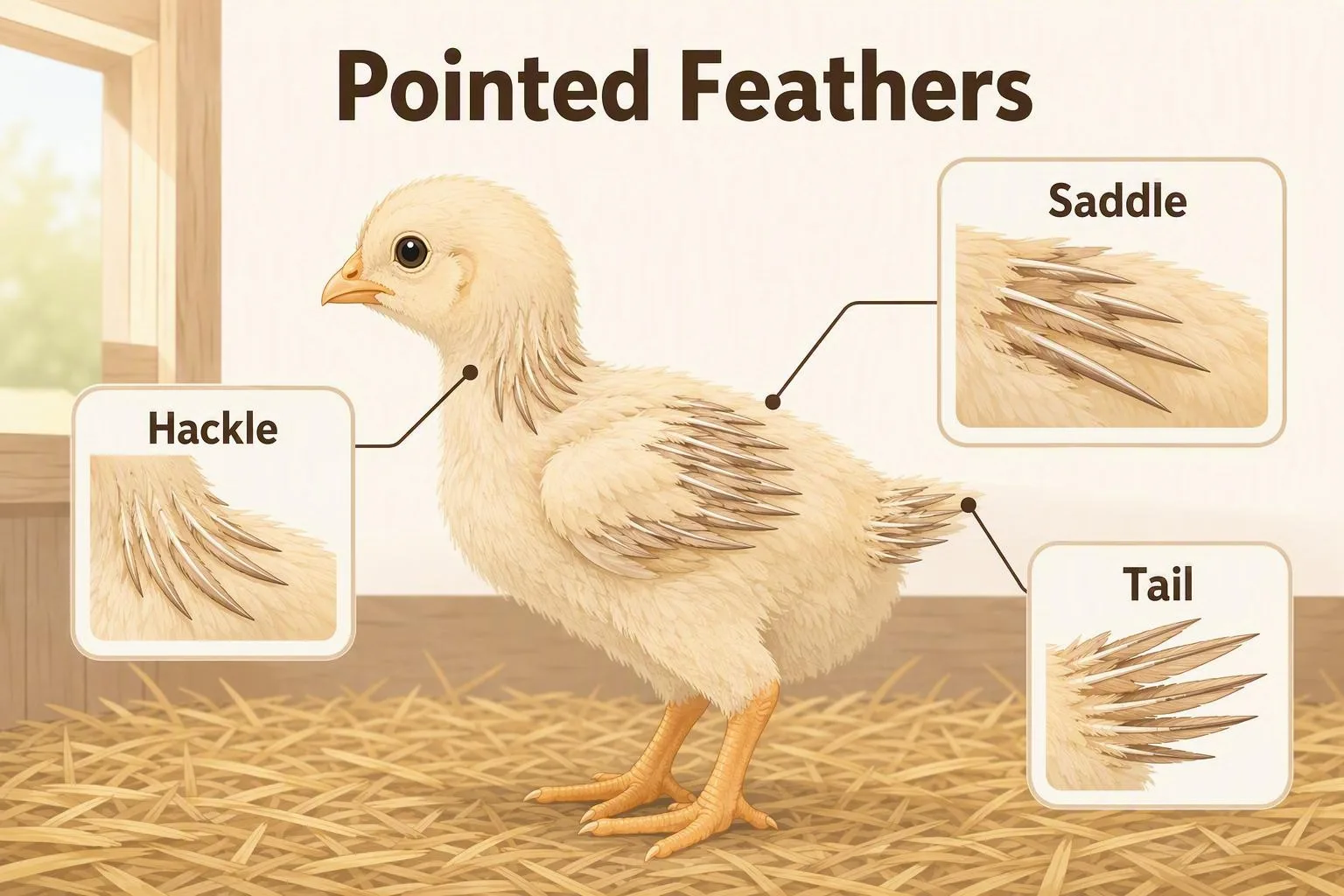
Sign 5: Pointed hackle and saddle feathers usually settle the question around 12 to 20 weeks
Pointed feathers are the strongest visual sign in this guide, but they’re not an early one. Look first at the hackles, the narrow feathers along the sides and back of the neck. Then check the saddle area, which sits over the lower back just ahead of the tail.
In a typical cockerel, hackle and saddle feathers grow narrower and more pointed, with a sharper taper at the end. Pullet feathers are usually broader and rounder at the tip. The contrast is easier to judge when you compare the same feather area on birds of the same breed, rather than comparing a small bantam with a large, slow-feathering breed.
My own practical window is deliberately wide. In my rechecks, and in the range keepers commonly report, some cockerels show a useful feather contrast around 10 to 12 weeks. Others are not clear until closer to 16 to 20 weeks. I use the earlier window to start looking and the later window to avoid forcing a call.
Don’t use tail length by itself. Breed shape, feather wear and a developing molt can make a pullet’s tail look long or a cockerel’s tail look unimpressive. Read the neck and saddle feathers first, then use the tail as supporting detail.
I use American Poultry Association breed standards to understand the adult pattern I may eventually see, not as a chick-sexing shortcut. Adult standards describe mature comb and feather form. A chick has not grown into those traits yet, so the standard helps identify the destination but cannot supply a missing early marker.
Crowing and attitude are timing clues, not a sixth sign
Crowing can make you look up from the feeder, but it should start a recheck rather than end one. The working range I use is roughly six to twenty weeks. That is an experience-based window, not a schedule every cockerel follows.
Some birds produce a thin, broken attempt before they learn the sound. Others stay quiet longer. A hen can also make a crow-like call, so one odd noise isn’t enough for a final sex call. I want the sound backed by a changing comb or pointed neck feathers.
Mounting, chest bumping, food guarding, boldness and sparring are just as easy to overread. Young birds test flock rank, and temperament differs between individuals. Treat behavior as a highlighter. It tells you where to look next, not what to write on the final flock list.
Turn five clues into a recheck calendar and a humane next step
Don’t turn the five signs into a vote, with three weak clues defeating two strong ones. Record what you saw, how old the chick was and whether the comparison was fair. My five-checkpoint calendar looks like this:
- Hatch day: record the breed, breeder, parent pairing and any stated sex-link or autosexing method. Note down patterns without assigning certainty.
- Day 1 to 3: inspect wing feathers only when the line is known to be feather-sexable. Save a photograph beside the breeder’s instructions.
- Weeks 3 to 8: photograph combs weekly from the same angle. Compare size, width, texture and redness with same-breed flockmates.
- Weeks 4 to 12: keep leg thickness, stance, spur bumps and behavior in the notes. These overlap with comb checks because growth signs don’t switch on like a light.
- Weeks 12 to 20: inspect hackle and saddle feather shape at several checkpoints, especially if the earlier clues disagree.
That schedule is my practical recheck system, shaped by my own rechecks and by the broad timing keepers commonly describe. It is useful because it tells you when to look again, not because it promises a particular result on a particular day.
If you need an answer earlier, rely on a reputable hatchery’s stated sexing method, a documented autosexing line or qualified professional help. For a line-specific check, compare the breeder’s description with University extension guidance on breed-specific chick sexing. Don’t attempt vent sexing at home. A chick’s body is small and delicate, and a technique that requires specialist handling is a poor experiment for a backyard keeper.
Check your local rules before you plan around a rooster. Noise limits, flock rules and housing expectations vary by location. Your coop also needs a realistic plan for more than one outcome, including safe separation or rehoming if a cockerel can’t stay with your flock.
This week, take a same-angle photograph of each chick, write the hatch date and breed above it, and mark your next check date. If they’re still under heat, pair that notebook with your plan for brooder temperature for chicks and raising baby chicks week by week. Before they move outside, review your chicken coop requirements too. A clear sexing note is useful, but a warm brooder and suitable housing are what carry the birds through the waiting period.