Do Chickens Sleep at Night? What Your Flock Actually Does
By the time the last usable light leaves the run, your adult hens are usually already choosing a roost. So, do chickens sleep? Yes—adult chickens normally sleep at night, in a perched, low-activity state, with brief awakenings rather than one unbroken human-style block.
Short answer: Expect many backyard hens to settle around dusk, sleep through most of the dark period, and wake as the coop brightens. The exact hours move with season, latitude, weather, coop light leaks, and any supplemental lighting you use.
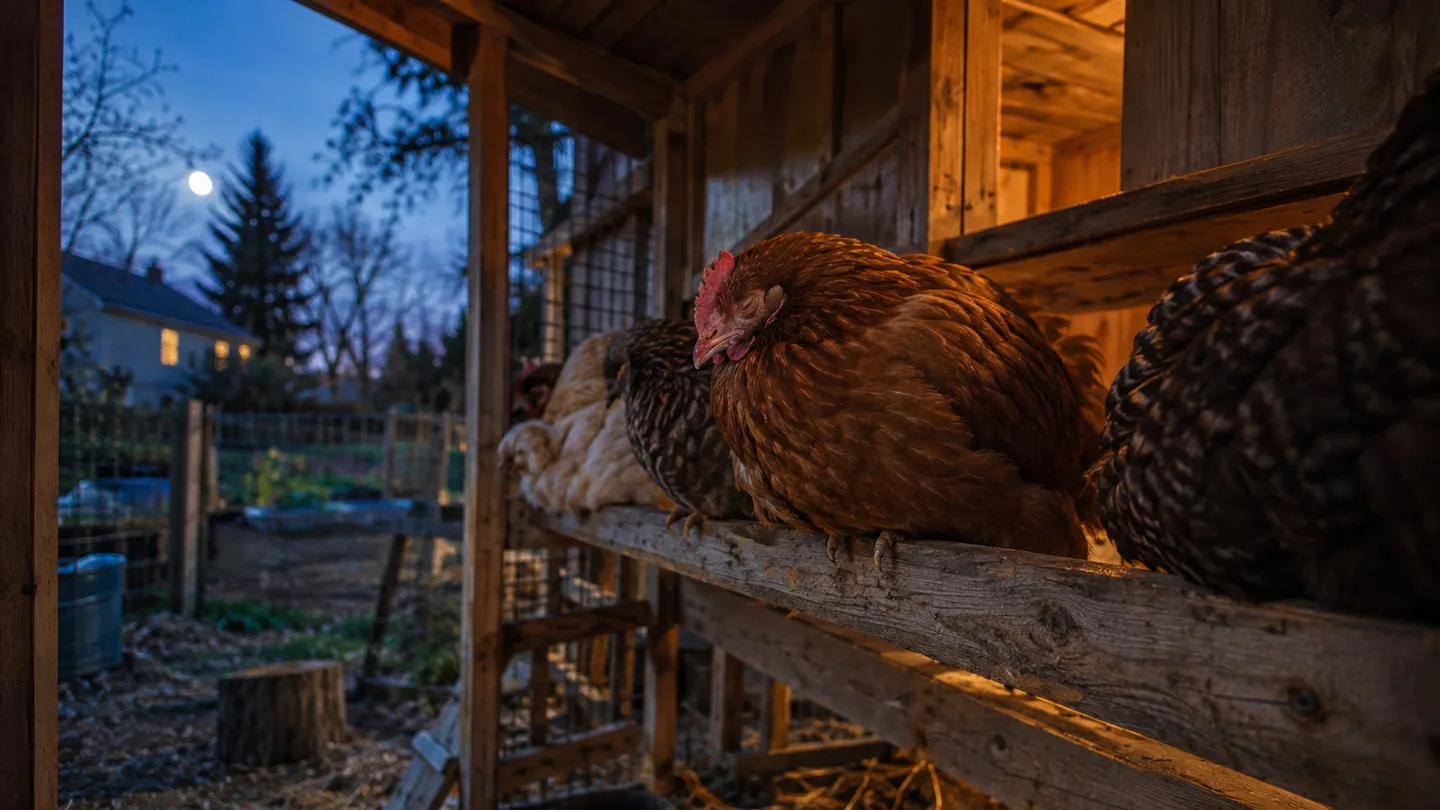
Yes—adult chickens sleep at night, usually on a roost
Most adult hens do not need you to put them to bed. During the last 30 to 60 minutes of useful evening light, they usually finish drinking, make a final peck around the run, and climb onto a perch. Once the coop is properly dark, activity drops sharply.
For a typical backyard flock, roughly 8 to 12 dark hours is a useful planning range. A summer night may be shorter. A winter night, or a flock kept farther from the equator, may be longer. That range is not a timer stamped onto every bird. It is a way to picture the dark period your coop needs to provide.
Chicken sleep also does not look exactly like human sleep. A hen may open an eye, shift her feet, resettle her feathers, or adjust her balance before becoming still again. Those small movements do not automatically mean she is distressed. The practical question is whether she returns to a relaxed perch and looks normal at first light.
If you are asking, do chickens sleep at night because one bird is still moving after dark, start with the surroundings. A light shining through the pop door, a predator outside the wire, a wet perch, or another bird pushing for space can interrupt an otherwise ordinary routine.
The dusk-to-dawn clock: how season, latitude, and coop lights change sleep hours
Chickens respond to changing light more reliably than to the clock on your wall. Think of bedtime as a fading-light process, not a fixed appointment.
- During the last 30 to 60 minutes of usable evening light, birds usually move from feeding and scratching toward the coop. Younger birds may take longer to settle, especially if roost space is crowded.
- After darkness arrives, most adult birds stay perched. A hen may shift position, but long periods of pacing are a reason to inspect the setup.
- Near first light, the flock becomes more alert. You may hear quiet movement before the birds leave the roost, particularly if dawn light enters through high ventilation openings.
Six to 12 or more dark hours is a useful illustrative range, not a promise for every location. Latitude changes the length of natural nights. Season changes it too. Cloud cover can make evening feel earlier, while a bright security light can keep one side of the coop active after the rest of the yard is dark. Shade from a building or tree can also move the flock’s apparent bedtime forward.
Supplemental lighting changes the calculation again. If you use a timer to extend the laying day, treat the dark period as a part of the schedule, not as leftover time. I would preserve about eight hours of uninterrupted darkness rather than leaving a dim bulb on all night. Extension guidance on photoperiod and supplemental lighting for laying hens is useful if you are building a timer schedule instead of guessing.
My practical judgment is simple: fix a light leak before you add another device. A predictable dark period usually does more for calm roosting than a night-light marketed as comfort. If a porch lamp shines directly into the coop, block that glare first and see whether the bedtime changes.
A sleeping hen is quiet, perched, and not completely motionless
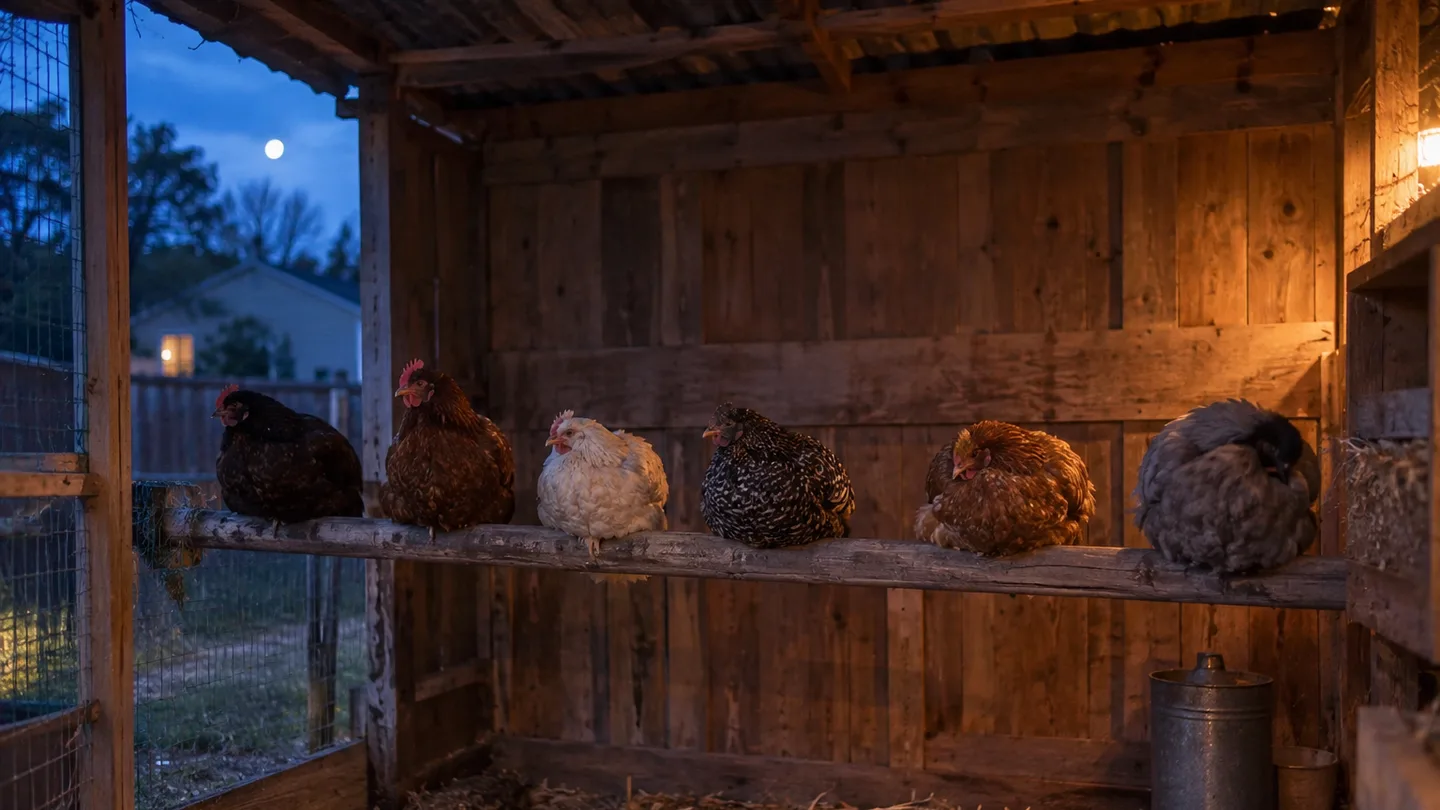
Normal overnight behavior is easy to mistake for illness if you only look for total stillness. A sleeping hen commonly sits with her feet wrapped around the perch, feathers relaxed, and eyes closed or only briefly opening. She may tuck her head into her shoulder feathers. She may also make a small balance adjustment when another bird moves.
That is different from a bird spending long stretches on the floor, pacing along the wall, repeatedly falling, or staying fluffed and unresponsive when the coop brightens. Those signs move the question away from sleep and toward a housing, injury, or health problem.
In my own small-backyard approach, I use a two-night observation instead of opening the coop and disturbing everyone. I stand outside the run at dusk, let my eyes adjust, and note where each bird settles. At first light, I check whether the same birds are perched, alert, and able to step down normally. I repeat the check the next evening. It gives you a pattern without turning bedtime into a daily handling session.
Use this short checklist:
- At dusk, note whether each bird can reach the roost without being shoved away.
- After dark, look for quiet perching rather than prolonged pacing or repeated wing-flapping.
- At first light, check that birds can grip the perch, stand, walk, and reach feed and water.
- Do not shine a bright flashlight into their faces or pick them up unless a bird appears unsafe.
So, do chickens sleep with their eyes open? You may see brief eye opening or a quick head lift. That observation by itself is not a diagnosis. Judge the whole bird, the other flock members, and what happens at dawn.
Chicks and broody hens do not follow the adult overnight pattern
Baby chicks sleep in frequent bursts. During the first week or two, a chick may eat, drink, walk around for a short spell, and then drop into another nap. That stop-start rhythm is not the same as an adult hen settling once for the night.
Chicks still need a proper brooder with a warm area, room to move away from the heat, reliable access to feed and water, and a period of darkness for rest. If they pile tightly under the heat source, avoid it completely, or remain weak when the rest of the group is active, check the brooder temperature, drafts, access to water, and general health rather than assuming they are simply sleepy.
A broody hen has a different pattern again. She may remain on a nest for long stretches, puff her feathers, object when you approach, and take only short daily breaks to eat, drink, dust-bathe, and defecate. She may not use the normal adult roost during that period. If she is alert when she leaves the nest and returns with purpose, the nest-bound routine can be part of broodiness.
The decision point is age and context. A chick napping in bursts, an adult hen perched at night, and a broody hen guarding a nest should not be judged by the same sleep standard. A bird that is weak, cold, breathing abnormally, or unable to reach food is presenting a separate problem.
Build the sleep setup: 8–12 inches of roost per bird, darkness, and safe airflow
Your flock does not need a complicated sleep system. It needs enough stable perch space, a dark period, and air exchange that does not blow directly across the birds.
A practical starting point is about 8 to 12 inches of usable roost length per adult bird. For planning purposes, that works out like this:
- 3 birds: about 24 to 36 inches of total roost length.
- 6 birds: about 48 to 72 inches.
- 12 birds: about 96 to 144 inches, often split across more than one perch.
Use the word usable carefully. A perch blocked by a wall, nest box, feeder, or aggressive bird does not provide its full advertised length. A six-hen setup with a six-foot perch gives 72 inches total, or 12 inches per bird, if every bird can settle along it. If one end is blocked and the dominant hens claim the middle, the real space is smaller.
For many backyard breeds, a perch around 2 to 4 inches wide works well when its upper edges are rounded rather than sharp. A height of roughly 12 to 24 inches suits many small-coop arrangements. Heavy breeds, young birds, birds with leg problems, and poor fliers may need a lower perch or a step-up route. The separate guide to how high should roosting bars be can help if you are rebuilding the frame.
Do not solve a short-roost problem by stacking narrow bars at different heights and assuming every bird will use them. Some birds will crowd the highest bar. Others may be pushed down. A lower, wider, stable arrangement is often the better judgment call for a mixed backyard flock.
Keep the sleeping area dark enough for a clear night period. A bright bulb, red heat lamp, or night-light should not be treated as a sleep aid. If supplemental laying light is part of your plan, use a timer and preserve about eight hours of uninterrupted darkness. If you remove a light leak and make the dark block predictable, I would expect bedtime to become less variable over the next few evenings. If it does not, the light was not the whole problem.
Ventilation belongs above or around the roost so moisture and stale air can escape without creating a direct stream across sleeping birds. The broader chicken coop requirements still matter: secure openings, a dry floor, a roof that does not drip onto the perch, and a layout that lets you inspect the flock without climbing over them. Choose the best bedding for chicken coop conditions only after you have dealt with leaks and airflow; dry litter cannot compensate for water entering from above.
When the nighttime routine changes, use this normal-versus-warning check
A late bedtime is a clue, not a verdict. Start by separating a one-night environmental disturbance from a pattern that follows the same bird or birds across several nights.
| What you see | First place I would look | What to do |
|---|---|---|
| The flock settles later after a bright evening | Light leaks, porch lights, or a timer | Block the glare, check the schedule, and watch the next two evenings. |
| One bird is restless while the others perch | Perch access, a foot problem, an injury, or a bird being pushed off | Observe closely at dusk and first light; do not assume it is a sleep preference. |
| Two or more birds become restless together | Predator pressure, rodents, a loose latch, roof noise, leaks, or a draft | Inspect the coop immediately, including outside the wire and around the roof. |
| A bird sleeps on the floor or repeatedly falls | Perch access, balance, leg weakness, injury, or illness | Make the bird safe and seek veterinary or local extension guidance if it cannot perch normally. |
| Open-mouth breathing, marked weakness, or failure to respond at dawn | A health problem rather than a normal sleep pattern | Arrange prompt veterinary advice. Do not try to fix this with a brighter light or extra heat alone. |
One restless night can follow a storm, a new animal outside the run, or a loose piece of roofing. Mild variation is worth monitoring over two or three nights if the bird is otherwise eating, drinking, walking, and alert. Repeated falls, open-mouth breathing, inability to perch, or marked weakness at first light deserve a faster response.
This week, stand outside the coop at dusk and again at first light. Count the usable inches of roost, note whether light reaches the birds after dark, and watch whether every hen can perch and step down normally. If you are still planning the flock rather than troubleshooting it, use raising backyard chickens for beginners to turn that small observation into a complete housing and daily-care plan.
The useful rule to remember is this: a sleeping chicken should look settled, not perfect. Quiet movement is normal. A repeated change in access, balance, breathing, or alertness is the part that needs your attention.