At What Age Do Chickens Start Laying Eggs? 16–24 Weeks
At 16 weeks, you may find the first egg. Another pullet the same age may not lay for several more weeks. If you’re asking at what age do chickens start laying eggs, plan on a window rather than a deadline.
For a small backyard flock, 18–24 weeks is the useful planning range for many egg pullets. Some light, early-maturing birds begin near 16 weeks. Larger or slower-maturing birds may wait until 22–28 weeks or longer.
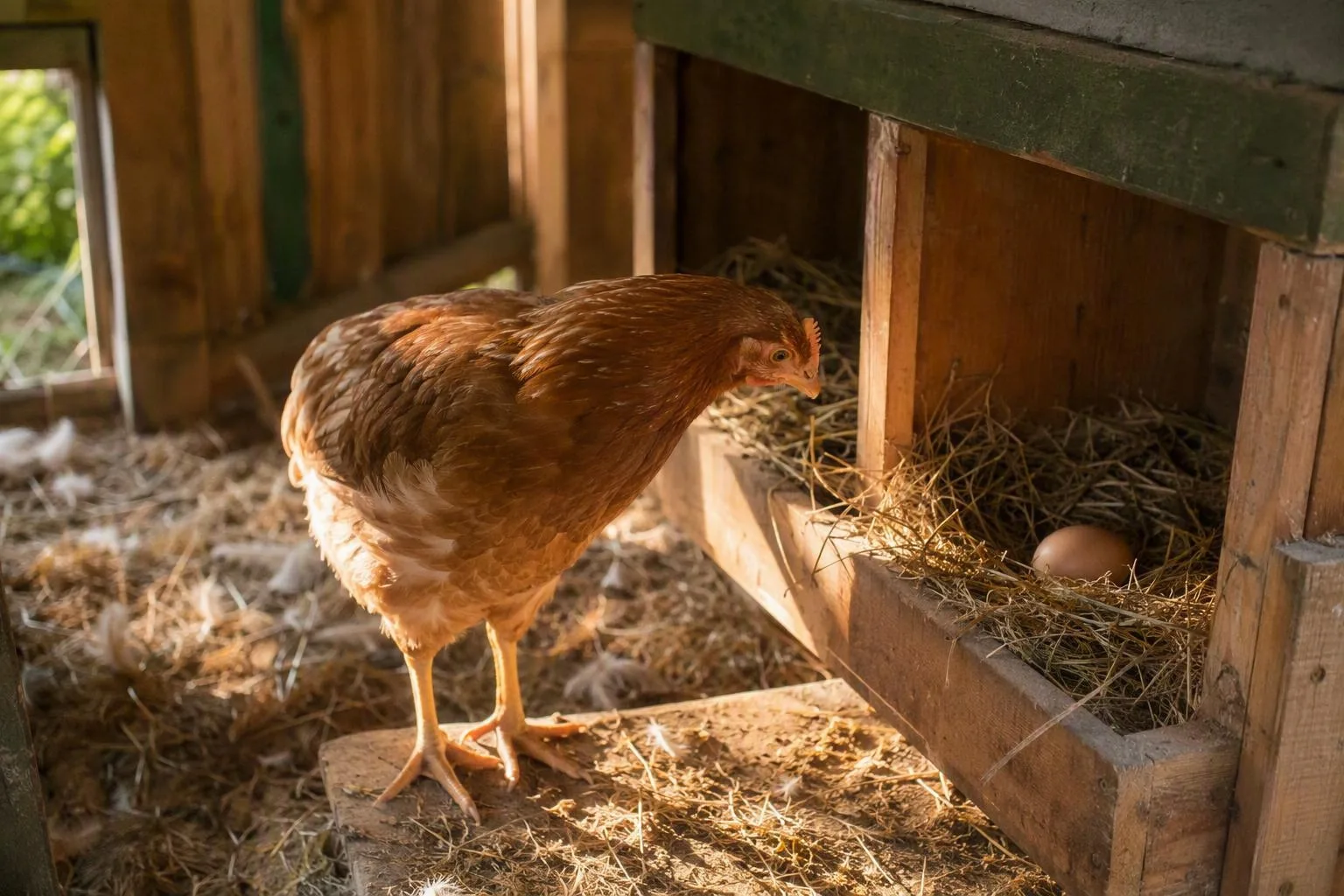
At what age do chickens start laying eggs? Plan on 18–24 weeks
Count from the hatch date, not from the day you brought the pullet home. Sixteen weeks is 112 days. Twenty-four weeks is 168 days. So a chick that arrived at your house at one week old reaches the 16-week mark one week after the date you might first expect if you counted from delivery.
That first-egg age is a window. It isn’t a test your hen passes or fails on one particular Tuesday. Breed, mature size, growth, daylight, feed access, and stress can all move the date. A healthy, active pullet at 24 weeks may simply be developing on the slower side.
A rooster doesn’t set the laying clock. Hens ovulate and lay unfertilized eggs without one. You need a rooster only if you want eggs that could develop into chicks, which is the whole answer to do you need a rooster for eggs: no.
Breed and body size can shift first egg age from 16 to 28 weeks
Use breed information as a planning guide, not a due date. The practical bands I use for a backyard flock look like this:
| Pullet type | Useful planning band | What to expect |
|---|---|---|
| Light egg-type | 16–20 weeks | Often earlier, but individual birds still vary |
| Standard dual-purpose | 18–24 weeks | A sensible range for many ordinary backyard pullets |
| Large or heritage-type | 22–28 weeks or later | Allow more time for a bigger, slower-maturing frame |
Those labels cover a lot of ground. Two birds sold under the same breed name can have different strains, growth rates, and mature sizes. A bird bred primarily for early egg production may reach reproductive readiness sooner than a bird selected for a heavier body or a slower-growing heritage line.
I’d rather know the expected mature size than stare at a calendar. The guide called Backyard chickens breeds can help you compare likely body type before you order chicks. Then write the breed and hatch date on your flock record. That small note will be more useful than a vague promise that a pullet will lay at exactly 20 weeks.
The daylight calendar explains many late-starting pullets
A pullet’s age is counted from her hatch date, but her surroundings can make that age behave differently. A May 1 hatch reaches 20 weeks around September 18. A September 1 hatch reaches 20 weeks around January 19 of the following year. Both birds are the same age on paper. The second bird reaches maturity during a season when natural days are shortening or still short.
Your latitude changes the exact daylight pattern. So does shade from buildings, heavy cloud, and the amount of light that actually reaches the coop. The useful point is not a perfect sunrise table. It’s the direction of change. A pullet approaching maturity as days lengthen may begin sooner than a same-age pullet approaching maturity as days contract.
For backyard planning, I treat shortening days near roughly 12 hours of light as a possible delay signal for some pullets. If you choose supplemental light for mature hens, 14–16 total hours, counting natural and artificial light together, is a practical target used by many keepers to support production. It’s optional. It should not be used to force a small, thin, sick, or visibly underdeveloped bird into laying.
Light also isn’t a repair tool. It won’t correct poor feed access, a frozen waterer, parasites, illness, extreme heat, or repeated predator pressure. Before adding a timer, compare your plan with a university poultry extension service and check whether your local winter conditions make the change worthwhile. In my own small backyard setup, I once circled week 20 as a due date for a light-bodied pullet. She spent that week scratching under the rosemary and gave me no egg. My mistake was treating the calendar as the problem instead of checking her development and the shortening days. Once I stopped pushing the date, the daily checks became calmer and more useful.
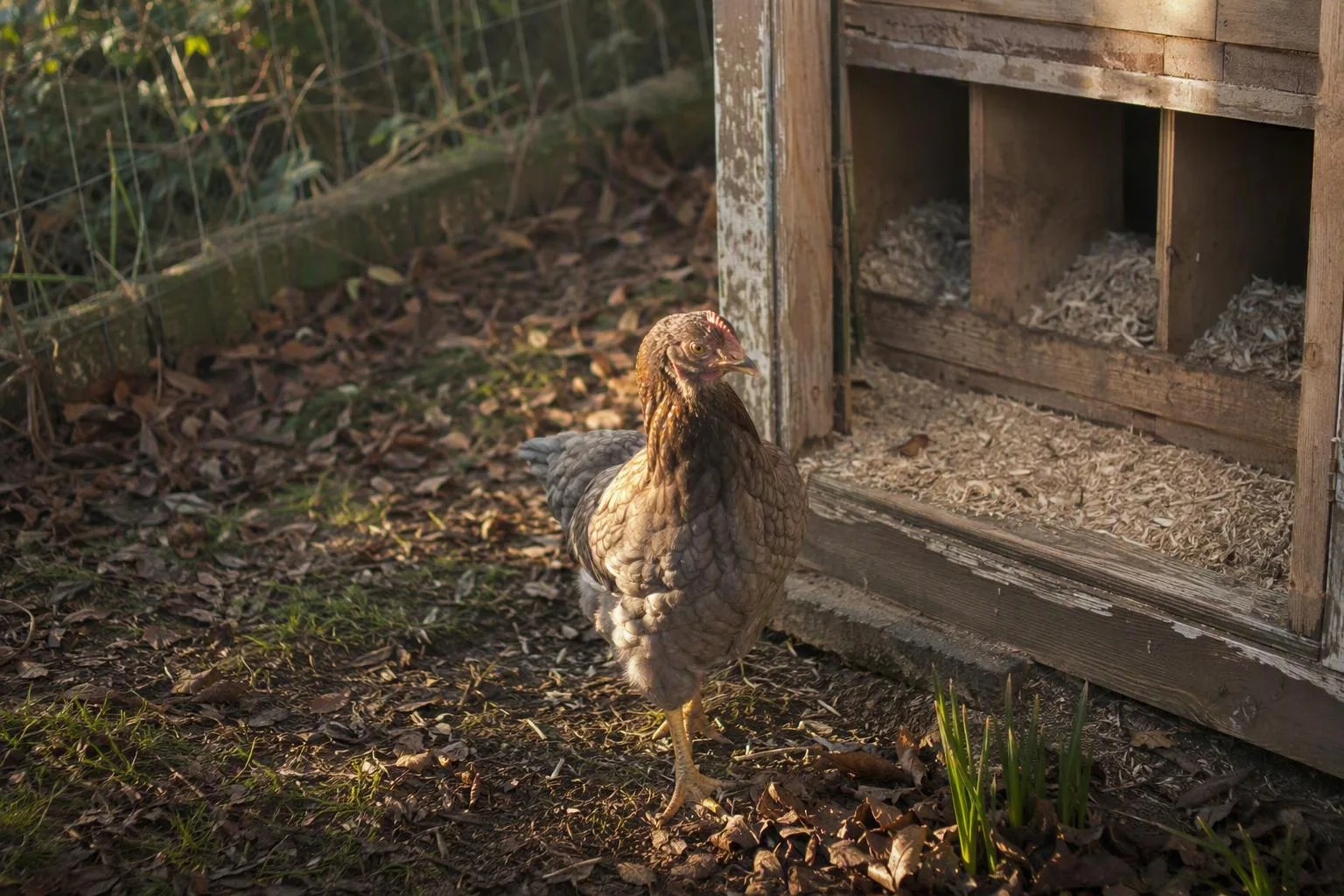
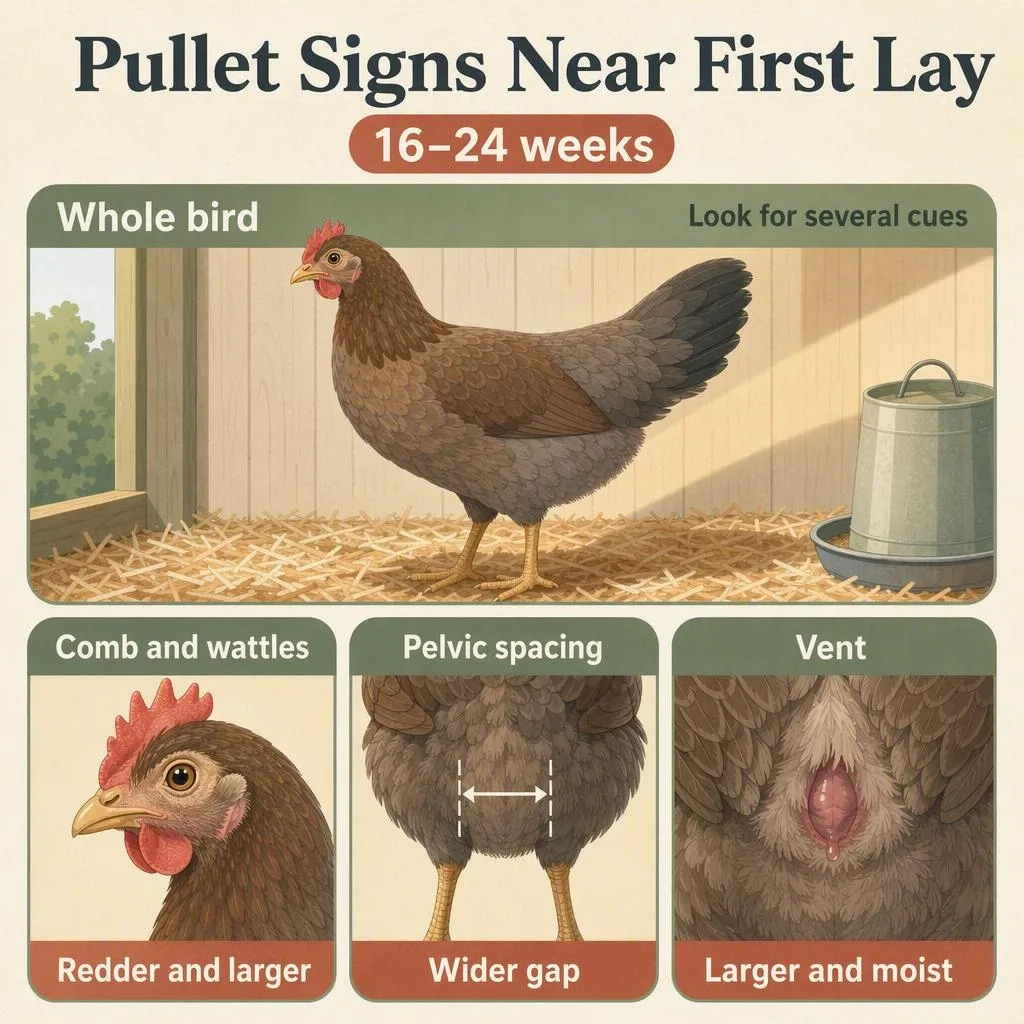
Four signs your pullet is getting close to her first egg
Start with the whole bird, not one bright red comb. A pullet nearing lay often shows several changes at once:
- Comb and wattles: They may become redder, warmer-looking, and fuller as the bird approaches maturity.
- The squat: When you reach gently over her back, she may lower her body and hold still. Don’t chase or pin her to test this. A calm bird that chooses the posture is giving you a better clue.
- Nest interest: She may inspect the nest box, sit in it briefly, or scratch at the bedding instead of ignoring it.
- A wider pelvic area: The bones around the rear of the body may feel less tight than they did in a younger pullet. Some keepers use a two- or three-finger-width check as a rough cue, but it cannot tell you the exact laying day.
Two or more signs together are more useful than a red comb alone. Combs can redden with breed, heat, excitement, or individual variation. If a pullet has a red comb but remains small, avoids the nest, and shows no squat response, I’d keep watching rather than announcing that the first egg is due.
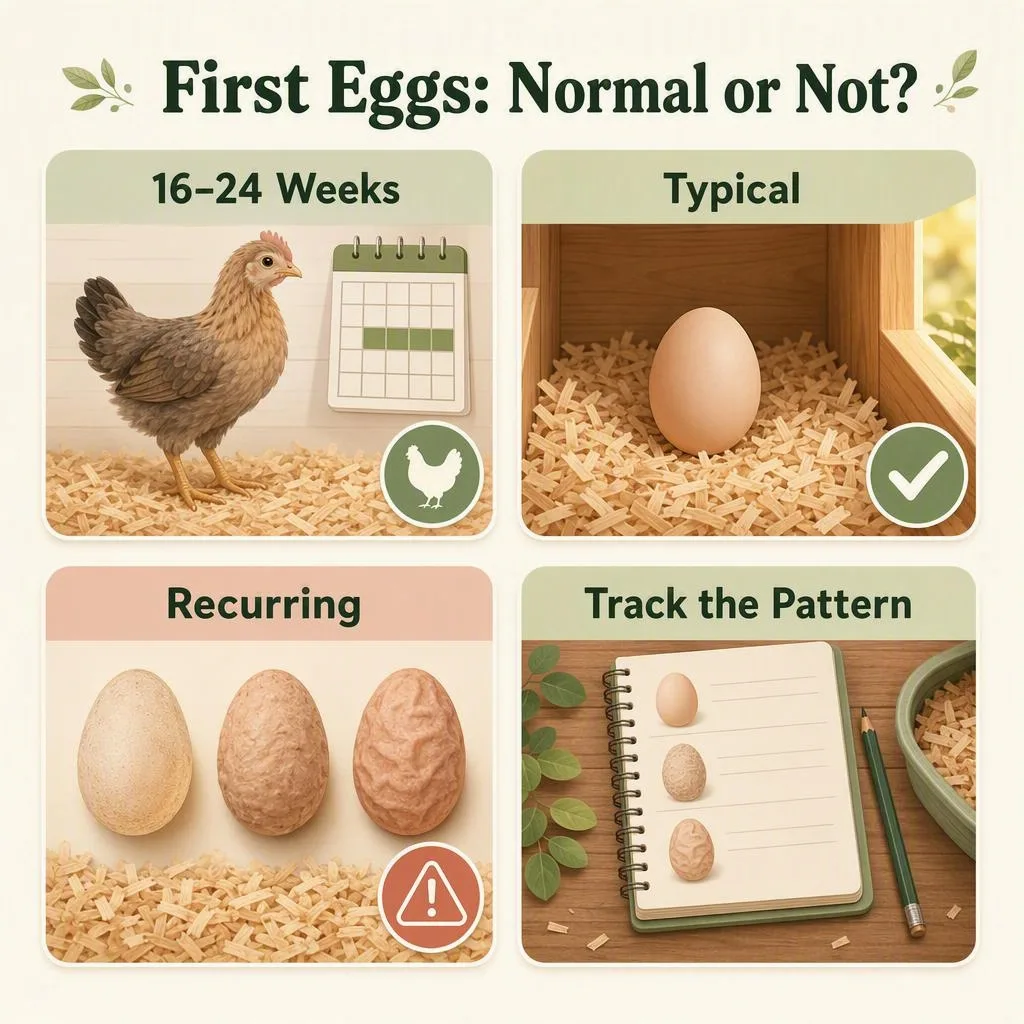
The first 2–4 weeks may bring tiny eggs and an uneven schedule
The first egg is often a little thing. Early pullet eggs may be noticeably smaller than the eggs you’ll collect later. They may also be misshapen, soft-shelled, shell-less, or occasionally contain two yolks. One odd egg during the transition doesn’t automatically mean the bird is ill.
Don’t expect a new layer to produce an egg every morning. Her early schedule may have gaps, and her output may build over the first two to four weeks instead of switching on at full production. Keep collecting and recording what you see. A small first egg followed by a normal egg, then a day off, is a different pattern from repeated shell defects or a bird that looks uncomfortable.
Take repeated problems seriously. Straining, weakness, marked lethargy, a prolapse, or ongoing soft and shell-less eggs deserve prompt advice from a poultry veterinarian. Don’t pull at a stuck egg or start giving calcium products by guesswork. The cause may not be a simple shortage, and a bird in distress needs more than a laying timetable.
No egg at 24 weeks? Run this five-check diagnostic
At 24 weeks, a healthy-looking pullet is not automatically abnormal. I use this order so I don’t jump straight to supplements or artificial light.
- Confirm the record. Check the hatch date and sex. A mistaken age, an uncertain hatch date, or a cockerel in the group changes the answer immediately.
- Check the breed and body type. Compare her with the mature size and usual development of her breed or strain. A large, heritage-type bird belongs at the slower end of your planning range.
- Look at growth and condition. Is she alert, eating, moving normally, and continuing to fill out? Weight loss, a prominent breastbone, poor feather condition, or a sudden drop in activity moves this from a timing question toward a health question.
- Check feed and water access. Make sure she can reach a complete ration and clean water throughout the day. Watch the feeder, not just the feed bag: a timid pullet can be pushed aside by older birds, and a blocked or empty waterer can reduce intake.
- Check light, season, and recent stress. Note whether days are shortening. Then review moving pens, predator pressure, heat, a molt, parasites, illness, or a recent flock change. A bird dealing with one of these may postpone normal reproductive activity.
If those checks pass, give a slower bird more time and recheck around 28 weeks. That is a sensible second checkpoint for many large or late-season pullets, not a universal cutoff. If she is losing weight, persistently diarrheic, struggling to breathe, repeatedly straining, or showing a prolapse, contact a poultry veterinarian rather than trying to make her lay.
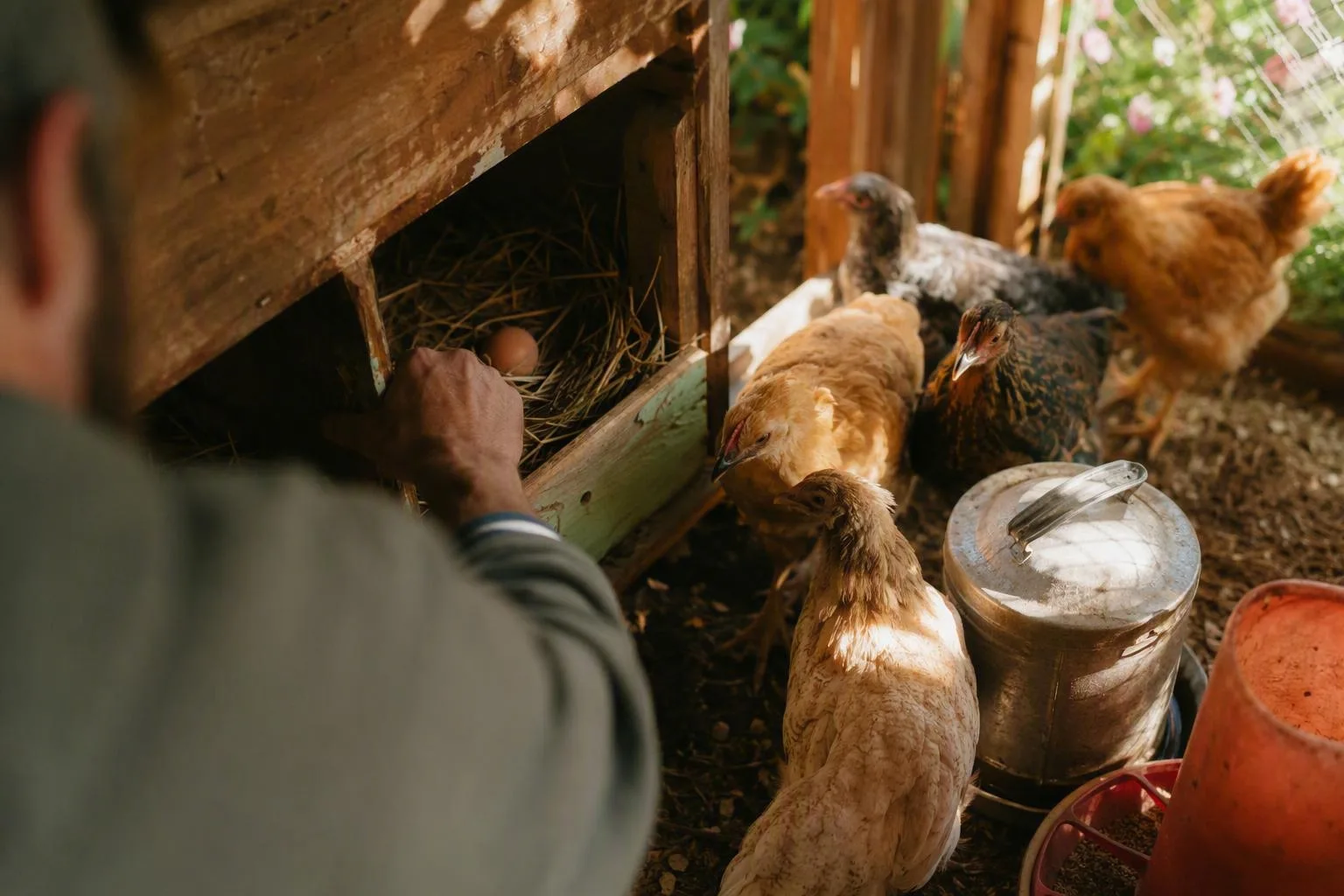
Prepare the 16-week handoff: feed, shell calcium, nest space, and records
At 16 weeks, write down each pullet’s hatch date and breed. Keep a complete grower or developer ration available according to the feed label, with clean water that doesn’t run out overnight. Feeds differ, so the bag’s transition instruction beats a generic calendar.
At the first egg, or at the timing printed on your product label, move the laying birds to a complete layer ration. Offer oyster shell in a separate dish rather than mixing extra calcium into the whole flock feed. That lets the laying hens choose shell material without turning every ration decision into a guessing exercise for younger birds.
For feed budgeting, I use roughly 90–120 grams of complete feed per adult laying hen per day. That is a planning range, not a promise of exact consumption. Bird size, forage, cold weather, spillage, and rodents can move it. Four hens at that rate use about 10.8–14.4 kilograms in 30 days before waste, so check your current local bag price when you build the monthly budget.
Plan one nest box for about three to four hens. More boxes can still help if one bird guards the favourite corner. If you’re measuring a box or rebuilding one, chicken nesting box size is the useful detail to settle before the first egg arrives.
Start a 14-day log. Record the first egg, any gaps, shell quality, weather, daylight, and visible stress. A log turns a vague worry into a pattern you can act on. For the wider setup, raising backyard chickens for eggs is the neighbouring plan to review once your pullets move from grower feed to the laying routine.
Three quick questions about first eggs
Do chickens need a rooster to start laying eggs?
No. A hen can lay unfertilized eggs without a rooster. You need a rooster only when you want fertile eggs for hatching.
Can you eat a pullet’s first egg?
A small or unusual first egg is not, by itself, a food-safety test. If it is clean, intact, and handled according to your local food-safety guidance, you can treat it as a kitchen egg. Discard cracked eggs and eggs with heavy contamination rather than trying to make them safe by washing harder.
Can you incubate a chicken’s first eggs?
Only eggs from a hen that has mated can be fertile. First eggs are often undersized or irregular, so I’d save planned hatching for clean, normally shaped eggs after the pullet’s pattern has settled. For the 16-week handoff this week, make the record, inspect the feeder and waterer, refresh the nest bedding, and mark the date you’ll review the log.
Frequently Asked Questions
Do chickens need a rooster to start laying eggs?
No. Hens ovulate and lay unfertilized eggs without a rooster; a rooster is only needed if you want fertile eggs for hatching.
Can you eat a pullet's first egg?
Usually, yes, if the egg is clean, intact, and handled according to local egg-safety guidance. A small or unusual shape is not by itself a food-safety test; discard cracked or heavily contaminated eggs.
Can you incubate a chicken's first eggs?
Only eggs from a hen that has mated can be fertile. First eggs are often undersized or irregular, so planned hatching is better suited to clean, normally shaped eggs after the pullet's laying pattern has settled.