Chickens and Dogs: 7 Steps to Safe Backyard Introductions
Your dog can look perfectly settled until a hen bolts. That one wingbeat can change a loose, sniffing dog into a chasing dog, which is why chickens and dogs need a staged introduction rather than a hopeful nose-to-beak meeting. The safe target isn’t friendship. It’s a dog you can interrupt and a flock that always has somewhere to go.
For a backyard flock, that means seven small decisions: screen the dog, build the barriers, work at distance, and treat every shared-space session as temporary until your control is boringly reliable.
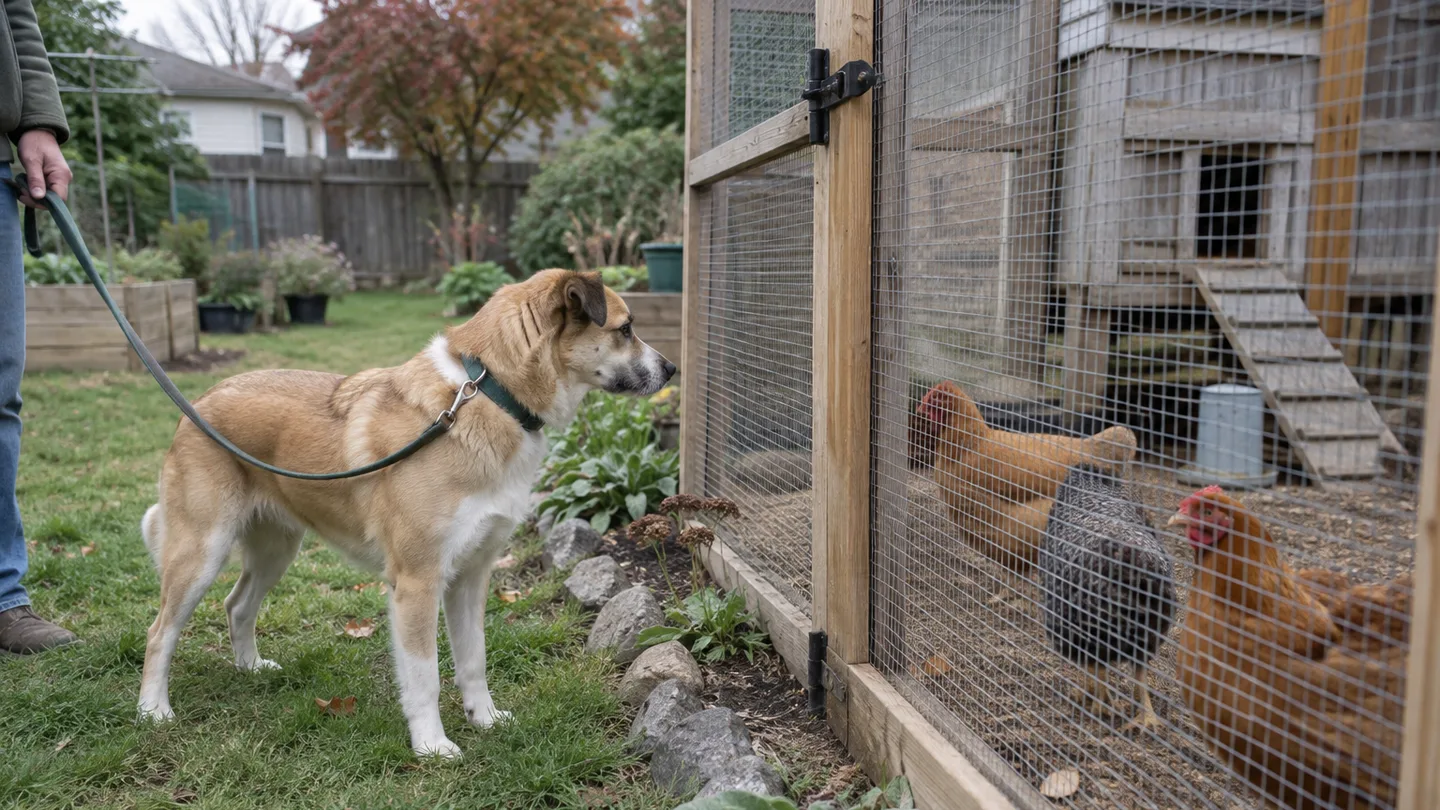
Before Step 1: screen the dog and set the no-contact line
Start with a go/no-go screen, not an introduction. Ask whether your dog has chased, pinned, grabbed, or killed a small animal before. Squirrels, rabbits, cats, and escaping birds all count as useful evidence. Then watch what happens when you say the dog’s name near an exciting distraction. Can your dog turn back to you? Can the body soften? Can the dog settle without whining, stalking, or pulling?
Proceed only when one adult can control the dog on a fixed 6-foot leash and end the session without being dragged toward the flock. Your minimum setup is secure physical separation, a leash that does not extend, and a clear stop rule: at the first hard stare, crouch, stalk, lunge, or chase, you create distance.
A dog with a history of grabbing small animals, or one that cannot disengage even behind a fence, may belong in a barrier-only plan. That isn’t a failed introduction. It may be the safest long-term answer. If you’re unsure how to read the behaviour, bring in a qualified behaviour professional before testing shared space.
Step 1 — Build two secure zones before the first meeting
Before your dog sees a chicken, walk the entire yard as if you were trying to escape from it. Find gaps under gates, loose corners, climbable panels, weak latches, and places where a nose or paw can reach through. The flock needs a reliable run or coop zone. The dog needs a separate route, holding area, or room where you can put the dog without walking through the birds.
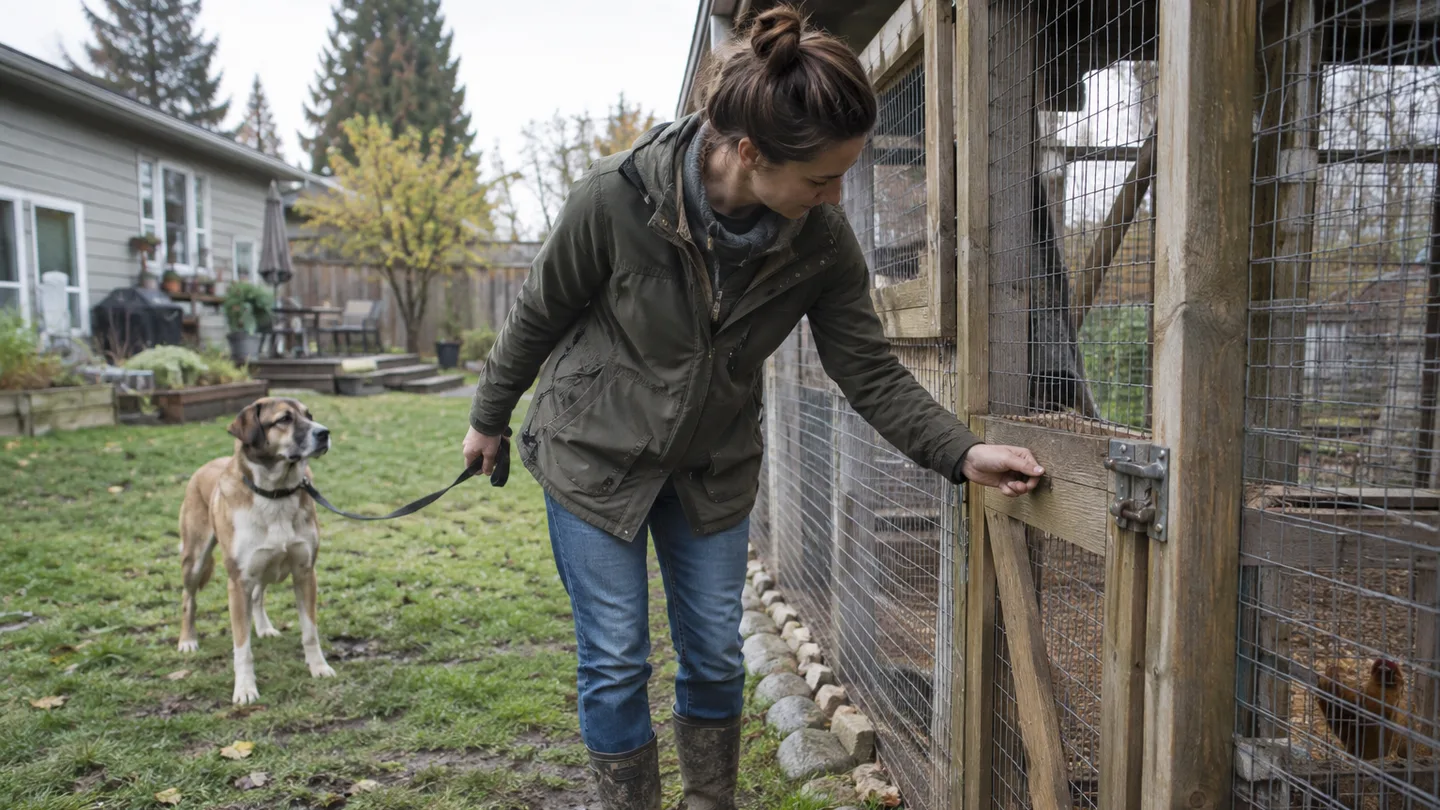
I don’t treat ordinary chicken wire as a dog-proof barrier. It can help contain calm hens, but it is not the part I’d trust to stop a determined dog leaning, digging, or pushing. Rigid framing, secure posts, suitable hardware cloth, and solid panels at dog level matter more than choosing a mesh label and assuming the job is done.
Check the gate from both sides. Can you close it with one hand while holding the leash? Does the latch resist a shoulder bump? Can a chicken reach a narrow escape space without being trapped against a fence? Use your existing chicken coop requirements as the starting checklist. Treat the barrier as part of your best chicken predator protection plan, not a separate chore.
Step 2 — Start with scent and sight through the fence for 5–10 minutes
The first meeting should be scent and sight through a secure barrier. Keep the dog far enough away to notice the flock without locking on. A 5–10 minute session is a workable starting window, not a target to endure. If the dog is calm after two minutes, you can finish there. Short, successful repetitions teach more than one long session that ends with a lunge.
Reward a soft body, a glance away, a response to the name, and the ability to take a treat. If the dog will not eat, the distance is probably too short or the excitement is too high. Your hens should still be able to scratch, eat, perch, and move away. Birds pressed into a corner, piling against the fence, or freezing in place are telling you to stop.
Step 3 — Work from 15–20 feet down to the run gate
Once several barrier sessions are boring for both sides, begin at roughly 15–20 feet from the run with the dog on a fixed 6-foot leash. Go farther if your dog cannot look away at that distance. Hold the leash with enough slack for ordinary movement, then reward check-ins before the dog reaches the end of it.
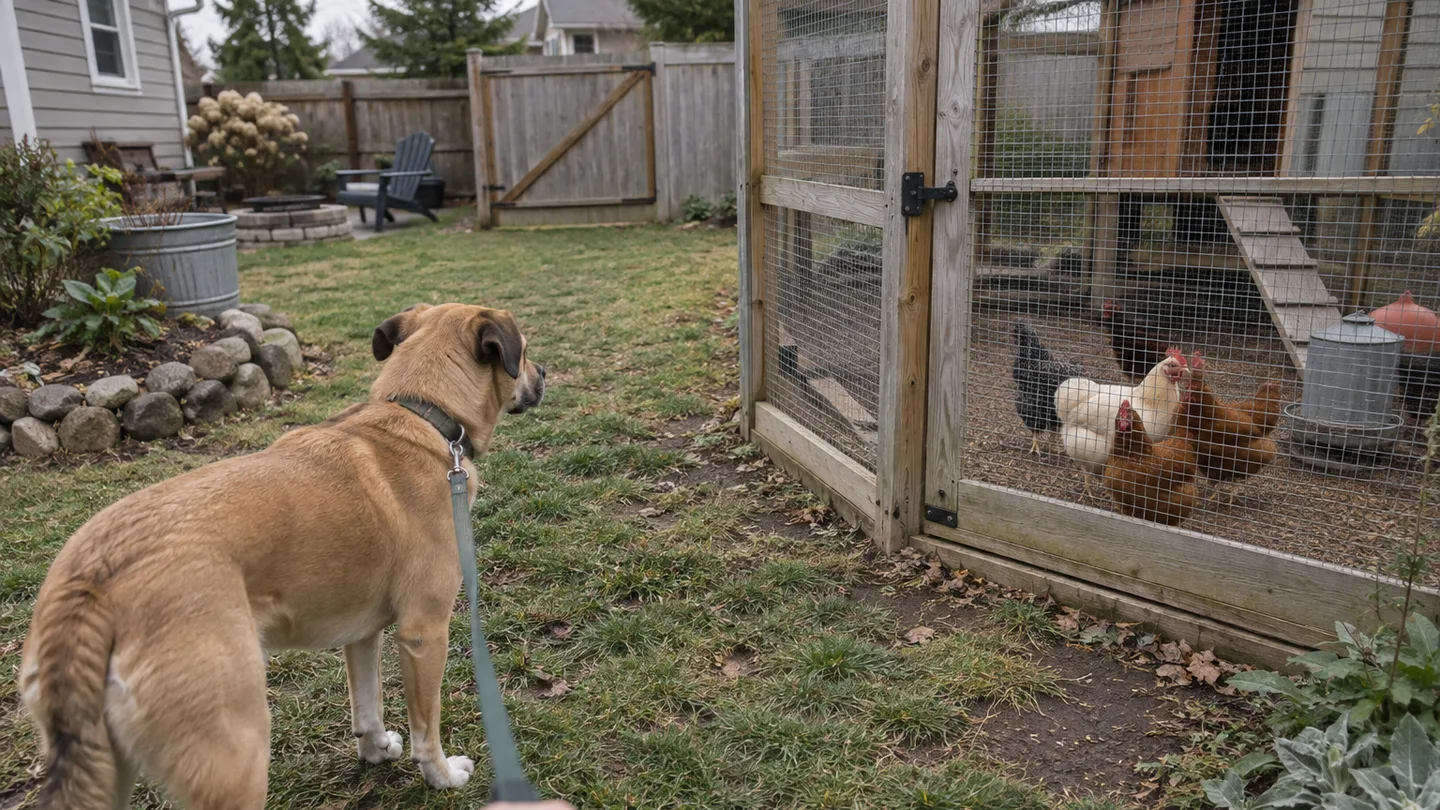
Close the gap in small increments. I’d rather repeat a comfortable distance over several sessions than move to the gate because the dog happened to stand still once. At each new distance, look for loose movement, a response to the name, and the ability to turn away from the birds. If those disappear, return to the last distance where they were present.
A retractable leash gives the dog changing line length and extra speed at exactly the wrong moment. Leash corrections can also add tension without teaching the dog what to do instead. Your useful tool here is information: if the leash goes tight, you know the distance or difficulty needs to change.
Step 4 — Walk past the run while the chickens keep an exit
Stationary watching is not the same as passing a flock. Keep the hens behind the barrier and walk parallel to the run for two to five passes. Cap an early session at about 10–15 minutes, then leave while the dog can still respond and the birds are behaving normally.
Progress looks plain. The dog can pass without pulling, stalking, or staring. The hens keep eating, scratching, perching, or moving away rather than bunching at the far end. If the dog starts leaning into the leash, or the birds stop their normal activity, widen the distance and reduce the number of passes next time. Read how much space do chickens need before you build escape routes around a narrow run; room to move is part of the training setup.
Step 5 — Try 2–5-minute shared-space sessions, still with a leash
Only after repeated calm barrier work should you try the same larger area. Keep the dog leashed. Have a second adult present if you can. Give the chickens more than one route away from the dog, and avoid corners, tight garden beds, and narrow passages. Never hold a chicken up to the dog or force nose-to-beak contact.
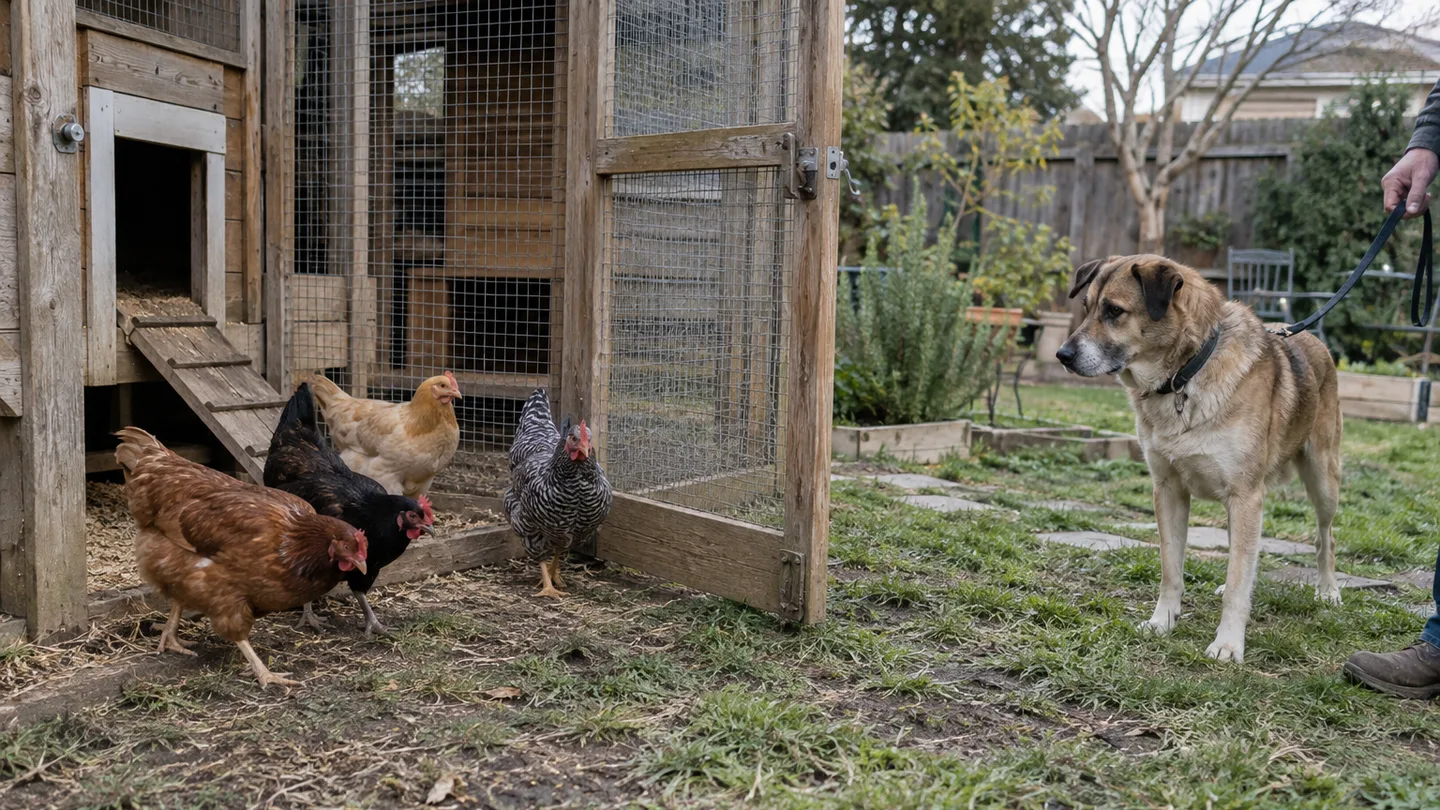
In my own backyard setup, I had four hens and an adult mixed-breed dog. I walked him past the run at about 20 feet for several sessions, then tried a small shared patch of grass with a 6-foot leash. For the first minute he sniffed. Then one hen burst from behind a board. His head snapped around and his body went rigid. I backed him out before the leash went tight, put the gate between us, and ended the session.
The next attempt began at the run gate, not in the grass. The result wasn’t a magical friendship; it was useful information. He could walk past with me, but I still didn’t trust him loose. That is a valid result. Shared-space progress can take days or weeks, and no calendar says your flock is ready on a particular day.
Step 6 — End the session at the first chase signal, not after the chase
Fixation, crouching, stalking, hard staring, barking, lunging, or a sudden panic-flap from a hen is your reset point. Don’t wait to see whether the dog settles while close to the birds. Use this sequence:
- Create distance without running or jerking the dog toward the flock.
- Move behind a secure barrier and close it.
- Check the hens for limping, bleeding, shock, or a bird unable to stand normally.
- Change the next session by adding distance, shortening the time, choosing a quieter location, or returning to fence work.
Punishing after the chase cannot undo the chase. It may add more excitement around the birds without giving your dog a replacement behaviour. If a dog has bitten or punctured a chicken, separate the bird in a quiet box and contact an avian or farm vet promptly. Feathers can hide small punctures, so use poultry veterinary guidance on bite and puncture injuries in chickens rather than relying on a quick surface check.
Repeated chasing, grabbing, or an inability to disengage is the point to stop home introductions. Compare your plan with veterinary behaviour guidance on prey drive, desensitisation, and counterconditioning, then decide whether permanent separation is the responsible answer.
Step 7 — Make coexistence conditional, never assumed
The safe final rule is simple: loose together only when an adult can intervene immediately. Otherwise, use physical separation. That applies to normal afternoons as well as visitors, feeding time, open gates, deliveries, children moving through the yard, and any moment when the dog is already excited.
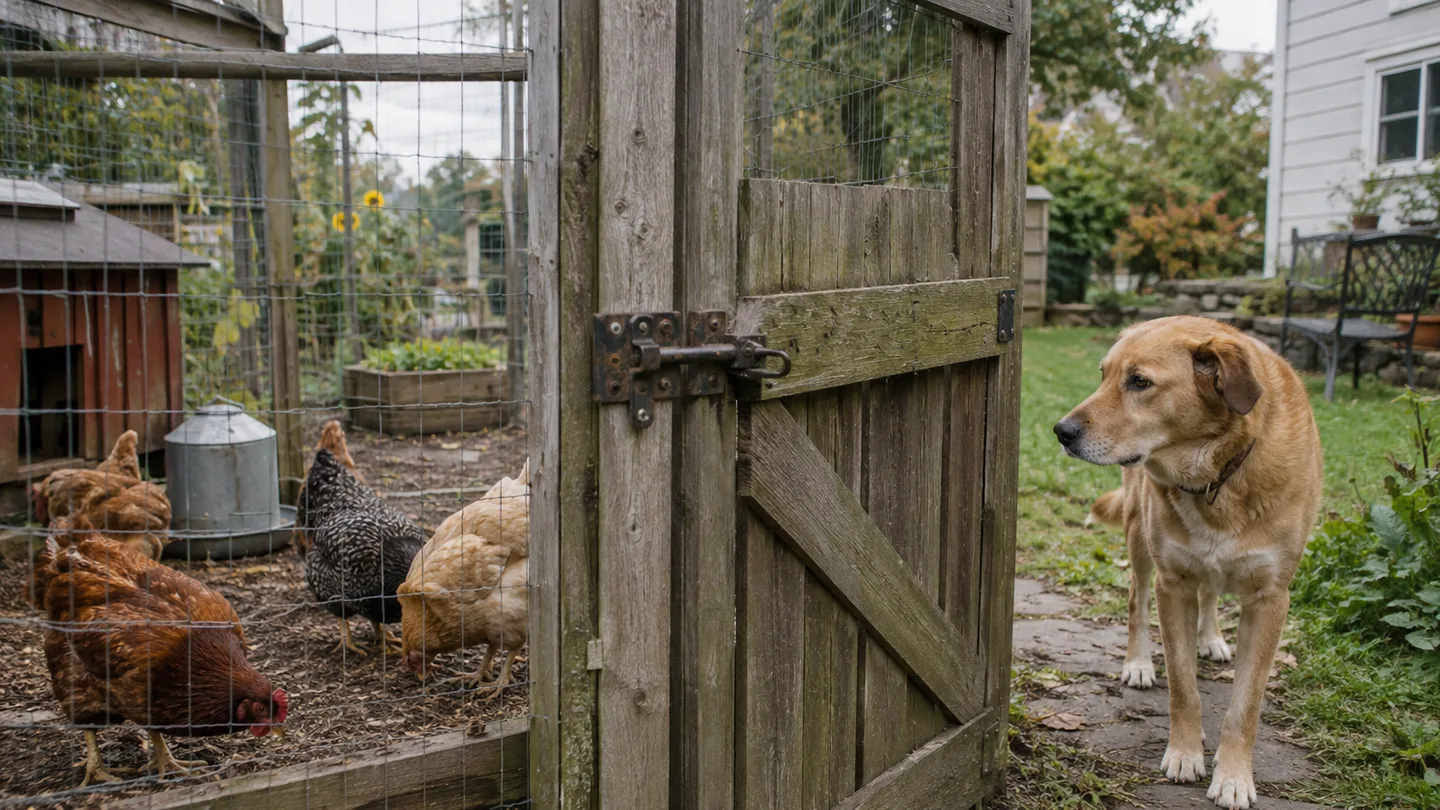
Keep the routine in three parts: supervise when the dog and hens share an area, separate them whenever nobody is watching, and inspect the barrier before releasing either side. A calm week does not erase a dog’s interest in chasing. One successful session does not prove that a sudden wing flap, noisy visitor, or loose gate will be handled safely.
If you plan to keep free range chickens, make the dog’s separation system part of the design from the beginning. My preferred decision rule is conservative: if you cannot reach the dog within a few seconds, the dog and chickens are not loose together.
The rule I keep: trust the setup more than the mood. A calm dog is encouraging. A closed gate is dependable.
FAQ: three questions before the gate opens
Can I use a muzzle during a dog-and-chicken introduction?
A properly conditioned basket muzzle may add a safety layer for some dogs, but it does not replace a barrier, a fixed leash, supervision, or behaviour work. Don’t use a muzzle to justify a close or unsupervised test. The dog still needs to learn how to disengage, and the hens still need room to escape.
Should I introduce the dog to one chicken or the whole flock?
Start with the flock behind a secure barrier. Avoid holding one bird up to the dog. An isolated chicken cannot choose distance, and being carried toward a predator-shaped animal can create panic rather than useful information.
What if my dog is calm at home but chases squirrels, cats, or rabbits outdoors?
That chasing history matters. Begin with barrier-only management and work farther away, where your dog can still respond to the name. If you cannot build calm disengagement, get qualified behaviour guidance before attempting shared space.
This week, spend 15 minutes checking every run gap, latch, and dog-side route. Put a fixed 6-foot leash by the door, then practise name-and-turn-away exercises well away from the flock. Don’t release the dog as a test. Build the part of the setup that will still work on a distracted day.
Frequently Asked Questions
Can I use a muzzle during a dog-and-chicken introduction?
A properly conditioned basket muzzle may add a safety layer for some dogs, but it does not replace barriers, a leash, supervision, or behaviour work; never use it to justify a close or unsupervised test.
Should I introduce the dog to one chicken or the whole flock?
Use the flock behind a secure barrier first and avoid holding one bird up to the dog; isolating a chicken can increase panic and removes the bird's ability to choose distance.
What if my dog is calm at home but chases squirrels, cats, or rabbits outdoors?
Outdoor chasing is relevant evidence of prey behaviour, so start with barrier-only management, work farther away, and consider professional behaviour guidance before attempting shared-space contact.