Free Range Chickens: How Much Yard Space Do They Need?
Plan on 100 square feet of usable outdoor area per hen as a practical starting point. If you want grass and forage to survive more than a short burst of ranging, plan closer to 200–250 square feet per bird. Those figures answer the space question, but they don't answer whether your soil drains, your garden survives, or your birds can retreat from a hawk.
A backyard flock needs three separate footprints: indoor coop space, a secure run, and ranging ground. Treating one as a substitute for another is how a spacious-looking setup becomes muddy, damaged, or exposed.
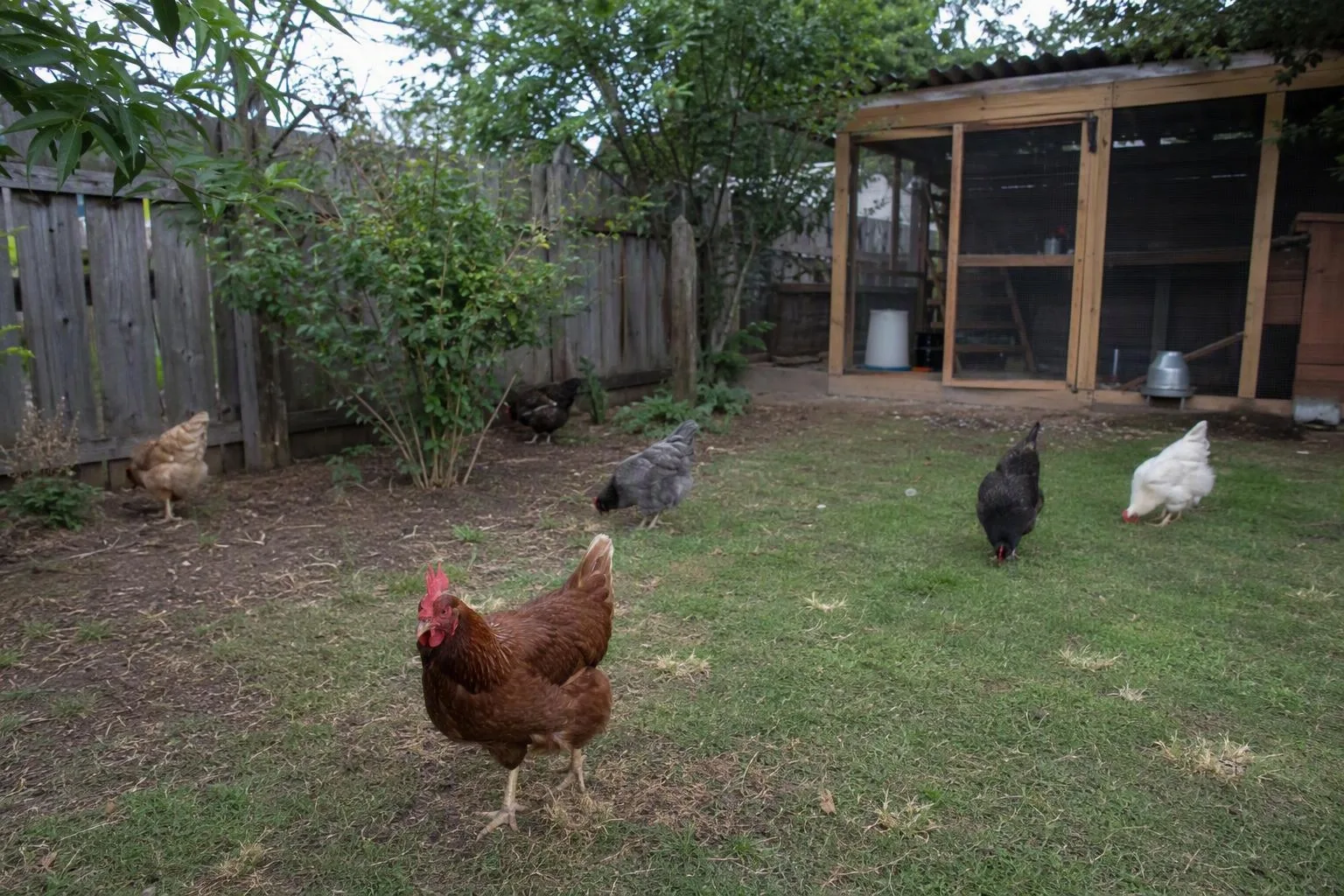
Begin with 100 square feet per hen—but don’t stop there
Start with the usable ground your birds can actually reach. The useful question behind how much space do chickens need is not your lot’s advertised size. It’s the safe, reachable area that remains after you remove the flower beds, driveway, poisonous planting, steep corners, locked gates, and places where runoff collects.
Use 100 square feet per hen when you need a workable starting plan for daytime access. Use 200–250 square feet per hen when preserving grass and forage is part of the goal. The larger range gives plants more opportunity to recover between visits. It does not turn free-ranging into a zero-maintenance arrangement.
These are planning figures, not universal legal limits or a guarantee that every flock will thrive at the same density. Soil, rainfall, shade, breed activity, flock size, and the number of hours your birds are outside can move the practical answer. I count only ground your birds can reach safely and use repeatedly, not a pretty strip behind a locked gate.
Keep the indoor and secure areas separate in your plan. A planning baseline of about 4 square feet of indoor floor area per bird and 8–10 square feet of secure run area per bird gives your flock somewhere dry and protected when the yard is wet, frozen, stripped, or unsafe.
Free range has three backyard meanings
People use free range to describe several backyard systems. Decide which one you mean before measuring. Full-yard access, a fenced ranging area, and supervised sessions have different trade-offs.
| Backyard model | What your birds do | What changes |
|---|---|---|
| Full-yard access | They use most of the safe property during the day. | More forage and choice, but more garden damage and exposure. |
| Fenced ranging area | They range inside a defined outdoor section. | Easier rotation and monitoring, with less total ground. |
| Supervised or scheduled access | They range for selected periods, then return to the run. | You can avoid traffic, wet ground, or high-risk times. |
None of these models removes the need for a secure retreat. A run is not a failure of free-ranging. It is the part of the system that lets you say no to a storm, a loose dog, a busy road, or dusk.
Run the numbers for 3, 6, or 12 hens
The three layers should be calculated separately. Do not subtract secure-run space from the ranging allowance. The run protects your birds and the ground under difficult conditions. The yard gives them room to choose, scratch, forage, and spread out.
| Flock | Indoor floor baseline | Secure run baseline | Ranging start at 100 square feet per hen | Forage-focused range at 200–250 per hen |
|---|---|---|---|---|
| 3 hens | 12 square feet | 24–30 square feet | 300 square feet | 600–750 square feet |
| 6 hens | 24 square feet | 48–60 square feet | 600 square feet | 1,200–1,500 square feet |
| 12 hens | 48 square feet | 96–120 square feet | 1,200 square feet | 2,400–3,000 square feet |
These are floor-area baselines, not complete coop plans. Your coop still needs dry bedding, useful ventilation without a direct draft on the roost, stable roost space, nest boxes, and protection from rain and wind. A large floor with stale, damp air is not a good trade.
Here is the simple calculation. Multiply flock size by 4 for an indoor planning baseline. Multiply it by 8–10 for a secure run. Multiply it by 100 for a starting ranging area, or by 200–250 if ground recovery matters. Keep the units in square feet throughout. A 20-by-20-foot yard is 400 square feet, but paths, beds, and inaccessible corners may reduce its usable area sharply.
The ground, not the tape measure, tells you when space is short
Raw area is only a rough measure of carrying capacity. Rain turns compacted clay into mud. Poor drainage keeps a shaded corner wet. Summer drought slows regrowth. Heavy shade can leave plants thin even when the yard looks large on a plan. A flock that stays outside all day puts more pressure on the same soil than a flock that ranges for two hours.
Breed and individual activity matter too. Quiet birds may disturb a patch more slowly than active scratchers, but every flock concentrates traffic at the gate, feeder, waterer, dust bath, and favorite shade. Design those high-use points rather than pretending the whole yard receives equal use.
- Bare soil around the feeder: move the station, add a cleanable surface, or spread stations across zones.
- Persistent mud: improve drainage, roof the high-traffic area, add a suitable surface, or shorten access until the ground firms.
- Manure buildup: move water and feed points, remove soiled material, and give that patch recovery time.
- Stripped vegetation or no regrowth: rotate sooner, enlarge the usable area, or return your birds to the secure run for longer periods.
A bare ring under a gate can be a normal high-traffic patch. Bare soil across the active yard, standing mud after ordinary rain, and vegetation that never returns are different signals. They show that the current area or schedule is asking more of the ground than the ground can replace.
Make a small yard work with zones, shade, and recovery time
Two zones are a useful minimum for a smaller backyard. Three give you more flexibility. The goal is not to make a small property look like pasture. It is to stop your birds from using the same square feet every day.
Put temporary poultry fencing across the yard and make one zone active while another rests. Move your birds before the soil is stripped, not after. Each active zone needs dependable water and shade. If the waterer sits in the only shaded corner, your birds will repeatedly cross the same route to reach it. That route will wear first.
Recovery time follows weather rather than a fixed calendar. Fast spring growth may let a rested patch show recovery within days. Hot, dry weather or prolonged wet conditions may stretch that recovery to several weeks. Check for living cover and stable soil before reopening a zone. If footprints still expose bare soil or rain immediately forms puddles, the patch is not ready.
When the yard cannot support all-day access, use a secure run as the dependable base and offer short supervised ranging sessions. That arrangement is less romantic than leaving a gate open, but it gives you control over ground damage and predator exposure. My judgment is that a smaller yard with gates and recovery time is a better plan than a larger yard treated as bottomless pasture.
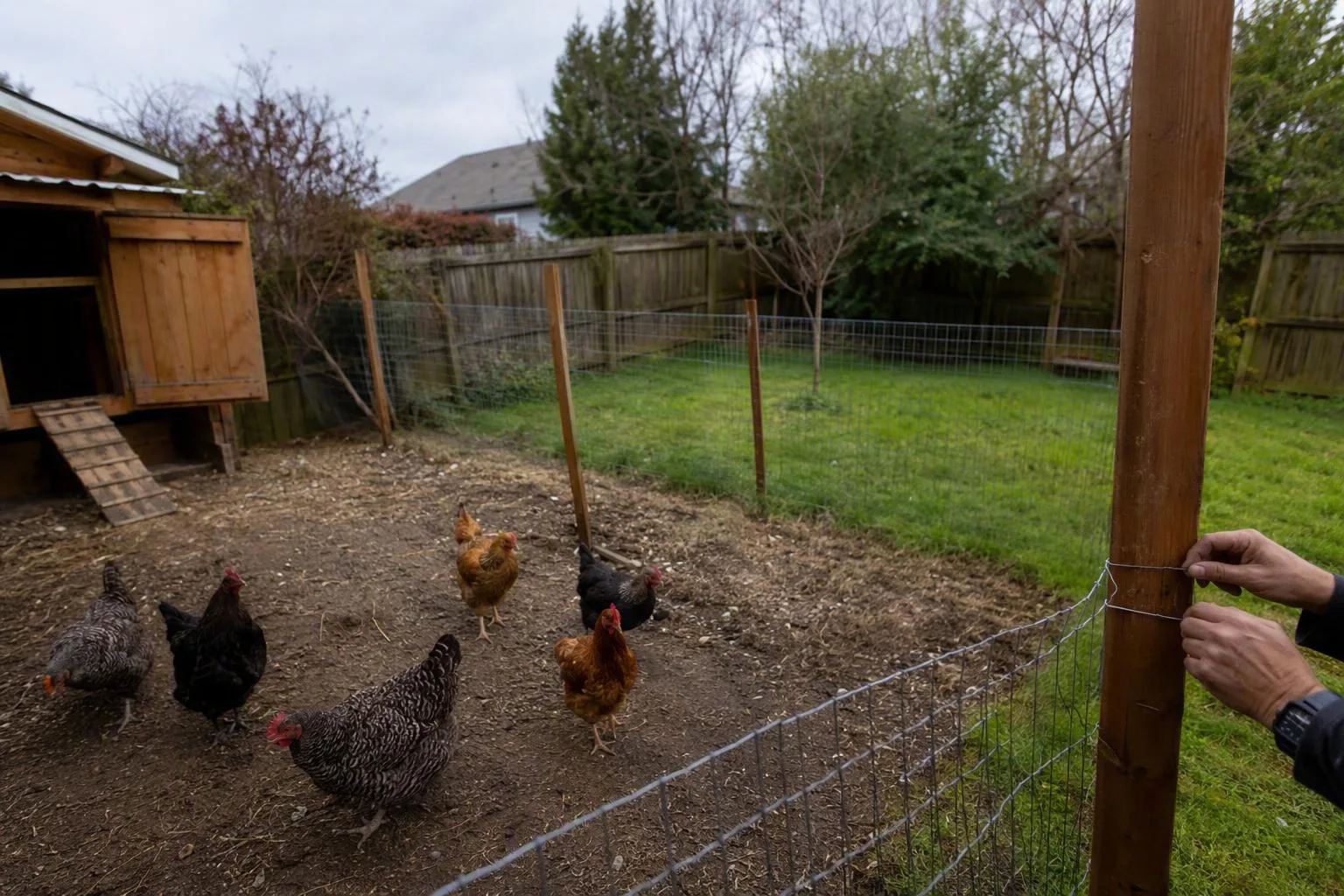
The boundary is set by predators, roads, and neighbors
Free-ranging increases exposure. It never replaces a secure retreat. Local predator pressure varies, so a plan that works on one suburban street may be too open for a property beside woodland, a dog path, or a busy road.
Hawks use the air above an open yard. Dogs and foxes test the perimeter. Raccoons may be more of a dusk or nighttime concern around openings, doors, and loose hardware. Traffic and neighboring property become risks when your birds can leave the intended area. You don't need to predict which threat will appear. You need a setup that limits several routes of approach.
For a practical barrier, use a roofed or netted run, small-opening hardware cloth on vulnerable walls and openings, and a dig-resistant perimeter. Pay attention to the door, corners, vents, and the ground line. Confine your birds from dusk through the night, and use the run whenever you cannot monitor changing conditions.
I treat ordinary chicken wire as bird containment, not full predator protection. It can keep your birds in a defined area, but it is not the part of the system I'd trust as the sole barrier against a determined dog, fox, or raccoon. The guide to best chicken predator protection is useful for checking the run before you offer more yard access.
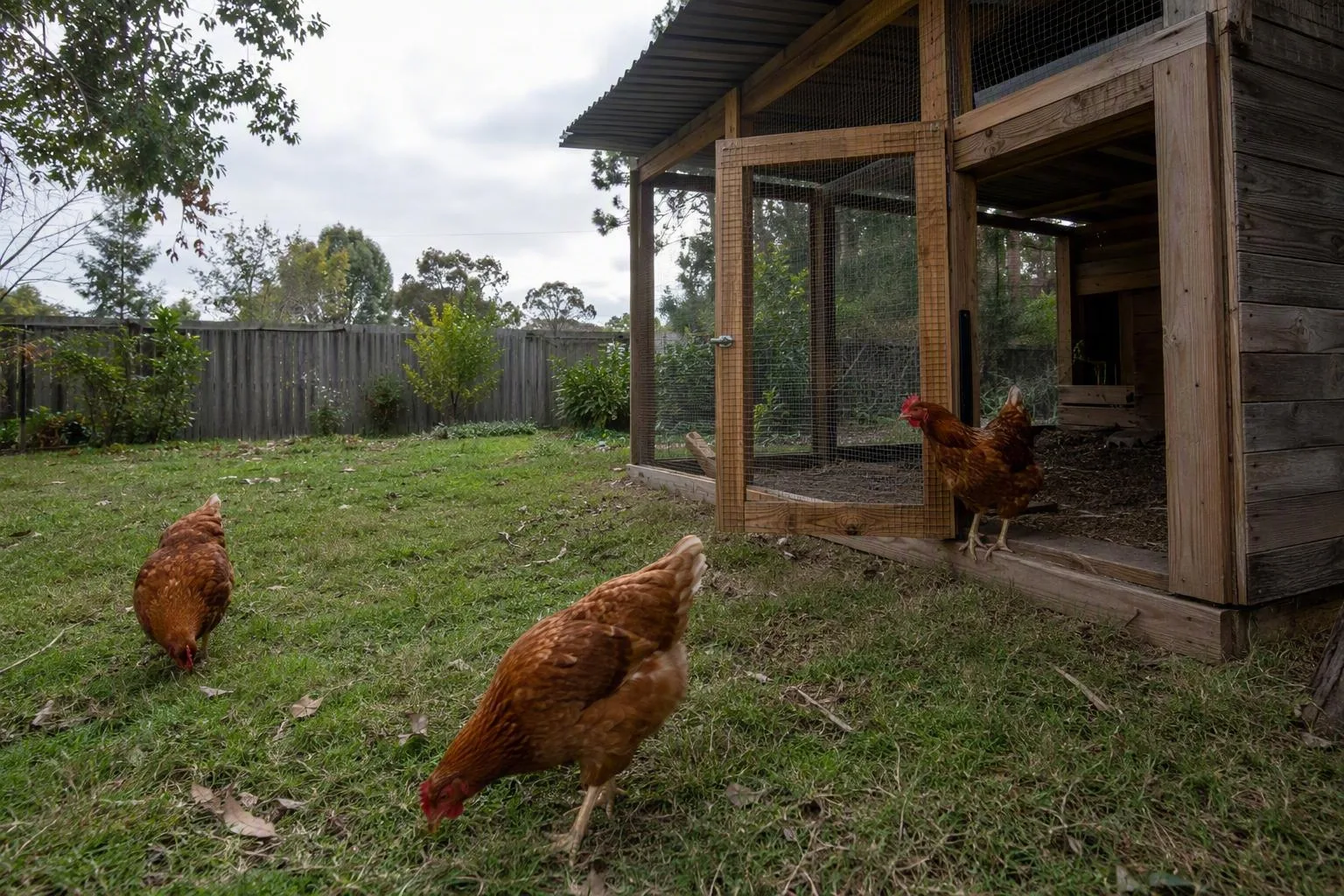
Protect your lawn and garden before the birds arrive
Free range is not lawn service. Your birds will scratch through loose mulch, make dust-bathing hollows, leave manure near favored routes, and investigate soft plants. Seedlings and freshly turned beds are especially easy to damage because loose soil invites scratching.
Fence the garden before your birds arrive, rather than trying to teach a hen that one bed is off-limits. Put feeders and waterers on pavers or another surface you can clean. Designate a sacrificial patch for scratching and dust bathing. A replaceable ground surface is easier to manage than a treasured border that receives daily traffic.
Grass and insects can add variety, but they are variable supplements. Free-ranging should not be budgeted as zero feed or treated as a replacement for a complete ration suited to your birds’ age and production stage.
Before buying birds, check local municipal zoning, animal-control, and poultry-roaming rules. Depending on the jurisdiction, rules may address flock size, setbacks, roosters, coop placement, or whether birds may cross the property line. Also look for government or extension guidance on backyard chicken housing before you finalize ventilation and weather protection.
Use this property decision tree
Use these questions in order. A no answer doesn't automatically end the project. It tells you which part of the system needs to change.
- Do local rules allow your plan? If not, stop and resolve the rule before ordering birds. If the answer is unclear, ask the relevant local office for the current wording.
- Can you provide the indoor and secure-run baselines? If yes, your birds have a protected fallback. If no, solve housing before treating yard access as the answer.
- Do you have at least 100 square feet of genuinely usable outdoor area per hen? If yes, test it against drainage, shade, gardens, and predator routes. If no, plan for a managed run with limited ranging rather than calling the whole property pasture.
- Can water and shade remain available in every active zone? If not, redesign the route or add another station. A zone that requires your birds to cross a risky or muddy area is not fully usable.
- Can you confine your birds when risk rises? If yes, scheduled ranging is possible. If no, use a more secure outdoor system and keep the open-yard portion smaller.
Consider three hens in a 20-by-20-foot yard. The total is 400 square feet, which clears the 300-square-foot starting figure on paper. If a garden, path, and inaccessible strip consume 120 square feet, only 280 square feet remains. That misses the starting allowance and is well below the 600–750 square feet I'd use for a forage-focused plan.
The smaller yard is not automatically impossible. It can work as a secure, enriched run with shade, a dust-bath area, perches, cleanable surfaces, and occasional supervised access. The mistake is promising yourself all-day free-ranging when the ground and barriers can support only managed use.
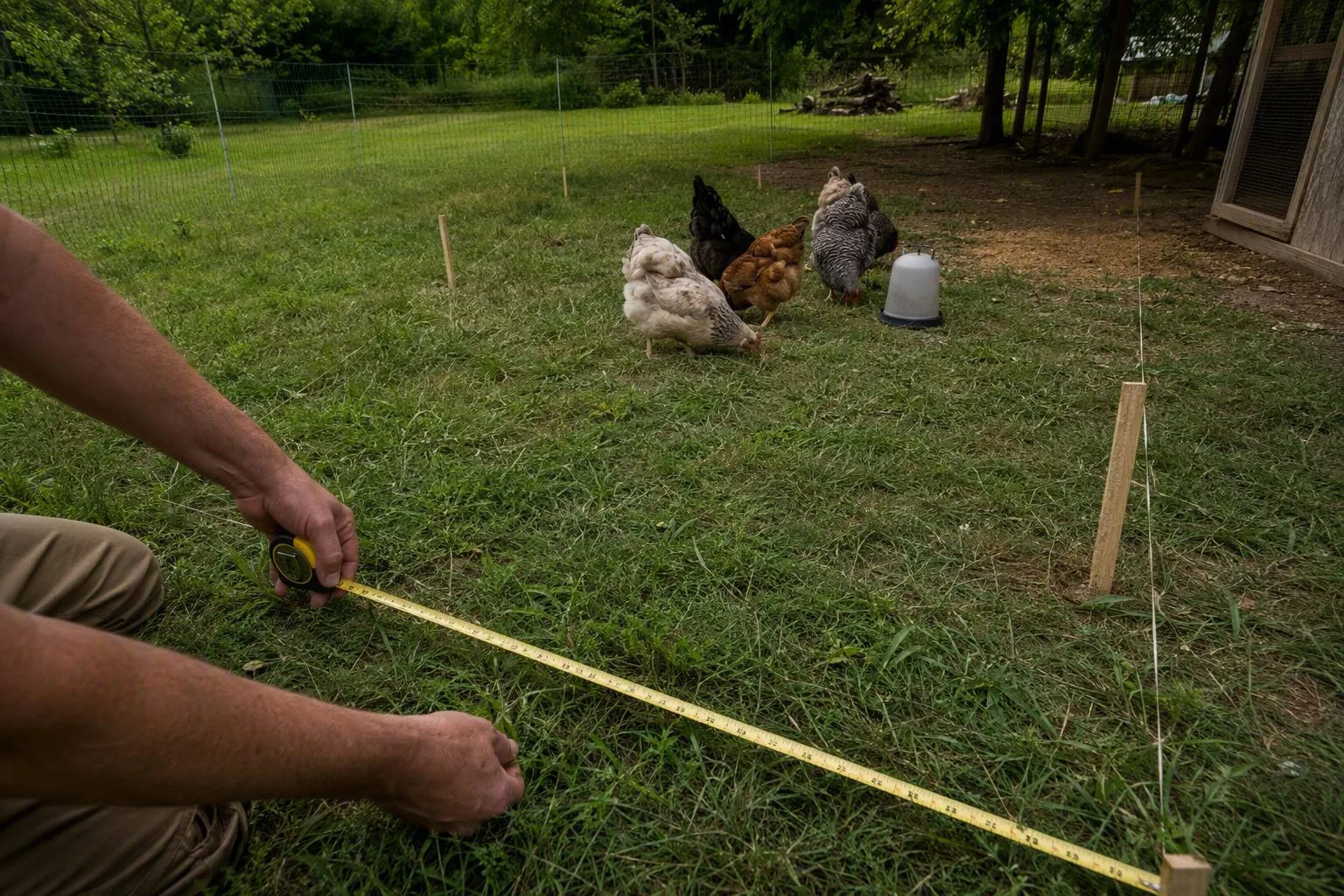
Take a seven-day ground and risk audit before you commit
Measure the proposed area this week. Mark the 100-square-foot-per-hen starting footprint, then mark the larger 200–250-square-foot forage target if your property allows it. Draw the coop, secure run, garden fence, shade at midday, water points, gates, and the routes your birds would actually take.
A practical yard audit: put a hose where the waterer would sit, stand in each zone at midday, and inspect the proposed routes after rain. If you can't reach a muddy corner without crossing a garden bed, don't count that corner as usable. Walk the property at morning, midday, dusk, and after wet weather so the plan reflects changing conditions rather than one sunny afternoon.
Finish by choosing one setup: managed free range with rotation, supervised access from a secure run, or a secure enriched run without open-yard access. Then write down your flock size and current local feed price and pair the plan with how much feed per chicken per day free range. Free-ranging changes management; it does not remove the regular feed bill.