Chickens and Cats: Can They Safely Share Your Backyard?
Adult hens and a calm house cat can share a backyard, but that doesn’t make unsupervised time together safe. The workable setup is a cat-resistant run, a cat you can redirect, and direct contact that stays supervised.
When I’m checking a mixed-animal yard, I start at the gate, not with the cat. I test the latch, look for a paw-sized opening, and identify where a hen could retreat if the cat rushed the mesh. That order matters. A friendly greeting tells you much less than what happens when a small bird suddenly runs.
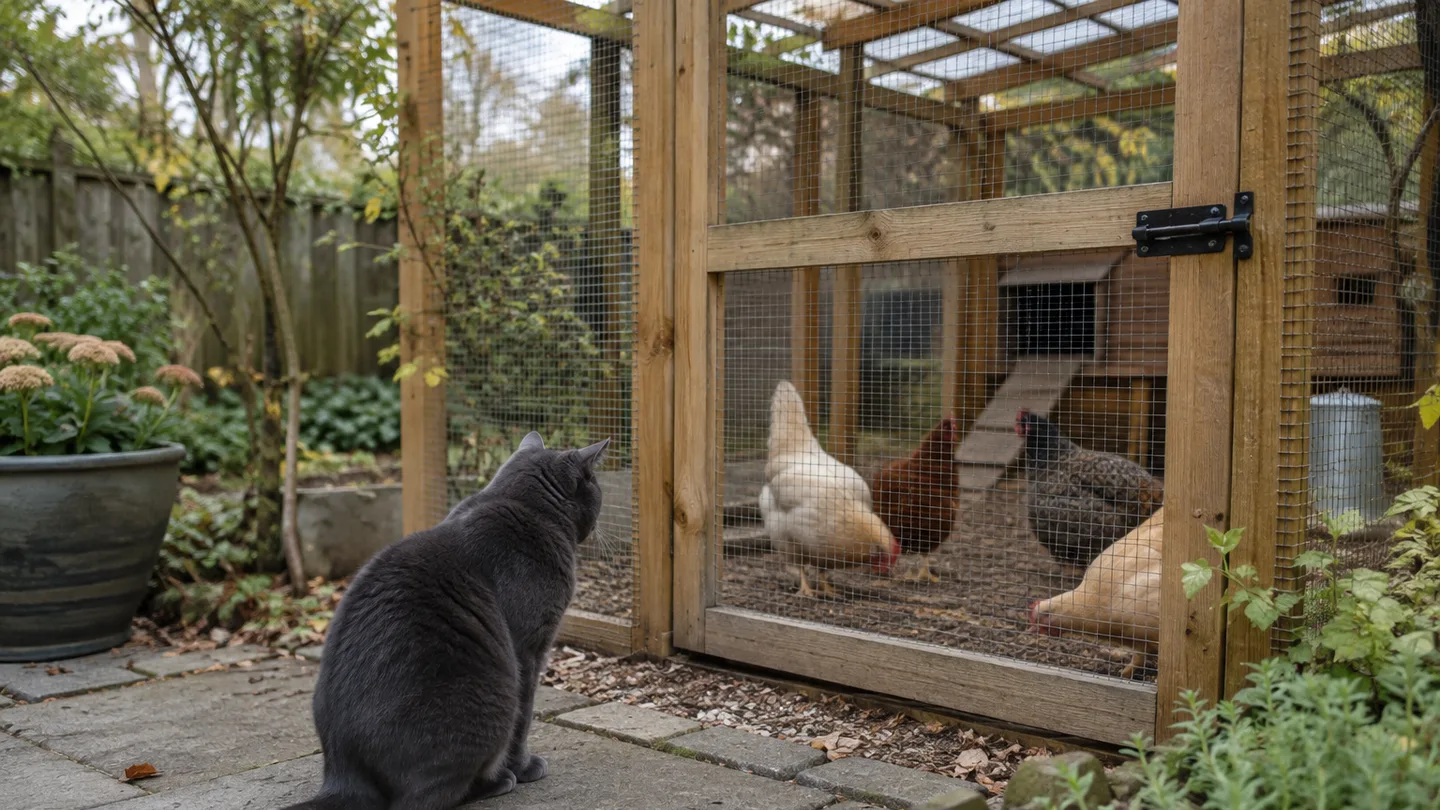
The short answer: yes with barriers and supervision, not on trust alone
Chickens and cats can occupy the same backyard when your birds have a secure, roofed enclosure and every direct interaction is watched. I would not make free-ranging together the default, even if your cat has never harmed another animal. A moving hen can trigger a different response from the one you see when the cat is sitting quietly on the porch.
I use three questions to set the risk level:
- How old and vulnerable are the birds? Chicks and injured hens need much more separation than sturdy adult birds.
- What does the cat do around movement? Prey behavior matters more than breed, size, or how gentle the cat is with people.
- Can the birds get behind a real barrier? A fence that contains chickens but lets a cat reach through is not enough.
The goal isn’t to make the animals become friends. It’s to prevent a fast chase from becoming the only thing either animal remembers about the other.
Day-old chicks through 6–8 weeks are a different risk category from adult hens
Day-old chicks and small pullets are the least forgiving combination with a cat. Their quick, jerky movement can invite chasing, and their size leaves them little room to escape or defend themselves. A cat doesn’t need to be aggressive in the human sense for that sequence to start.
Keep a brooder in a cat-free room, with a solidly secured top. An open tub is not a barrier. A loose wire lid may stop a chick from wandering out while still allowing a cat to reach in, hook a paw through, or knock the lid aside. Check the corners and fasteners each time you close the room.
Full feathering at roughly 6–8 weeks can be a useful risk marker, but it is not a safety certificate. Breed, growth rate, and the bird’s confidence all change the picture. Bantams, injured birds, and a broody hen with newly hatched chicks deserve extra separation because they are easier to corner and harder to move away from trouble.
Read the cat, not the breed: five behaviors that end an introduction
A cat that watches a hen through mesh may be showing ordinary curiosity, or it may be rehearsing a hunt. Look at the whole body and what happens after you redirect the cat.
- Stalking: the cat lowers its body and moves in short, deliberate steps.
- Fixed staring: the eyes stay locked on one bird while the cat ignores your voice or food.
- Tail lashing or a tense crouch: the body looks loaded rather than loose.
- Pawing through mesh: the cat repeatedly tests the barrier or reaches toward moving birds.
- Pouncing or lunging: any rush toward the run ends the session.
Relaxed curiosity looks different. The cat may sniff, blink, sit upright, look away, groom, or respond when you call. The important test is disengagement. A cat that notices the chickens and then chooses to leave is giving you useful information. A cat that cannot stop watching is also giving you useful information.
Indoor-only history and a cat that is affectionate with people do not predict safe behavior around birds. My practical stop rule is simple: repeated fixation, lunging, or reaching through the barrier means permanent separation. The safest cat is not the one that seems fascinated but gentle. It’s the boring one that notices the hens and moves on.
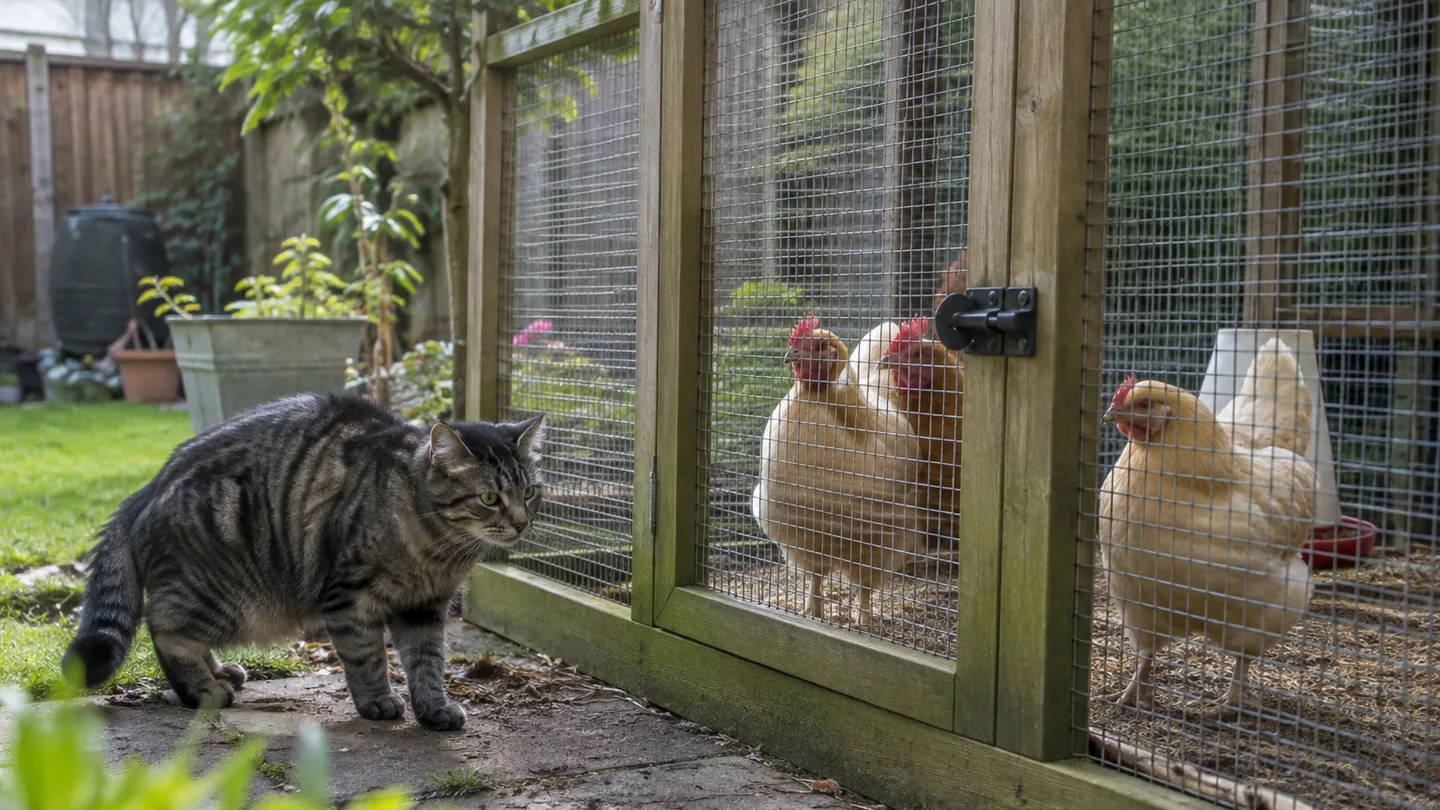
Use a three-stage introduction: 5–10 minutes behind a barrier before any closer contact
Make the introduction a series of short observations over several days, not one dramatic meeting. Your first job is to learn whether the cat can disengage and whether the birds keep acting like birds.
- Stage one: secure separation. Keep the cat outside a closed run while the hens remain free to walk, eat, drink, and move away. Start with the cat far enough back that it can notice the flock without stalking. Reward calm disengagement by calling the cat away or offering a separate activity.
- Stage two: repeated short sessions. Move closer only when the cat can look away and the chickens continue normal behavior. Keep these sessions to about 5–10 minutes. End them before either animal becomes frantic. Several uneventful sessions tell you more than one long test.
- Stage three: brief same-yard contact, if you reach it. Let the cat enter only with you beside it, the birds able to retreat behind a solid panel or into the run, and an easy route back out for the cat. Keep the first contact brief. This stage is optional, not a graduation every pair must pass.
Never hold a chicken near a cat’s face. Don’t force a nose-to-beak greeting, and don’t leave the yard for a quick trial run. If the cat stiffens, crouches, lunges, or keeps tracking one bird, calmly end the session and return to full separation.
Build the boundary: 1/2-inch hardware cloth, a roof, and no paw-sized gaps
A stronger boundary starts with the run itself. For a cat-resistant enclosure, I’d choose 1/2-inch hardware cloth over ordinary 1-inch chicken wire. The smaller openings reduce paw access and make it harder for a cat to reach a bird through the wall. Chicken wire is useful for containing chickens, but I would not treat it as a complete predator barrier.
Add a roof. A six-foot fence can still be climbed, jumped, or used as a launching point by a determined cat. Secure the door with a latch that cannot be lifted by a paw, and inspect the lower edge for gaps where a cat could squeeze under or reach in. If the same run must resist raccoons, add a dig-proof apron or buried mesh as well.
When I’m checking a run, I look at it from a cat’s height. Can a paw reach the nearest hen? Can the cat stand on a box, log, or fence rail to gain leverage? If a cat persistently paws at the mesh, move feeders and perches farther inside so your birds are not forced to crowd the boundary. Before building, answer the separate question of how much space do chickens need; a secure run that is too tight still creates avoidable stress.
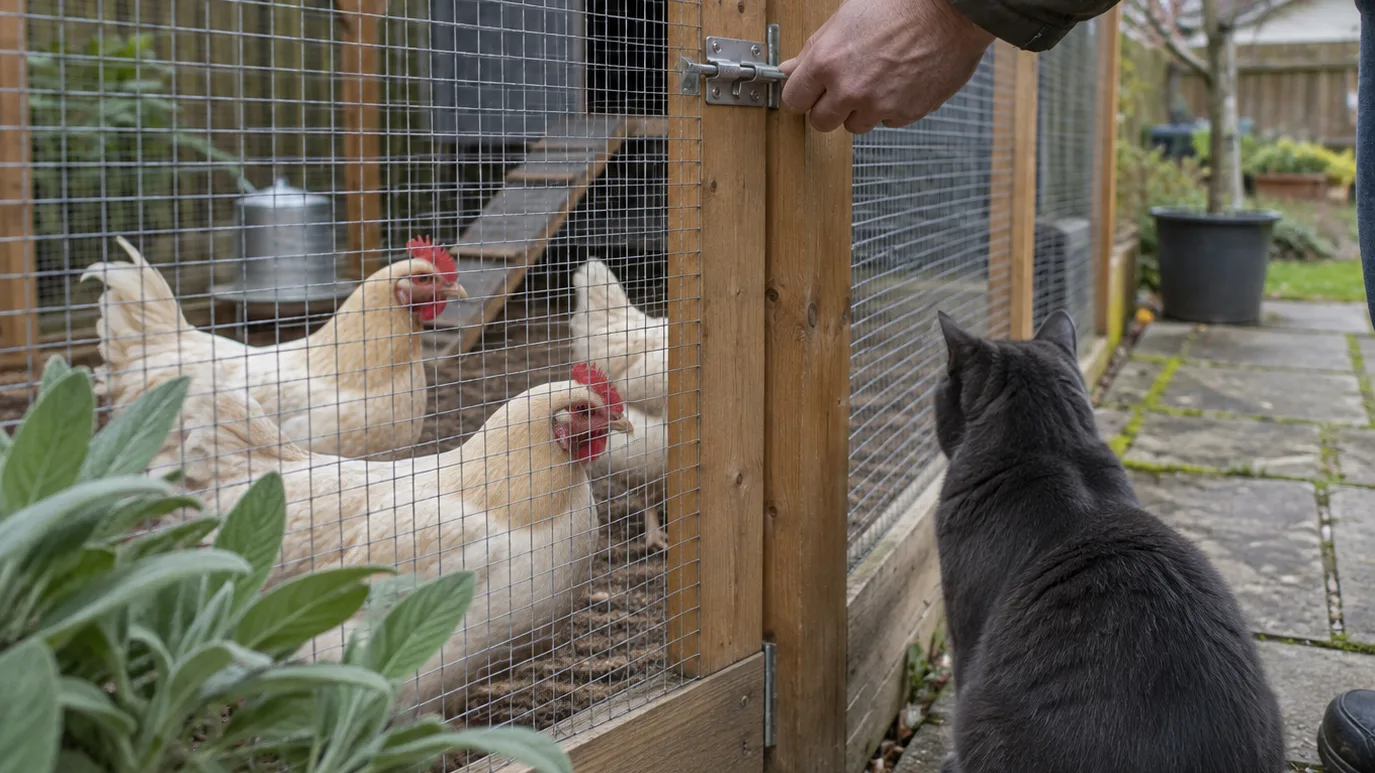
Separate the daily resources: feed, water, litter, and droppings
Even when neither animal is hunting, shared resources create unnecessary trouble. Keep cat food and water outside the chicken run, and keep litter boxes where chickens cannot scratch through them. Do not let your birds investigate or scatter cat feces. Keep spilled feed cleaned up rather than allowing it to become a reason for cats to linger beside the run.
There is no magic safe distance that replaces a physical barrier. A bowl several feet away does not help if a cat can still enter the run or reach through the mesh. Use a short morning-and-evening check: confirm the run door is latched, look for tipped water, check the mesh at ground level, and remove fresh contamination before the birds have access to it.
This is also where practical chicken coop requirements matter. A clean, well-arranged enclosure gives your birds somewhere to move away from a visitor instead of forcing them into a corner.
A scratch is not just a scratch: injury and vet thresholds
I’d treat any cat bite or puncture wound on a chicken as a same-day call to an avian or exotics veterinarian, even if the mark looks tiny. Punctures can be easy to miss under feathers, and waiting to see whether the bird seems fine can waste the useful early window for professional advice. For injury triage, look for avian or exotics veterinary guidance on cat-bite wounds rather than relying on a general pet first-aid post.
Seek urgent help for an eye or face injury, breathing difficulty, collapse, uncontrolled bleeding, inability to stand, or a bird that becomes rapidly weaker. While you make the call, place the chicken in a quiet, separate carrier or small hospital area. Don’t keep returning it to the flock to see whether it improves.
If there is no visible wound after a chase, observe the bird closely through the next day. Check appetite, drinking, walking, droppings, breathing, and whether it stays hidden. A worsening change, persistent weakness, or any new wound moves the situation beyond casual home observation.
Neighbor cats, feral cats, and free-ranging hens change the answer
A known household cat gives you a chance to observe and train around its behavior. A neighbor’s cat, a feral cat, or several roaming cats turn the problem into predator exclusion. You cannot supervise an animal that appears while you are indoors, and you cannot assume that a calm resident cat will keep other cats away.
Use extra caution around dawn and dusk, when outdoor cats may be active and visibility is lower. Remove hiding cover and climbable objects close to the run, but don’t rely on an empty-looking yard. For free range chickens, provide a roofed retreat that the flock can reach quickly. Adult hens still need somewhere to go when a cat, hawk, dog, or other threat enters the yard.
The cat is not a security system for your chickens. Its presence does not reliably deter other predators, and a cat chasing a hen can create the same escape problem as an unfamiliar animal. If you’re weighing the trade-off, read about free range chickens as an access decision, not simply as a choice between more room and less room. More space helps only when your birds can still reach safety.
Choose one of three setups this week: closed brooder, covered run, or permanent separation
Don’t finish with a vague promise that the animals will learn to get along. Choose the setup that matches what you have actually observed.
- Closed brooder: Keep chicks in a secured brooder in a cat-free room until they are fully feathered and sturdier. This is the default for day-old chicks and small pullets.
- Covered run: For adult hens and a calm, redirectable cat, use a roofed run built with close mesh, secure latches, and no reach-through gaps. Introductions remain supervised, and same-yard contact is never required.
- Permanent separation: Use separate zones for a cat that stalks, lunges, paws at birds, or cannot disengage, and for any yard with roaming or feral cats you cannot control.
Save this checklist: inspect the mesh, test every latch, remove climbable objects, confirm the birds have a retreat, and plan the first barrier-only session for 5–10 minutes. If you’re still designing the flock, pair this check with chicken coop requirements and a realistic run plan. The next useful action is not introducing the cat. It’s closing the gap the cat could use.