Chicken Spurs: When to Trim Them—and When to Leave Them Alone
A long-looking chicken spur doesn’t automatically need trimming. If your bird walks normally and the spur isn’t snagging, injuring another bird, or causing repeated trouble, leaving it alone is usually the sensible call. There’s no universal length that tells you when to reach for clippers; the bird’s comfort and the spur’s behavior matter more than its appearance.
First, identify the spur: the pointed growth on each leg isn’t a toenail
A spur is the pointed projection on the back of a chicken’s lower leg, above the foot. It grows from the leg rather than from the end of a toe. The scales around it are part of the leg’s surface; a fresh wound, scab, or crusted patch may look pointed too, but it shouldn’t be assumed to be a normal spur.
Roosters commonly develop noticeable spurs as they mature, but their size and shape vary. Hens can develop spurs as well. So don’t use “large means rooster” or “hen means no spur” as your identification test. Look at where the growth sits, whether the surrounding skin looks intact, and whether the other leg has a similar structure. If you’re uncertain whether a growth is a spur or an injury, ask a poultry veterinarian rather than trying to trim it to find out.
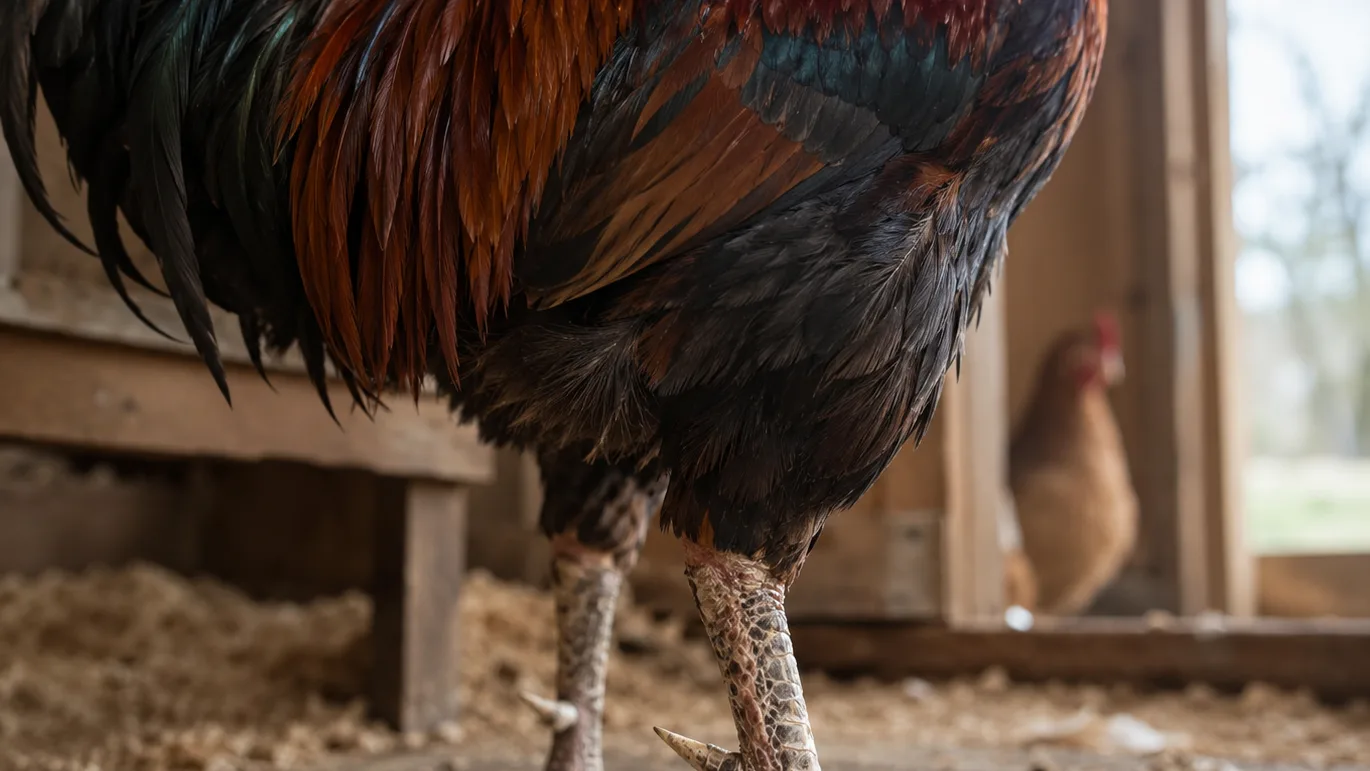
Check both legs. One spur may curve while the other stays straighter, or one may be more prominent. That difference alone doesn’t establish a problem. A useful inspection is simple: watch the bird walk, then look at each leg while it stands calmly. You’re checking for a change in movement, damage, or a spur that catches during ordinary activity, not judging the bird against a picture of a supposedly ideal spur.
Also distinguish a spur from the nails on the toes. Toe nails meet the ground or perch as the bird moves; the spur projects from higher up the leg. If you’re handling a bird to inspect it, keep the bird supported and steady rather than pulling a leg outward to get a better view. If you need a refresher on how to catch a chicken calmly, use that handling guidance before attempting a close examination.
No standard length in inches or centimetres means “trim now”
A spur can look dramatic and still cause no practical trouble. Conversely, a shorter, hooked spur may snag on a particular surface or make a specific interaction uncomfortable. That’s why I’d make the decision from function and condition, not from a ruler. No single length cutoff can account for different spur curves, the bird’s gait, the surfaces in its run, or the way the flock behaves.
Leave a healthy spur alone when your bird walks comfortably, the point isn’t catching on objects, and you aren’t seeing repeated scratches or injuries that plausibly involve it. “Plausibly” matters: a scratch can come from claws, rough edges, or flock conflict. Seeing one mark once doesn’t identify its cause. Look for a pattern and inspect the bird and the setting before deciding that spur trimming is the answer.
Check both spurs separately. If one looks longer, that’s a reason to pay attention, not a reason by itself to cut. Compare its curve and condition with the other side, then watch the bird move. A spur that has changed suddenly, looks cracked, or is tender when the bird is touched deserves assessment; routine shortening isn’t a substitute for finding out why it changed.
My preference is to leave a spur alone unless I can name the problem it is causing. That’s a practical judgment, not a promise that every spur will remain harmless. Trimming removes protective covering and introduces handling stress, while leaving a trouble-free spur avoids both. If the only concern is that it looks unusually long, monitor it during your ordinary checks instead of trimming for appearance.
Use these three problem signals to decide whether trimming is worth considering
Think in three signals: snagging, repeated injury during interaction, and interference with comfortable movement. Each gives you a reason to investigate. None proves on its own that clipping is the right fix.
- Snagging: You see the spur catch on wire, a perch, or another surface during normal movement. First inspect the surface for a sharp edge or gap. A snag caused by damaged fencing may call for repairing the fence, not shortening the spur.
- Repeated scratches or injuries: You find recurring marks on a bird that spends time with a particular rooster, or you observe contact during mounting or flock interactions. Check for other possible causes and consider whether space, supervision, or flock management needs attention. Trimming one spur may not address the behavior that keeps producing contact.
- Movement trouble: You observe an awkward step, a repeated catch, or a stance that appears to protect one leg. Don’t assume the spur is responsible. Foot, leg, or joint discomfort can affect gait too, so a new limp or pain deserves a closer health assessment.
Here’s a concrete decision example, clearly a scenario rather than a report from a real flock: imagine a backyard rooster named Ash whose right spur curves outward. During several ordinary walks, its tip catches on the same loose section of wire near the run door; the left spur doesn’t. The first move is to secure that wire and watch him on the repaired route. If the catching stops, clipping wasn’t needed. If it continues on sound surfaces, the spur is repeatedly damaged, or Ash begins to limp, pause and get an experienced poultry professional or veterinarian to assess him before considering any trim. The details change the decision; “curved” alone doesn’t.
A single scratch on a hen also isn’t enough to convict a rooster’s spur. Look for recurrence, observe interactions when you can do so safely, and check whether other birds have similar marks. If flock conflict is part of the picture, review breeding and rooster-management choices rather than treating trimming as a complete fix. For pain, swelling, an open wound, a sudden change in the spur, or limping, seek veterinary assessment instead of routine clipping.
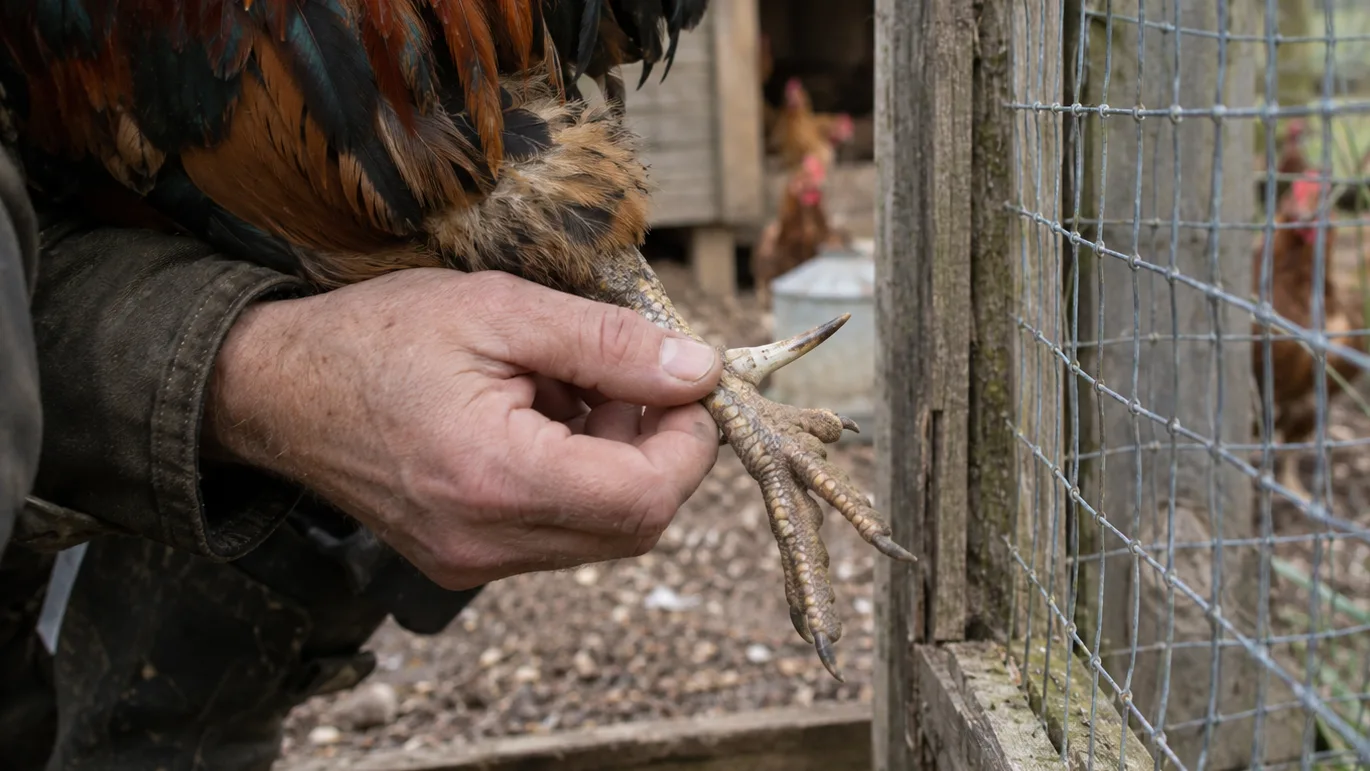
The spur has a living core: trim only the outer tip, never down to the base
The visible spur has a hard outer covering over living tissue supplied by blood. The pointed end may look like dead material, but you can’t safely assume the entire spur is an inert nail. Cutting too close can cause pain and bleeding. That anatomy is the reason a small, cautious adjustment is different from removing or shortening the structure substantially.
If a minor trim is genuinely appropriate and you know how to restrain the bird safely, use a clean, suitable cutting tool and take off only a very small amount from the tip. Stop and reassess rather than making a large cut in one go. There isn’t a universal millimetre amount I can recommend: the safe margin depends on the bird and the shape of the spur, and the living core may not be visible from the outside.
For a substantial shortening, uncertain anatomy, a damaged spur, or a bird that won’t stay safely restrained, hand the job to a poultry veterinarian or an experienced poultry professional. Restraint is part of the procedure, not a minor detail. A struggling bird can be injured, and a rushed cut gives you less control over where the tool lands. If you’re not confident you can keep the bird and your hands steady, don’t improvise.
Don’t twist the sheath off. Don’t use heat-based removal methods. Either approach can injure living tissue and turn a cosmetic concern into a painful wound. If you’re researching the procedure, seek veterinary guidance on leg and spur injuries rather than relying on a demonstration that doesn’t account for your bird’s anatomy or condition.
Before handling, decide what would make you stop: movement, distress, an unexpected change in the spur, or any sign that the cut would need to go beyond the tip. If any of those appear, stop and get help. For a safe, uncomplicated check, knowing how high should roosting bars be can also help you assess the bird’s normal environment and whether its usual perch setup is creating repeated contact.
If a trim goes wrong, bleeding or limping is a stop sign—not a reason to keep cutting
If you see bleeding, stop trimming. Keep the bird calm and avoid further cutting or pulling at the spur. If bleeding doesn’t settle, the bird seems unwell, or you’re unsure how serious the injury is, contact a veterinarian. Don’t guess at medication or apply a treatment based on a dose from an unrelated bird; treatment decisions belong with a veterinary professional who can account for the injury.
After any handling or trim, watch for a change in gait, ongoing pain, swelling, a cracked or damaged spur, or reluctance to put weight on the leg. A bird may be unsettled briefly after handling, but worsening or persistent signs need attention. Compare both legs so you don’t mistake an old difference in spur shape for a new injury, and tell the vet what changed and when you noticed it.
If the bird limps, don’t keep trimming in the hope that a shorter spur will fix the problem. A limp can have causes beyond the spur, and cutting won’t diagnose them. Seek veterinary guidance on the leg and spur problem, especially when there’s a wound, swelling, pain, or a sudden change. Your local poultry extension office may also be able to point you toward appropriate local care or flock-management support, but it can’t replace a vet when a bird is injured or unwell.
Make a monthly check your reminder—not a monthly trimming schedule
A monthly look at both legs can be a handy keeper’s reminder, not a medically established interval or a guarantee that trouble won’t recur. Use routine handling you already do, or observe the bird standing and walking if handling would be stressful. Note whether each spur looks stable, whether the skin is intact, and whether either side is catching or affecting movement.
If a problem repeats, work back through the cause. Check rough wire, gaps, and perch contact. Watch flock interactions and consider whether a management change would prevent scratches more effectively than shortening a spur. If you’re changing roosts, compare the setup with guidance on how high should roosting bars be and watch whether your bird uses the new arrangement comfortably.
This week, inspect both legs and write down one plain answer: is either spur causing a repeated, observable problem? If not, leave it alone and check again during your ordinary care. If yes, identify the surface or interaction involved before deciding what to do. That small note gives you a better starting point for a vet or experienced poultry professional than a trim based only on appearance.