Scaly Leg Mites in Chickens: Signs and Treatment Steps
Scaly leg mites are easiest to notice when a hen’s leg scales stop looking like neat overlapping tiles. They lift, roughen, and collect pale crusts around the toes and shanks. Don’t start by scraping them clean: compare both legs in good daylight, then choose a plan that addresses the bird, the flock, and the coop.
Raised scales are the clue: signs that point to scaly leg mites
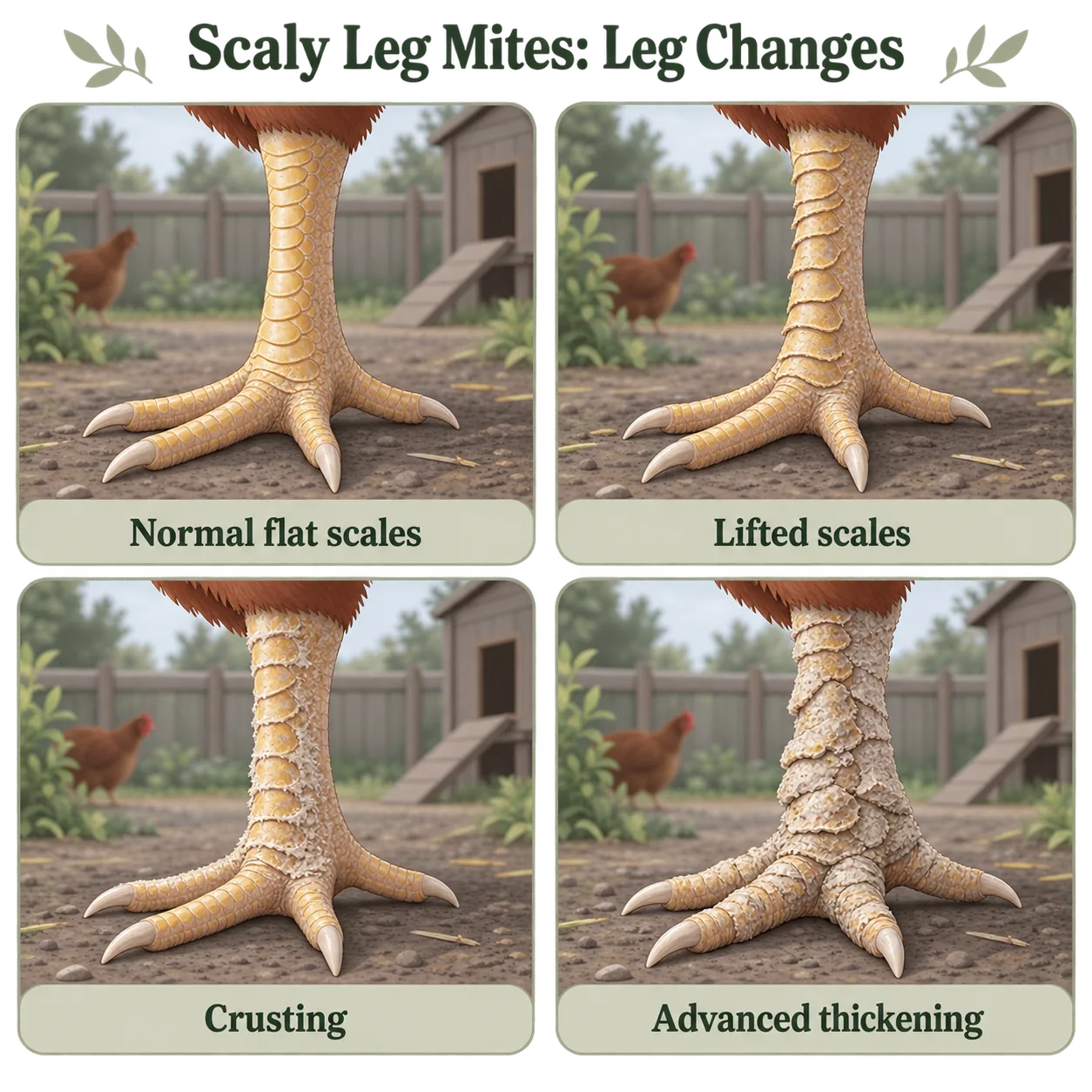
Healthy chicken leg scales usually lie flat and orderly. With a suspected scaly leg mite problem, the scales may look raised, uneven, dry, or pushed apart. Pale crust can collect between them. As the skin gets irritated, a bird may spend more time shifting on the perch, avoid jumping, or develop a stiff-looking walk.
The useful clue is the pattern, not one ugly-looking scale. Raised scales across several toes, both shanks, or more than one bird give me a stronger reason to investigate mites. A single rough patch could also come from an old injury, ordinary wear, dried mud, or another skin problem. You need the whole leg and the bird’s movement before you decide what you’re seeing.
Feather-legged breeds can be harder to inspect because feathers hide the shanks and toes. Older hens may also have more worn or thickened scales, so their legs do not always look as tidy as a young bird’s. That makes a clear baseline photo useful. Take it before you soften, wipe, or treat anything.
For a second reference point, compare your notes with a veterinary reference on scaly leg disease in chickens if the swelling is marked, the footpad is involved, or the pattern does not fit the usual raised-scale picture.
A 10-minute leg check separates mites from bumblefoot, injury, and frostbite
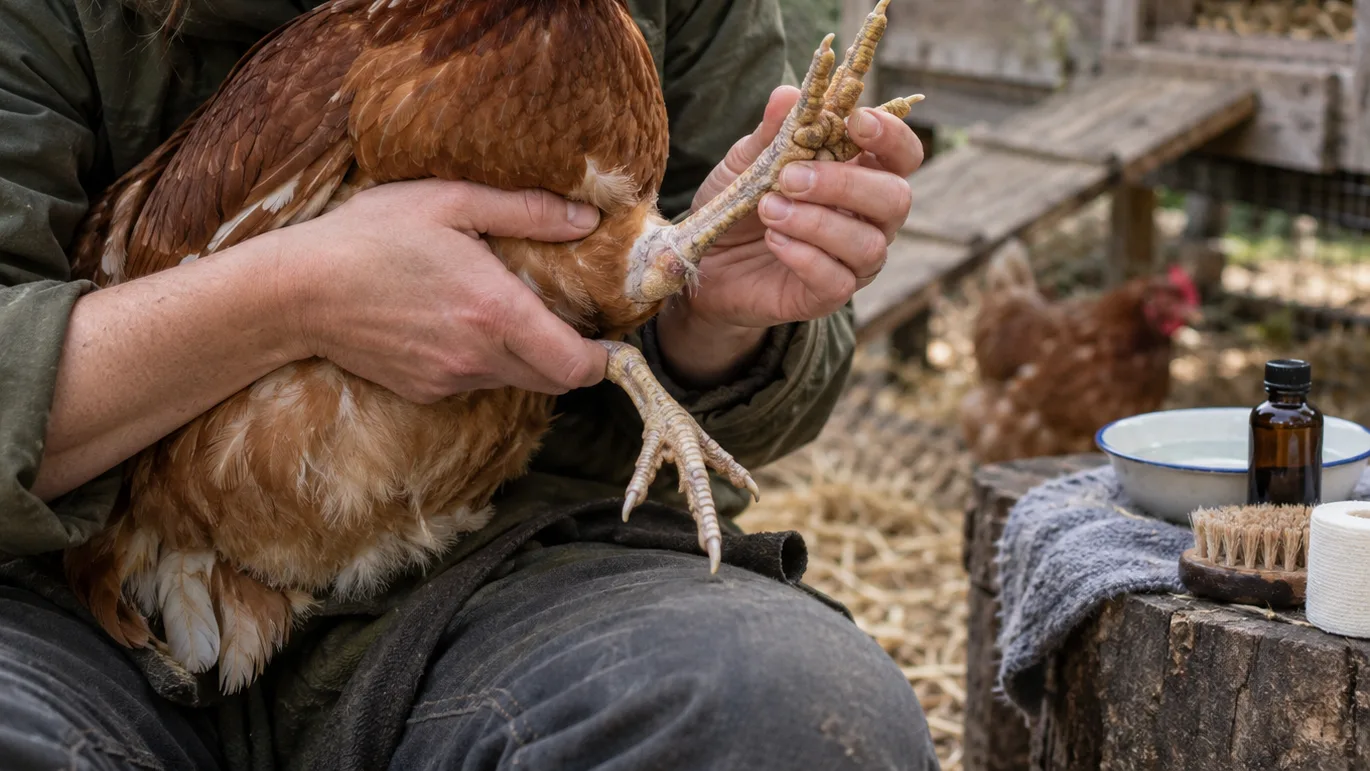
Plan roughly ten quiet minutes per bird for the first check. Choose daylight, hold the chicken securely without squeezing the chest, and work from the top of the leg down. You are trying to see the pattern before you disturb it.
- Compare both legs. Look at the shanks, toes, joints, and the spaces between the toes. Uneven changes are useful clues.
- Check the scale surface. Look for lifting, pale crust, cracks, bleeding, or swelling. Do not peel a loose-looking scale away.
- Inspect the soles. Turn the foot just enough to see the pad. Look for a single dark plug, a scab, a puncture, or a swollen pressure point.
- Watch the bird move. Note whether it can stand, perch, walk, and put weight on both legs. A bird that stops eating or drinking needs attention beyond a routine leg check.
| What you see | Where I’d look next |
|---|---|
| Raised scales on several toes or both legs | A scaly leg mite pattern; inspect every bird |
| A single dark plug on the footpad | A bumblefoot pattern; inspect the pressure point |
| Sudden pain in one leg | An injury, sprain, trapped toe, or another local problem |
| Blackened or damaged tissue after severe cold | A frostbite concern; seek prompt veterinary advice |
That is why bumblefoot in chickens belongs in the comparison, even when the shanks look rough. Bumblefoot usually sends you toward the sole and pressure point. Scaly leg mites send you toward the scale pattern on the toes and shanks. The two problems can also occur in the same bird, so do not stop after finding one abnormality.
When I first handled a bird with rough shanks, I made the mistake of rubbing at the scale edges with a towel. The towel caught a lifted scale, the hen jerked, and I stopped. I switched to a dry visual check, then wiped only loose dirt after I had taken a baseline photo. The result was not a magically clean leg. It was a calmer bird and a much clearer record for the next check.
Call a poultry vet or an experienced local extension contact the same day if the bird cannot stand, has marked swelling, has an open or bleeding wound, or is not eating or drinking. Those signs move the problem out of simple home monitoring.
Treatment is a cycle, not a single smear—use the label as the clock
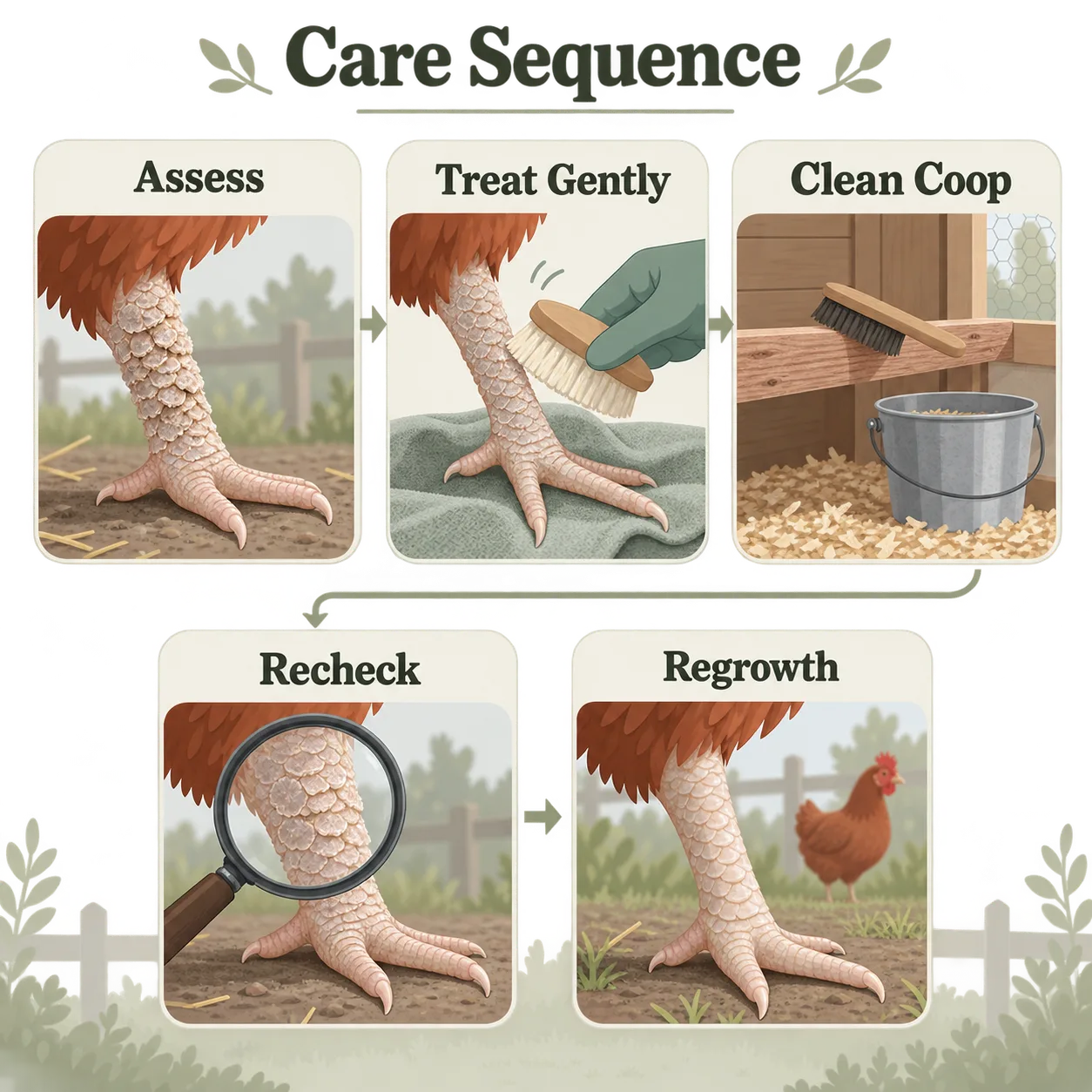
A sensible scaly leg mite treatment has several parts. You inspect the flock, protect the affected bird from further irritation, choose a product that is actually labelled for the situation, and repeat it on the schedule the label or veterinarian gives you. A single application rarely makes a damaged leg look normal overnight.
- Inspect every bird. Mite problems are easier to miss on a quiet hen or a feather-legged bird. Record which legs look abnormal and whether the bird is walking normally.
- Separate only when separation solves a problem. Move the bird to a clean, comfortable pen if flockmates are pecking the legs, the bird needs individual care, or you must monitor food and water. Isolation by itself is not the treatment.
- Remove surface dirt gently. After you have observed the scales, use a soft damp cloth to loosen mud or manure. Do not scrape, peel, or force crusts off. Dry the legs before applying any product.
- Separate comfort care from mite control. A very thin layer of plain petroleum jelly is commonly used by keepers to soften rough scales and reduce dryness. Treat it as supportive care, not as a guaranteed mite-killing product. Do not pack it into an open wound.
- Use medication only according to current poultry directions. An acaricide, an ivermectin-class product, or another treatment must be chosen for the bird and the legal use on its label or by a veterinarian. Follow the repeat interval and every egg or meat withdrawal instruction exactly.
If you choose the petroleum-jelly comfort routine, a practical keeper pattern is a very thin film every two to three days for roughly two to three weeks, with a fresh inspection at each application. That is a routine I would use to soften the surface while the underlying problem is being addressed, not a universal cure. Stop and ask for veterinary advice if the skin becomes wetter, more painful, or more inflamed.
Do not substitute dog, cat, livestock, garden, motor-oil, kerosene, or unlabelled essential-oil products for a poultry treatment. Similar-sounding pest products can have different active ingredients, concentrations, bird restrictions, and withdrawal rules. Check current poultry medication labels and national egg-and-meat withdrawal requirements before treating a laying hen.
For the wider flock workflow, the site’s chicken mites treatment guide is the useful next read. It can help you think beyond the one pair of legs in front of you.
Use a simple recovery record. Write down the day you first assessed the bird, check again around day 7, check again around day 14, and keep watching for several weeks as damaged scales grow out. My preferred progress marker is not a pretty leg on the first revisit. It is less discomfort, normal perching and walking, and clean new scale appearing at the base. If pain is worsening or there is no meaningful improvement after a complete label-directed course, arrange veterinary review rather than adding another product.
Break the reinfestation loop and set the vet threshold
Treating the visible leg can fail if the flock keeps contacting contaminated debris around roost joints, perch ends, cracks, and sheltered coop surfaces. The point is not to sterilize every board. It is to remove the places where dirt and mite material can stay protected from ordinary cleaning.
- Remove the bedding and debris before washing hard surfaces.
- Scrub roost joints, perch ends, nest-box corners, and cracks where a cloth or brush can reach.
- Replace porous material that cannot be cleaned and dried properly.
- Use a product for poultry housing only when its label specifically permits that use.
- Let cleaned surfaces dry before returning bedding and birds.
During an active treatment plan, inspect the flock again around day 7 and day 14. Look for new raised scales, fresh crusting, changes in walking, or a second bird developing the same pattern. A bird whose leg looks slow to repair may still be improving; a bird with new pain or new lesions is telling you to reassess the plan.
For new arrivals, I would use a 30-day minimum quarantine in a separate area, with a weekly leg check before joining the main flock. That gives you several chances to notice a quiet problem before shared roosts and bedding make the investigation harder.
Set the vet threshold before you need it. Seek prompt help for severe swelling, open wounds, persistent lameness, appetite loss, or failure to improve after the complete label-directed course. If the diagnosis remains uncertain, a photograph and a short timeline of what you applied will make the consultation more useful. For the cleaning side of the reset, review how to clean a chicken coop before you start.
Frequently asked questions
Can scaly leg mites spread to people?
The chicken-adapted mite associated with scaly leg disease is not expected to establish on human skin. I would still wash your hands after handling an affected bird, cover cracked skin, and avoid rubbing your eyes. If you develop a persistent or spreading rash, ask a medical professional instead of assuming it came from the coop.
Can you eat eggs from a hen treated for scaly leg mites?
Egg safety depends on the exact product and its current poultry label or veterinary instructions. Never assume that a topical product has no withdrawal period. Do not eat or sell eggs during a stated withdrawal interval, and keep a note of the product name and application date.
Are scaly leg mites and red mites the same thing?
No. Scaly-leg signs focus your inspection on the scales and skin of the toes and shanks. A red-mite suspicion sends you toward roost cracks, perch joints, and a night-time inspection, so the control plan is different. One problem can also hide behind the other.
Your next move this week: photograph every bird’s legs in daylight, inspect the roost joints and perch ends, and put a seven-day recheck on your calendar. That gives you a baseline, a flock-wide view, and a clear point at which to call your vet instead of guessing.
Frequently Asked Questions
Can scaly leg mites spread to people?
Explain that the chicken-adapted mite associated with scaly leg disease is not expected to establish on humans, but readers should wash their hands after handling affected birds and seek medical advice for a persistent human rash.
Can you eat eggs from a hen treated for scaly leg mites?
Egg safety depends on the exact product and its current label or veterinary instructions. Never assume that a topical treatment has no withdrawal period, and do not eat or sell eggs during a stated withdrawal interval.
Are scaly leg mites and red mites the same thing?
No. Scaly leg mites burrow beneath leg scales, while red mites hide in coop cracks and feed on birds mainly at night, so the inspection points and control plan differ.