How to Keep Snakes Out of a Chicken Coop: 7 Real Fixes
Ten minutes with a flashlight can do more for snake control than a shelf of repellents. Start at the people-door threshold, work around every mesh seam and pipe, and finish under the run. If small snakes are part of the problem, use 1/4-inch galvanized hardware cloth as your working benchmark, then remove the food and hiding routes that make your coop worth revisiting.
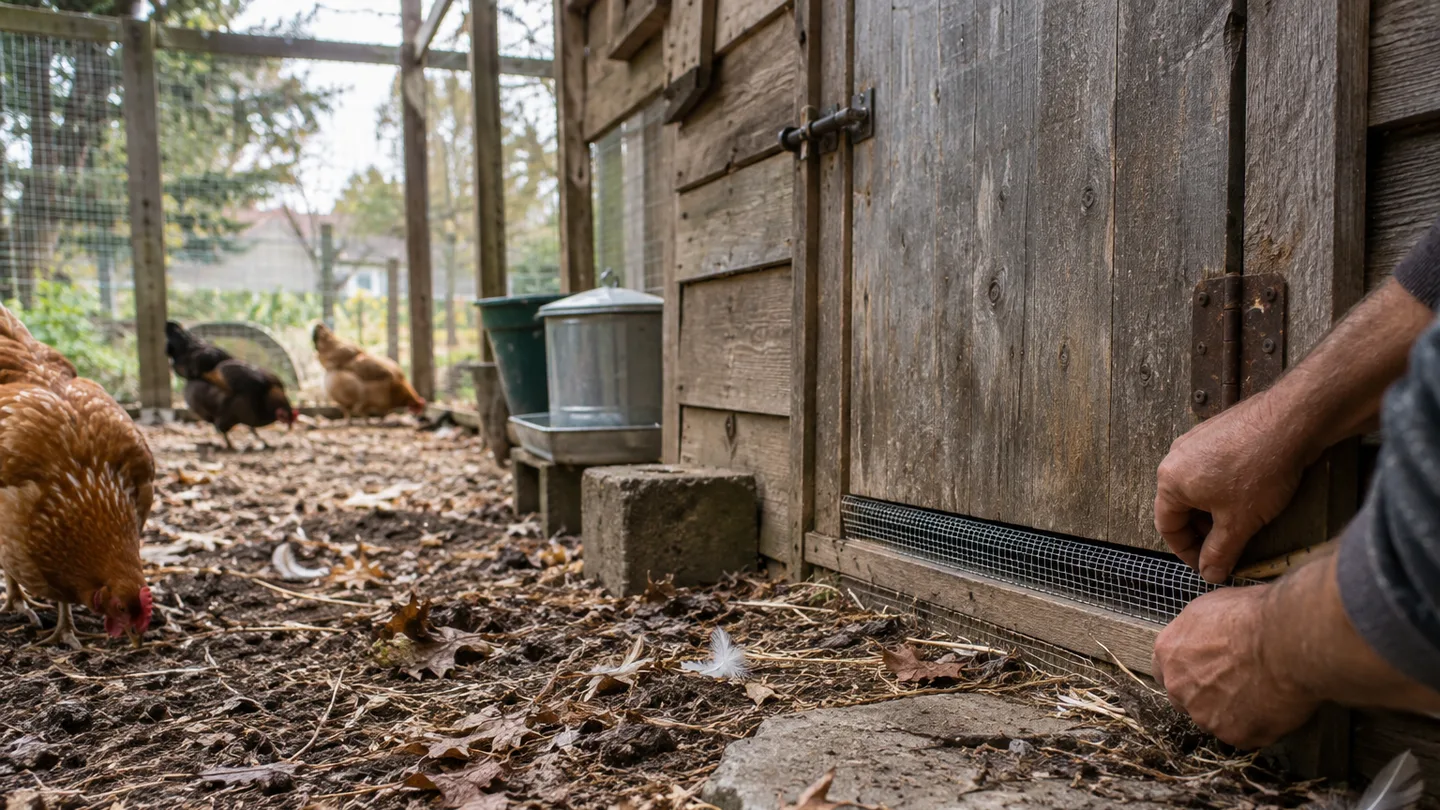
The 10-minute first pass: map every snake-sized route before you buy anything
Don’t begin with scent pellets or an ultrasonic device. Begin with the building. A snake only needs a route, and a route can be easy to miss when you inspect from one side of the wall.
Take a flashlight, your phone camera, and a short piece of stiff card. Walk the coop in this order:
- Slide the card under the people door and pop door. Check for daylight at both corners.
- Run the light along the floor-wall joint, especially where timber has warped or bedding hides the edge.
- Look at every hardware-cloth seam. A lifted corner or open overlap matters more than a perfect middle panel.
- Inspect vents, nest-box backs, cable holes, pipe openings, and the space behind removable panels.
- Walk outside and check where the coop meets the run, gate, posts, and ground.
Photograph anything questionable before you repair it. That gives you a record of the gap and makes the second inspection easier.
In my own small backyard setup, I once finished a mesh repair just before dusk and skipped the inside check behind a nest box. From the yard, the panel looked tight. A flashlight from inside showed a narrow strip of daylight where the box back met the wall. I re-fastened that edge and started checking repairs from both sides. That small habit has saved me from trusting a tidy-looking outside panel.
Use 1/4-inch mesh as a practical starting point where small snakes are a concern. It isn’t a guarantee against every species or every construction flaw. It is a tighter benchmark that gives you fewer routes to miss.
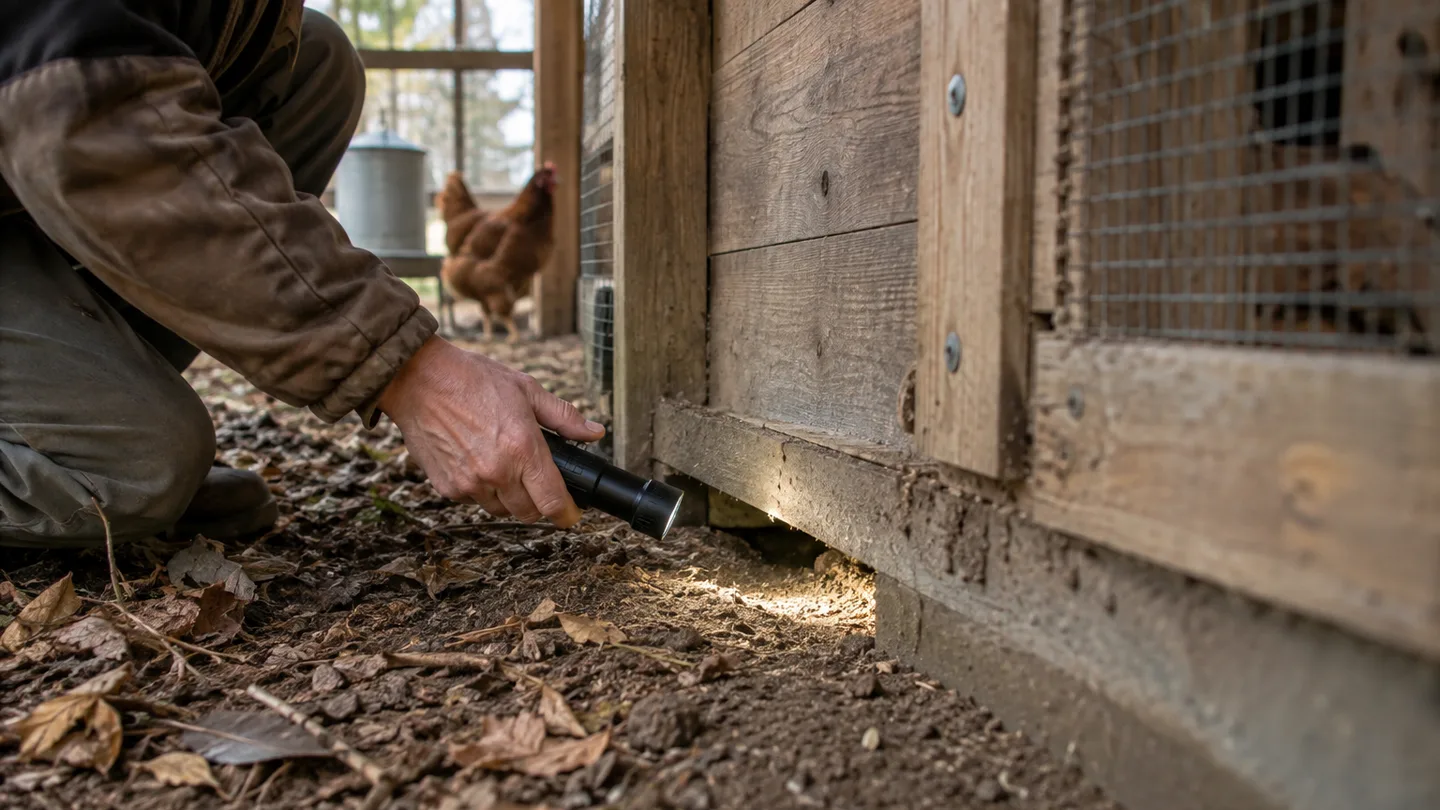
Fixes 1–3: harden the coop shell at mesh panels, doors, and nest boxes
Think of the coop as one shell. Fix the broad panels first, then the low edges, then the little openings around food and eggs. One open seam can defeat otherwise good material.
Fix 1 — Replace chicken wire at vulnerable panels with 1/4-inch hardware cloth
Chicken wire is useful for keeping hens in, but I wouldn’t choose it as the main snake barrier. Wider mesh can leave a route for small snakes, and a snake can also exploit a loose overlap or bent corner. For the practical difference between the two materials, see hardware cloth vs chicken wire.
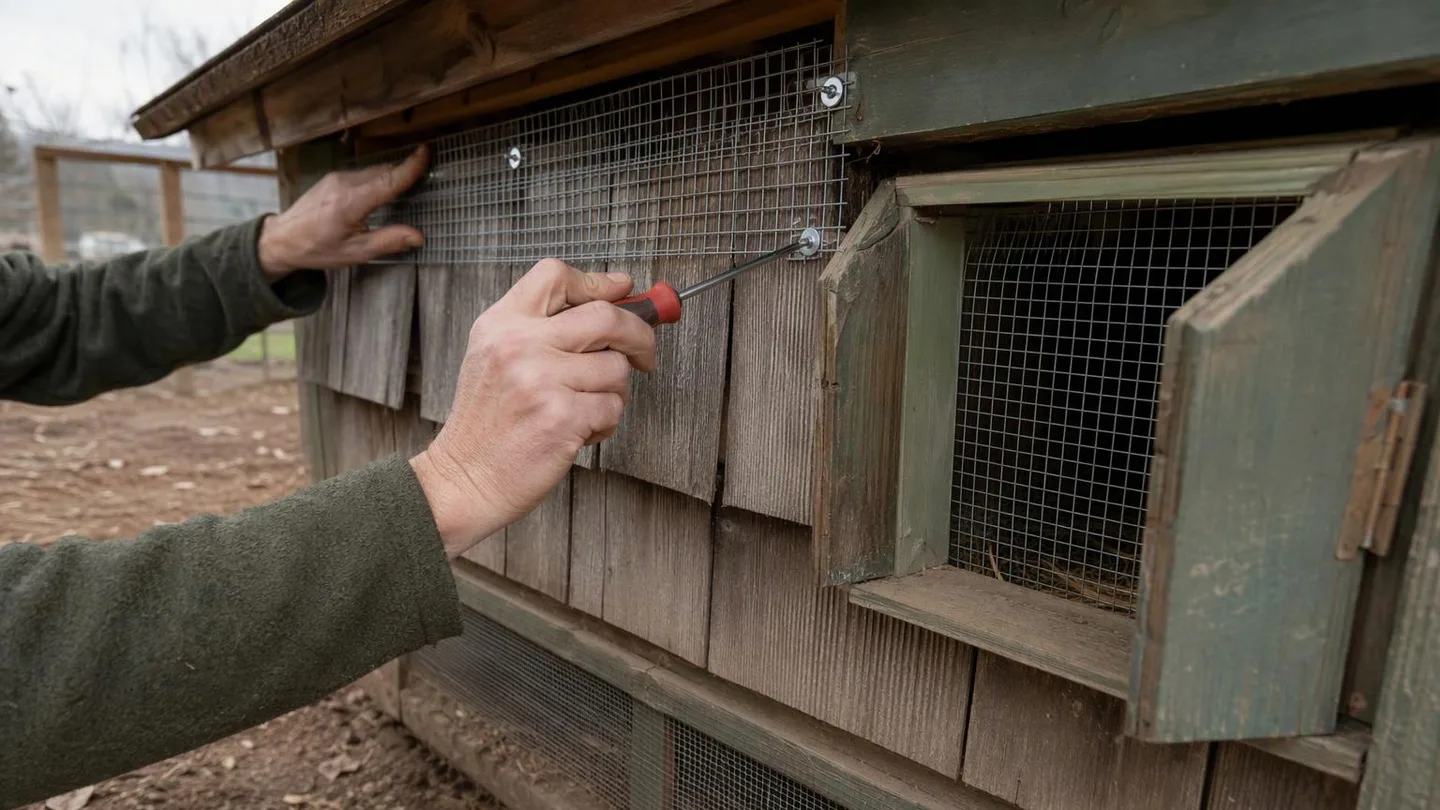
Use 1/4-inch galvanized hardware cloth on low wall panels, vents, chick areas, and any opening that connects directly with the coop interior. Fasten it to solid framing rather than relying on a single staple line. Secure all four edges. Where two pieces meet, overlap them on firm timber and fasten both layers so the seam cannot flex apart.
Run your fingers along the inside after fastening. If you can lift the mesh, a small animal may be able to work at it too. Add a solid strip of wood over a stubborn join instead of piling on loose staples.
Fix 2 — Eliminate daylight at the door threshold and floor-wall joint
The bottom edge deserves its own inspection. Fit a solid threshold or a close-fitting door sweep to the people door, then close the gap at the floor-wall joint with timber or a firmly attached mesh patch. The latch needs to pull the door squarely into that seal.
Do the light test twice: once from outside in daylight, and once from inside with the coop dark. A sealed panel is not useful if the bottom edge still shows a continuous line of light. Check the pop door as well. Its smaller size makes it easy to overlook, but the sill and side tracks can leave a direct route into the sleeping area.
Fix 3 — Screen vents, nest-box backs, and cable penetrations without choking airflow
Snakes don’t need a large doorway if a vent, cable hole, or nest-box gap leads to the same space. Cover open vents with 1/4-inch mesh and fasten every edge. Don’t stuff the opening with rags or seal over a high vent in a way that traps damp air. Keep the opening functional, but make the screen the route through it.
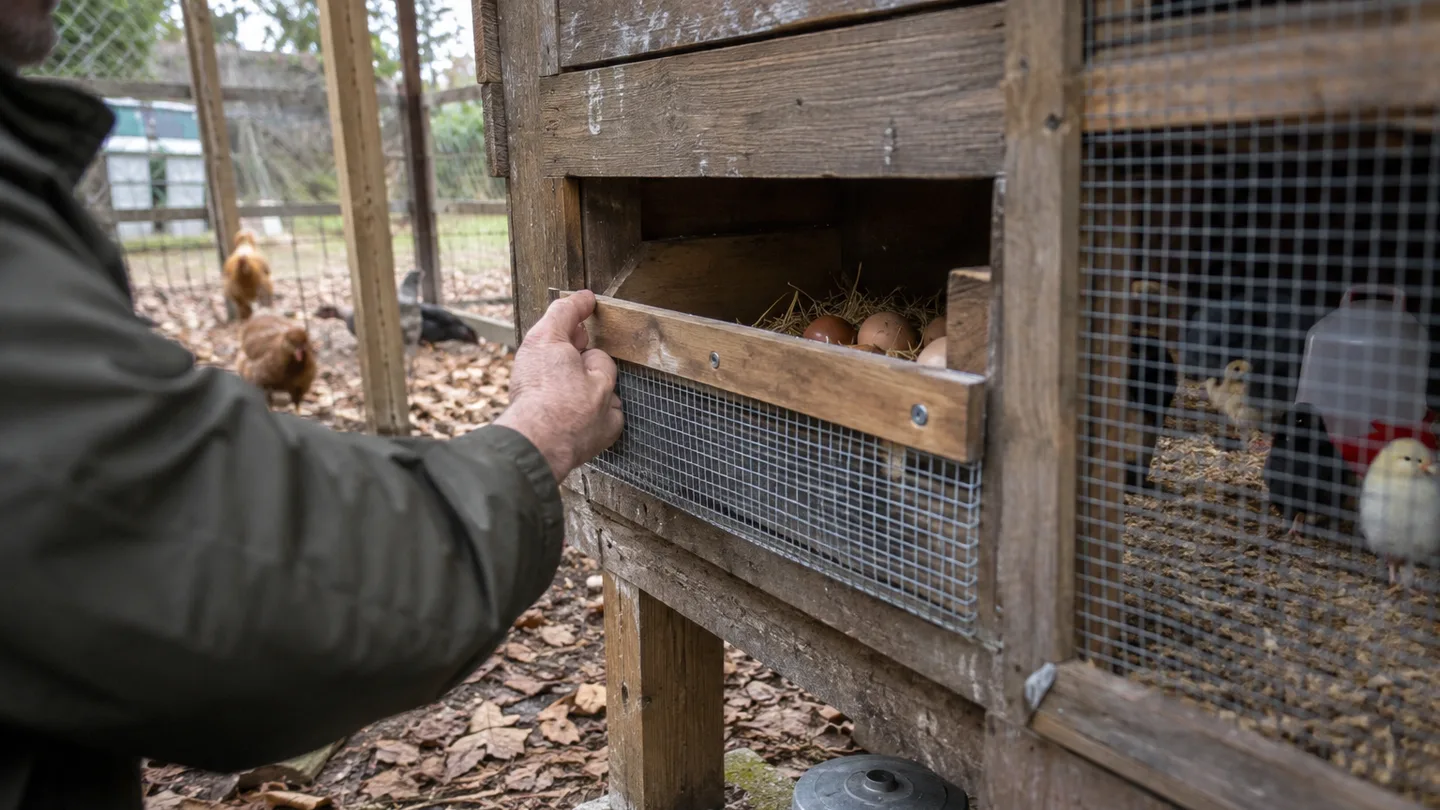
Inspect nest boxes from inside and outside. Remove the box if necessary. Look behind the back panel, below the perch rail, and around any hinge or removable lid. Eggs make these areas worth checking early. If you raise chicks, inspect the brooder as a separate enclosure rather than assuming the main coop repair protects it.
For a broader rebuild, the planning notes in Best predator proof chicken coop are useful alongside this small-opening check.
Fixes 4–5: make the run’s bottom edge and outer 1–2 feet difficult to cross
A snake-resistant run needs a continuous bottom edge and an outside strip you can inspect. Neither feature compensates for an open gate or an unprotected wall where the run joins the coop.
Fix 4 — Add a 1/4-inch mesh barrier with a buried edge or outward apron
For a run that sees repeated snake pressure, a practical starting layout is 1/4-inch mesh rising roughly 24–36 inches above ground. At the bottom, either bury the mesh about 6 inches or turn an outward apron across the soil for about 12 inches. The soil, slope, target species, and gate design can change the final arrangement, so treat those dimensions as a starting point rather than a universal fence specification.
The important part is continuity. Join the lower barrier to the coop wall, carry it through corners, and close the gate threshold. An apron that stops at the first post leaves a gap at the corner. A buried edge that ends before the gate leaves the easiest section unprotected.
Pin an apron flat while the soil settles, and check it after heavy rain. If the ground slopes, follow the actual contour instead of leaving a triangular void under the mesh. The wider perimeter plan belongs with chicken run predator protection, especially if raccoons and digging animals are also part of your problem.
Fix 5 — Keep a 1–2-foot inspection strip clear of grass, boards, and rock piles
Clear a practical 1–2-foot strip outside the run where you can see the bottom edge and reach it with a tool. Keep tall grass, stacked lumber, loose roofing, and dense piles of leaves away from that strip. Remove clutter that hides a lifted mesh edge or gives rodents a place to settle.
This is an inspection zone, not a guaranteed snake repellent. Bare ground won’t make a determined snake disappear. It will make a new gap, track, shed skin, or rodent sign easier for you to notice. That improves the speed of the next repair.
Fixes 6–7: remove the food trail that makes a sealed coop worth revisiting
Physical exclusion comes first, but housekeeping changes the payoff. Some snakes take eggs. Others may be following rodents attracted by spilled feed. Either way, reducing the reward makes a repaired coop less interesting to revisit.
Fix 6 — Lock feed down and deal with rodents without putting chickens at risk
Store feed in a tight-lidded, rodent-resistant container. Sweep up spills rather than leaving them under the feeder, and bring loose feed in at dusk where that fits your routine. Check beneath the feeder and around the wall for dropped grain. A clean floor makes rodent signs easier to spot too.
If rodents are already established, start with how to get rid of rats in chicken coop and choose a method that keeps hens, pets, children, and wildlife away from traps or bait. Enclosed mechanical traps can be useful when placed where chickens cannot reach them. If you consider rodenticide, follow the exact product label and local guidance. Read rodenticide safety guidance for poultry, pets, and wildlife before putting any product near a coop.
Don’t treat feed control as a replacement for sealing. A snake can still enter an open coop even if the floor is spotless. The useful order is barrier first, food reduction second, then a follow-up inspection.
Fix 7 — Collect eggs daily and make chick housing snake-tight
A snake that finds an open nest box has both shelter and a possible food reward. Collect eggs at least once a day. During active snake pressure, check more often if your schedule allows. Egg collection won’t seal a gap, but it reduces the time a reward sits in the same place.
A secure nest box also cannot protect an egg if the snake can enter the coop through a vent, floor seam, or cable hole. Check the whole route, not just the box.
For chicks, use 1/4-inch mesh or a solid-sided enclosure with sealed corners. Cover the top if the brooder is accessible to animals from above, and inspect around heat equipment, cords, and removable lids. A corner that looks harmless at adult-bird scale can be a direct route into chick housing.
A snake is already in the coop: a safe response tonight, then a permanent repair
If you find a snake inside tonight, stop trying to improve the coop for the moment. Keep children, pets, and chickens back. Close nearby doors only if you can do so without moving toward the snake or trapping yourself in the space. Don’t corner, grab, pin, or try to identify an unknown snake at close range.
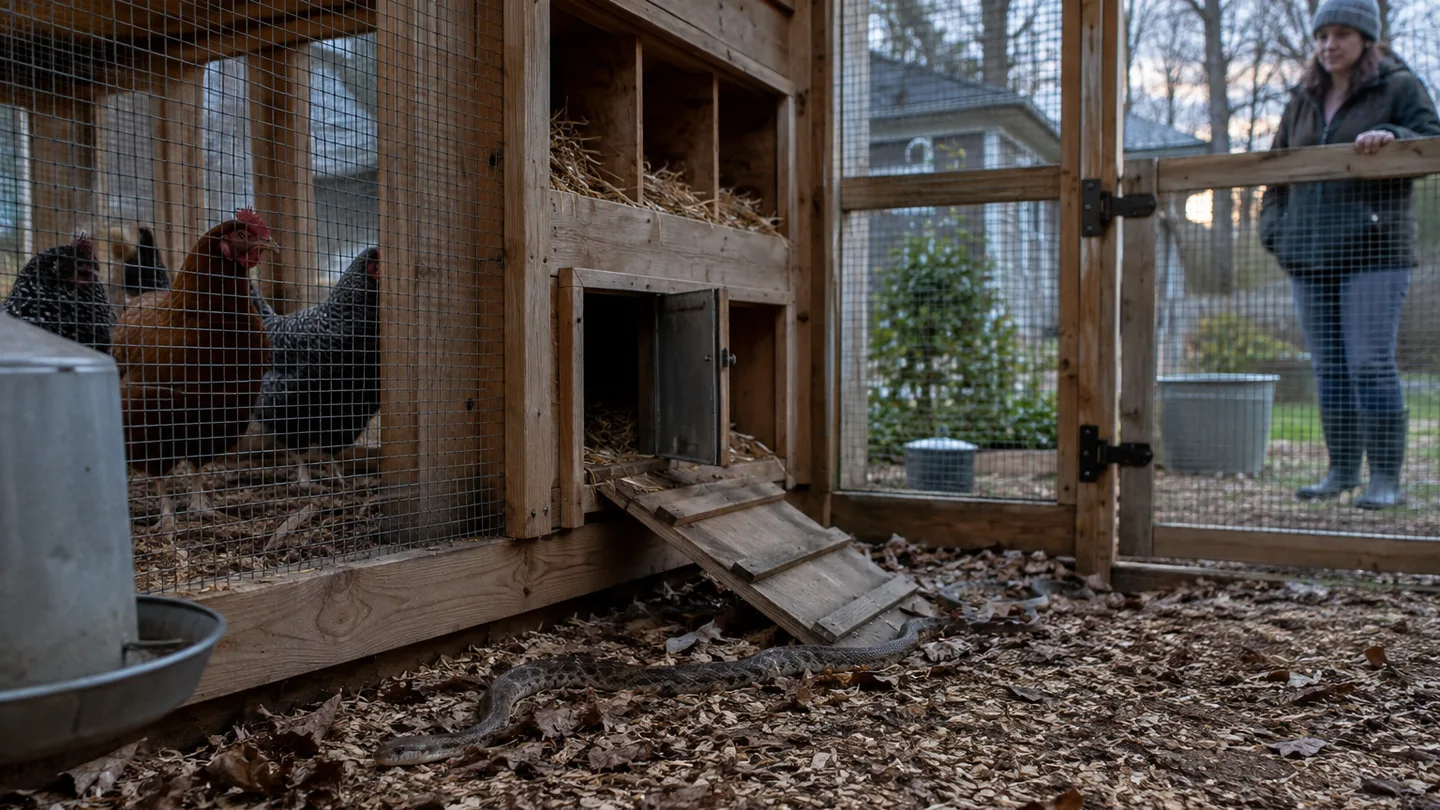
If the animal is venomous, trapped, injured, or simply unfamiliar to you, contact a qualified wildlife remover or your local wildlife agency. For identification, state wildlife agency guidance on local snakes is a better reference than guessing from a blurry phone photo. Take a distant photograph only if you can do it without approaching.
Move the birds only if you have a genuinely secure temporary enclosure ready. Don’t push them toward the snake to flush it out. If a chicken has punctures, swelling, weakness, unusual breathing, or a sudden change in movement after contact, call an avian or farm veterinarian. A snake sighting is a building problem; a possibly injured bird is a health problem.
After the snake is gone, return to the inspection order. Find the exact route. Look for disturbed bedding, a lifted mesh edge, a fresh gap behind a nest box, or a run connection that stops short of the coop. Repair that route, then repeat the light test from both sides. Removal handles the immediate sighting. Sealing the route and removing the reward are what address the repeat visit.
Common questions about keeping snakes out of a chicken coop
Will mothballs or commercial snake repellents keep a chicken coop snake-free?
I wouldn’t put mothballs in or around a coop. They are not a substitute for sealed openings and tight mesh, and a product intended for another use should not be treated as a coop remedy. For a commercial repellent, read the label and check local rules before using it around birds, pets, or wildlife.
Can a snake come back after you remove it from the coop?
It can if the entry route, spilled feed, rodents, eggs, or hiding cover remain. That is why I treat removal as the first response, not the finished repair. Close the route, clean the reward, and inspect again after the next rain or disturbance.
What should you do if you cannot identify the snake?
Keep people, pets, and chickens away. Don’t handle it. Use a distant photo only if it is safe, then contact a local wildlife agency or qualified remover, especially where venomous species occur.
Your next action this week: set a 10-minute timer, photograph every questionable opening, and repair the lowest route first. Once the coop shell is tight, use chicken run predator protection to carry the same logic through the gate, corners, and ground edge.
Frequently Asked Questions
Will mothballs or commercial snake repellents keep a chicken coop snake-free?
No dependable repellent replaces sealed openings and tight mesh. Mothballs are not a safe coop treatment, and any commercial product should be checked against its label and local rules before use around birds, pets, or wildlife.
Can a snake come back after you remove it from the coop?
It can if the entry route, spilled feed, rodents, eggs, or hiding cover remain. Removal handles the immediate sighting; sealing the route and removing the reward handles the recurring problem.
What should you do if you cannot identify the snake?
Keep children, pets, and chickens away, avoid handling it, and use a distant photo only if it is safe. Contact a local wildlife agency or qualified remover, especially where venomous species occur.