Hardware Cloth vs Chicken Wire: Which Keeps Chickens Safer?
For a backyard flock, the short answer is simple: use 1/2-inch welded hardware cloth for the coop and run’s primary barrier. Use chicken wire to keep hens inside a defined area, not to promise that raccoons, foxes, dogs, weasels, or rats will stay out.
That choice matters, but it isn’t the whole fence. A strong mesh on a weak frame is still a weak enclosure. The door, roof, corners, fasteners, ground edge, and latch all have to close the access routes a predator can use.
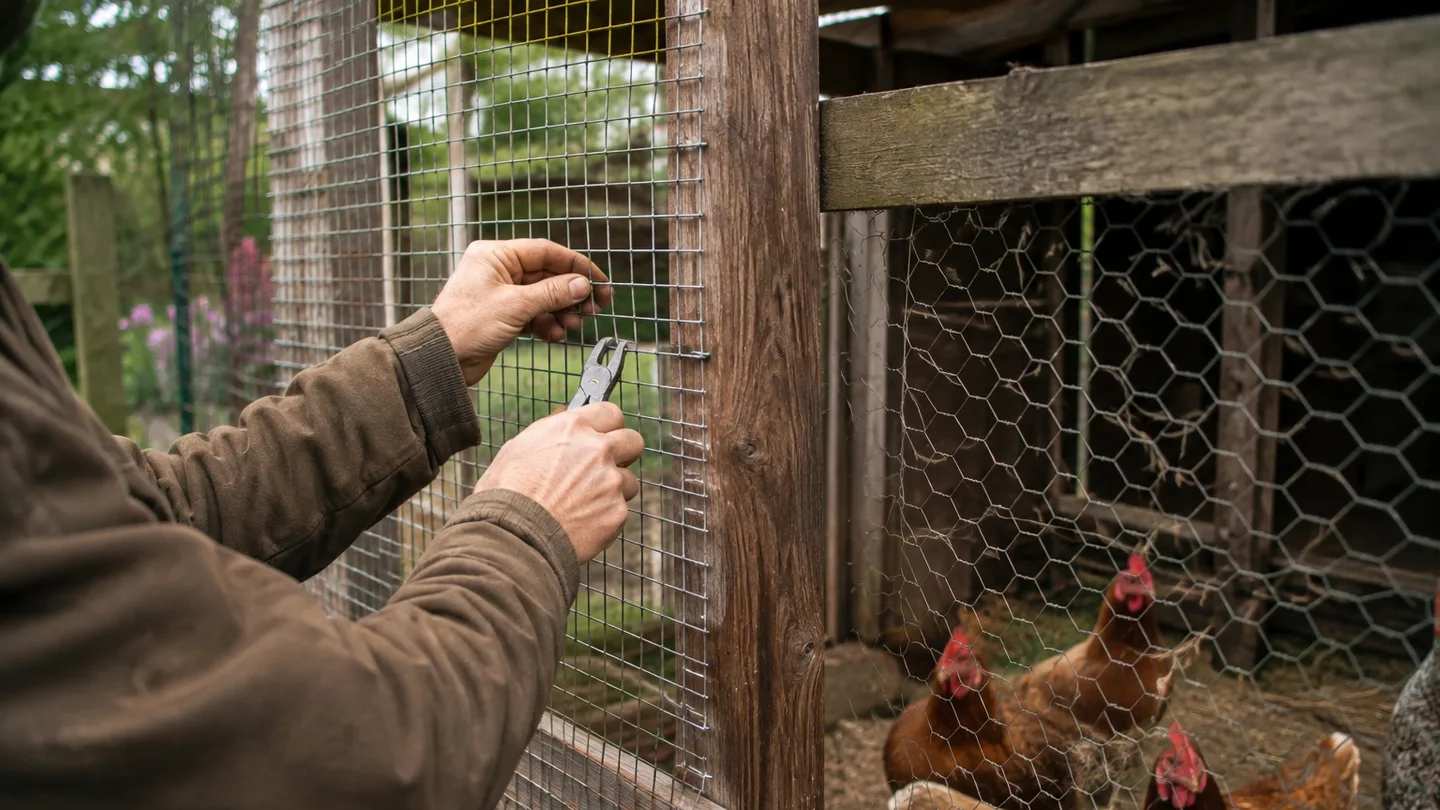
The verdict for a backyard flock: hardware cloth on the outside, chicken wire only where containment is the job
If your birds sleep in the coop or stay in the run while you’re away, make hardware cloth the outside layer. A 1/2-inch opening is a practical backyard baseline because it gives smaller intruders fewer places to reach through, while welded joints are harder to spread apart than light twisted mesh.
Chicken wire still has a job. It can divide a garden, close a supervised daytime extension, or keep hens from wandering into a planting bed. If a product listing calls chicken wire predator proof, ask a narrower question: predator proof against what, and for how long? That wording often hides the difference between containment and exclusion.
In my own small backyard setup, I once used chicken wire for a temporary side panel because it was already on hand. It kept the hens where I wanted them, but I did not treat that panel as the night barrier. When I rebuilt the run, I put hardware cloth on the predator-facing side, closed the lower corners, and moved the temporary wire to a supervised divider. The useful lesson was that chicken wire wasn’t useless. It was simply doing a different job.
The opening is the safety number: 1/2-inch hardware cloth versus 1- and 2-inch hex mesh
At the store, judge the material by its actual opening and wire thickness, not just by the product name. Hardware cloth is generally a welded grid. Chicken wire is generally twisted into a hexagonal pattern. That construction difference affects how easily an opening can widen when a paw, beak, or tool-like claw presses against it.
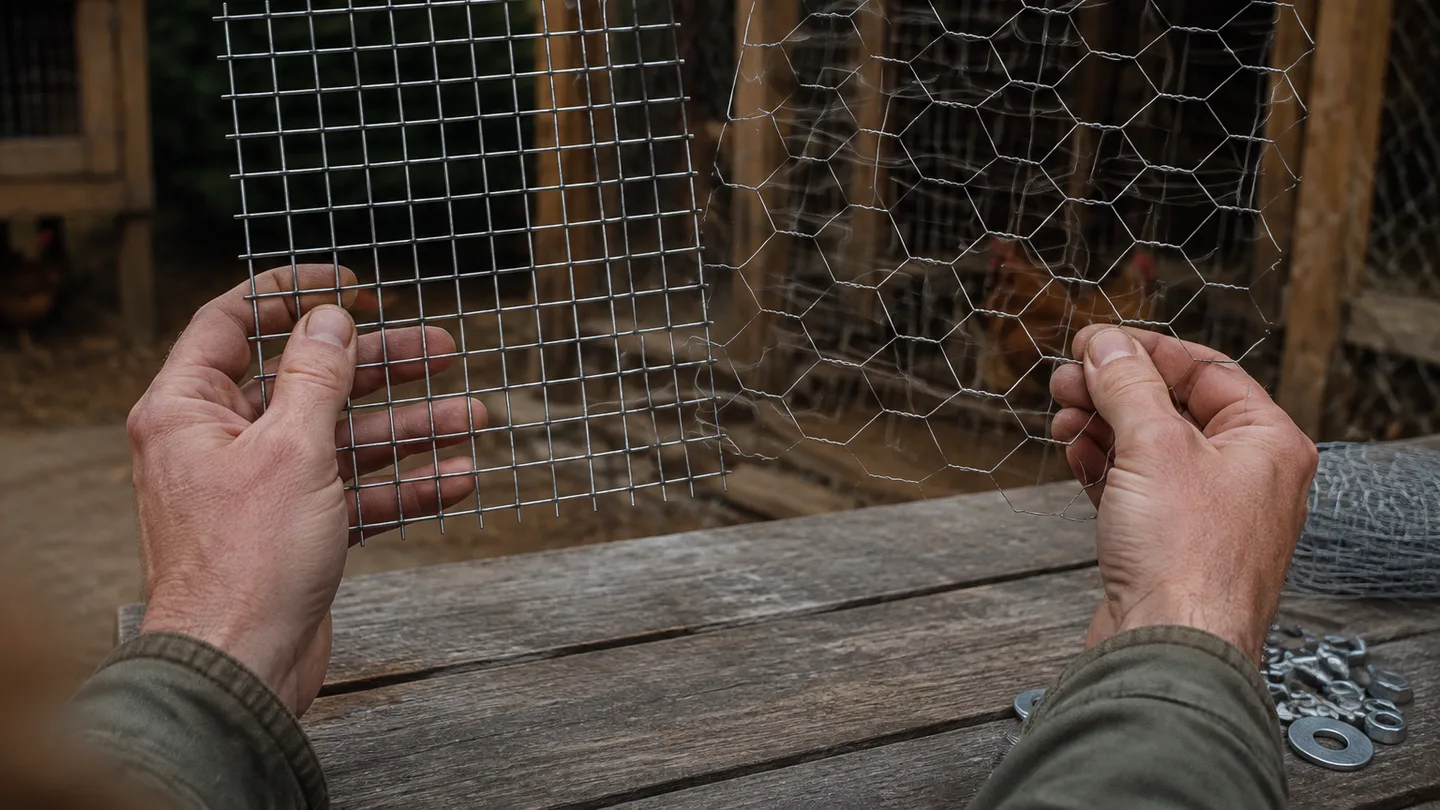
For most small-flock enclosures, I would start with 1/2-inch welded hardware cloth. One-inch mesh leaves more room for reach-through, and 2-inch chicken wire leaves still more. Those larger openings may be perfectly adequate for keeping hens in a low-risk garden section, but they are a poor primary barrier where small predators or determined raccoons are part of the local problem.
Use 1/4-inch mesh selectively around brooder openings, small vents, or other places where a chick or small intruder could use a narrow gap. It can restrict airflow if you cover too much area, so it belongs at vulnerable openings rather than across every wall by default.
Wire diameter matters as well. Gauge labels can vary by product and supplier, so compare the stated wire thickness when you shop. I treat a commonly sold 1/2-inch, 19-gauge roll as a reasonable starting point for ordinary backyard framing. In a high-pressure yard, or where the frame is light and flexible, 16-gauge material is a sensible upgrade. The trade-off is weight, cutting effort, and a higher material bill.
Predator pressure changes the answer: raccoons, foxes, weasels, dogs, rats and hawks
Think of chicken run predator protection as an access-path problem. Each threat tests a different part of the enclosure. The right mesh helps, but it cannot close a gap under the door or stop a hawk entering through an open roof.
| Threat | What it tests | Barrier decision |
|---|---|---|
| Raccoons | Larger openings, loose corners, and simple latches | Use fine welded mesh, close reach-through gaps, and fit a latch requiring two separate actions. |
| Foxes and similar diggers | The soil line beneath the wall or door | Add a buried edge or an outward-facing apron. Do not rely on wall mesh ending at ground level. |
| Dogs | Weak framing, corners, and panels that flex under pressure | Reinforce the frame and fasten the mesh to structural members, not just thin trim. |
| Weasels and mink | Small gaps around doors, vents, seams, and roof edges | Use 1/2-inch or smaller mesh where these small-bodied predators are a concern, and inspect every joint. |
| Rats | Feed access, chick areas, and weak lower sections | Secure the lower perimeter and remove easy feed sources. Mesh cannot compensate for spilled feed left beside the run. |
| Hawks | The open space above the birds | Use a rigid roof, properly tensioned overhead barrier, or solid cover suited to your frame. |
The table gives you the checking order I use: start with the access route, then choose the barrier. Raccoon protection is not just a finer roll of wire. It is fine mesh plus a latch that cannot be worked easily. Digging pressure is not solved by adding another layer to the wall if the soil beneath it stays open. Hawk protection is not solved by burying mesh deeper.
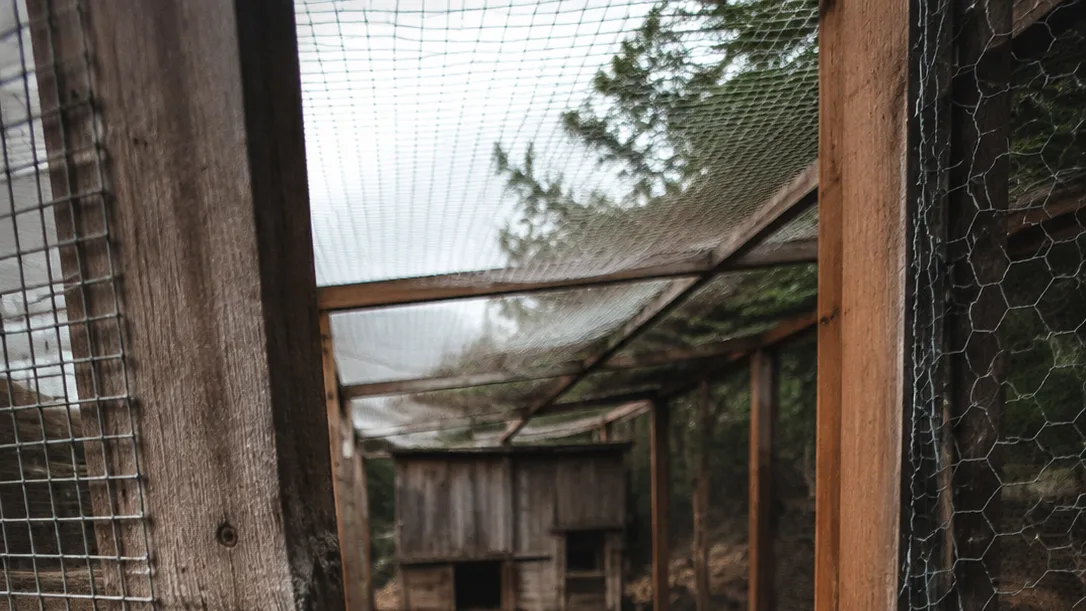
Before buying materials, read University Cooperative Extension guidance on predator-proof poultry housing and fencing, then compare it with state wildlife agency guidance on raccoon, fox, hawk and weasel exclusion. Local predator behaviour varies, and your own tracks, tunnel starts, bent wire, or repeated visits tell you which access path deserves attention first.
Build around the weak points: 12–18-inch dig barriers, 6–8-inch fasteners and sub-1/2-inch gaps
The barrier is only as strong as its attachment. Mount the hardware cloth on the predator-facing side of the frame where possible. That makes it harder for an animal outside the run to push the mesh away from the timber and create a pry point.
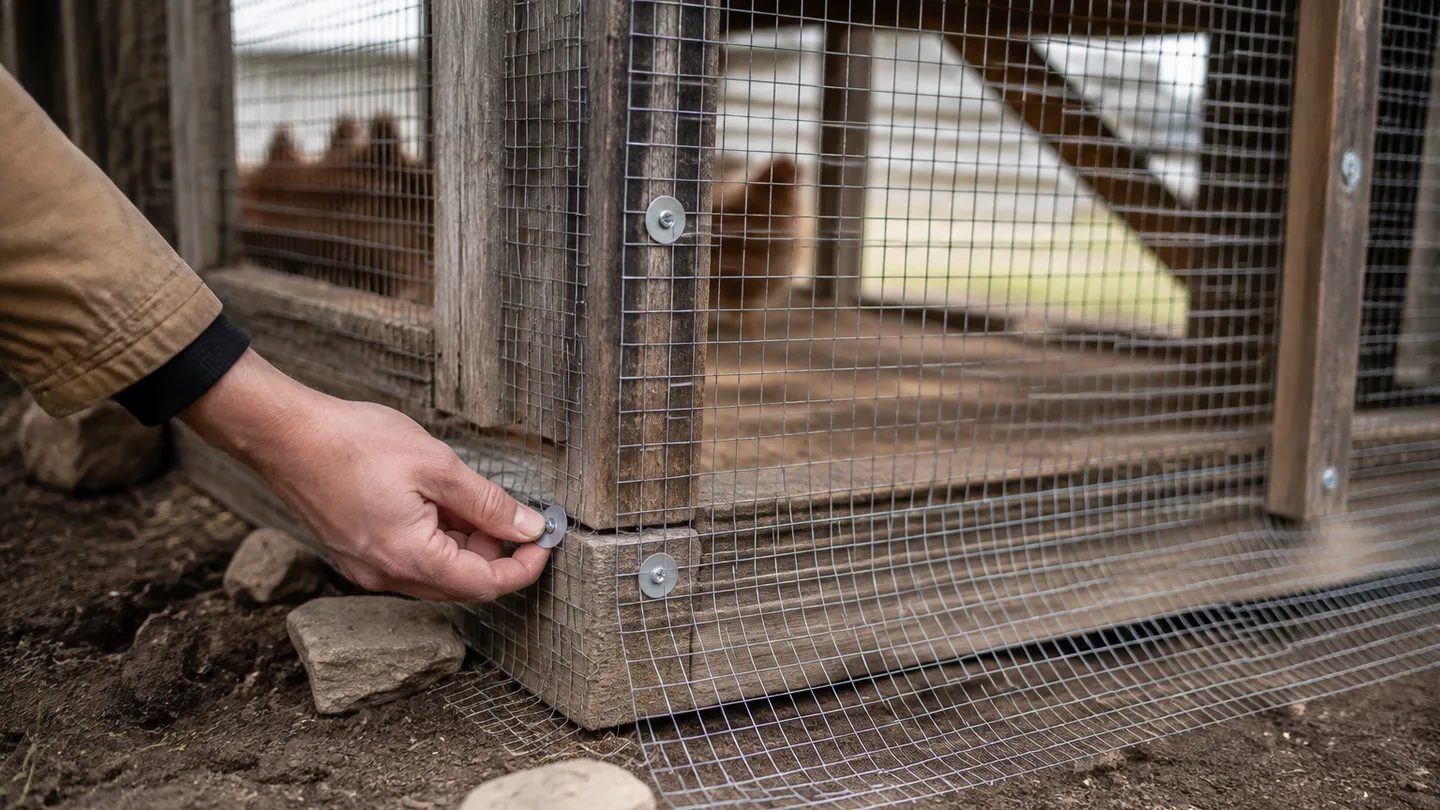
- Fasten the edges closely. Space screws with washers or suitable heavy-duty fencing fasteners about 6 to 8 inches apart along exposed edges. A few widely spaced staples leave long sections that can flex.
- Choose a ground barrier. Bury the mesh at least 12 inches where digging pressure is ordinary. Move toward 18 inches where foxes, dogs, loose soil, or repeated tunnel starts make the risk higher. An outward apron 12 to 18 inches wide, pinned flat under soil or gravel, is often easier to install and inspect. An 18- to 24-inch apron is the better choice when you have room and the yard shows persistent digging.
- Overlap and protect seams. Overlap joined pieces by about 2 to 4 inches and fasten both layers around the seam. Fold or cover cut edges so sharp wire does not sit inside the birds’ walking space.
- Close the small gaps. Keep door gaps, vent edges, and eave openings at or below roughly 1/2 inch where small predators are a concern. A neat wall can still fail at the corner where the door frame meets the floor.
- Secure the roof and latch. Seal eaves and roof joints. Use a latch that needs two separate motions, such as lifting and sliding, rather than a simple hook that a raccoon can work with a paw.
I would not use exposed hardware cloth as the routine walking floor. It can catch toes and create leg injuries, especially when the mesh bends or soil washes away from it. A buried edge or outward apron keeps the wire out of the birds’ feet while still putting it in the predator’s digging path. Keep chicken coop ventilation open and protected rather than sealing every vent; stale, damp air creates a different housing problem.
Price the whole enclosure, not the roll: a 4 × 8 × 6-foot run example for 3–12 hens
A roll price tells you very little until you calculate the surface you need. For a 4 × 8 × 6-foot run, the four walls require 2 × (4 × 6) plus 2 × (8 × 6), or 144 square feet. Add the 4 × 8 roof, which is 32 square feet. The wall-and-roof total is therefore 176 square feet before doors, vents, overlaps, and mistakes.
Add 10% to 15% for cutting and joining. That puts the starting order around 194 to 202 square feet before you calculate a separate buried skirt or ground apron. Do not quietly fold the apron into the wall estimate; measure it as its own strip because its width changes with the perimeter.
Use a chicken run material calculator if you like, but check the arithmetic yourself. Compare current local prices per square foot from at least two suppliers instead of comparing roll prices. Add screws and washers, corner reinforcement, latch hardware, seam patches, and replacement panels to the same list. The cheapest roll can lose its advantage once you need extra fasteners or discover that the supplied wire is too light for the frame.
Chicken wire can reduce the upfront cost for a supervised garden divider, a temporary daytime extension attached to a secure coop, or a low-risk internal partition. It does not create equivalent security around an unattended flock. Before building, also check local municipal rules for backyard poultry structures and enclosed runs.
The monthly fence-line check: repair pulled edges, rust, broken welds and bent latches before reuse
The fence line needs a calendar, not just a strong installation day. I would inspect the enclosure at least monthly and again after a severe storm. In a high-predator yard, give extra attention to the doors, corners, roof edges, and ground barrier because those parts move, settle, or collect debris first.
- Look for openings larger than the mesh you selected.
- Push lightly on the lower edge and check for pulled fasteners or a starting tunnel.
- Run a gloved hand near cut edges and repair sharp points before the hens reach them.
- Check for deep or flaky rust, broken welds, bent frame members, and latches that no longer close tightly.
- Make sure an apron has not lifted out of the soil and that a buried edge is still covered.
A small damaged spot can usually be patched with matching hardware cloth extending at least 2 to 3 inches beyond the damage in every direction. Fasten around the full perimeter of the patch, not just at two corners. Replace a larger section when the surrounding mesh or frame has lost strength; covering a soft, rusty panel with a new patch can leave the same weak structure underneath.
That routine is more useful than chasing a perfect product label. The best chicken predator protection is a barrier you can inspect, repair, and close consistently. Save the 176-square-foot calculation, then rebuild it for your own measurements.
Can you put hardware cloth over existing chicken wire?
Yes, if the frame is sound and the hardware cloth is fastened directly to it. Avoid loose layers that can trap feet or create a hidden gap. Treat the hardware cloth as the real barrier and the chicken wire underneath as backup or containment.
Is welded wire the same as hardware cloth?
No. Hardware cloth is a fine-mesh product, while welded wire is a broad category that may have much larger openings. Choose by actual aperture and wire diameter, not by the product name alone.
Should hardware cloth cover the floor of a chicken run?
Usually not as an exposed walking surface. A buried perimeter barrier or outward apron is the cleaner default. If you bury mesh beneath soil because local digging pressure demands it, keep the birds from contacting sharp wire and inspect the soil cover after erosion.
This week, measure every wall, the roof, and the ground barrier. Price enough 1/2-inch hardware cloth for that calculated area plus 10% to 15% waste, then inspect the coop’s latch and roof before you order. If your next concern is a cold snap, read do chickens need heat in winter alongside chicken coop ventilation so the enclosure stays secure without becoming damp and drafty.
Frequently Asked Questions
Can you put hardware cloth over existing chicken wire?
Yes, if the frame is sound and the hardware cloth is fastened directly to it with no loose layers that can trap feet or create a gap. Treat the hardware cloth as the real barrier, not the chicken wire underneath.
Is welded wire the same as hardware cloth?
No. Hardware cloth is a fine-mesh wire product, while welded wire is a broad category that may have much larger openings. Choose by actual aperture and wire diameter, not by the product name alone.
Should hardware cloth cover the floor of a chicken run?
Usually not as an exposed walking surface. Use a buried perimeter barrier or outward apron instead, and only use buried mesh under soil where local digging pressure makes it necessary and the birds cannot contact sharp wire.