How Much Layer Feed Per Chicken Per Day: A 4-Step Guide
If you're asking how much layer feed per chicken per day, start with 110–130 g of complete layer feed for each standard-size adult laying hen. Use 100–150 g as the wider planning range. A bantam may need less. A heavy breed, cold snap, or flock with little access to forage may need more.
That figure is a starting ration, not a command to fill the feeder and walk away. Feed offered, feed eaten, and feed wasted are three different numbers. Your birds may scatter feed, knock it into bedding, or find extra calories while ranging. The four steps below turn a useful estimate into a number that fits your own flock.
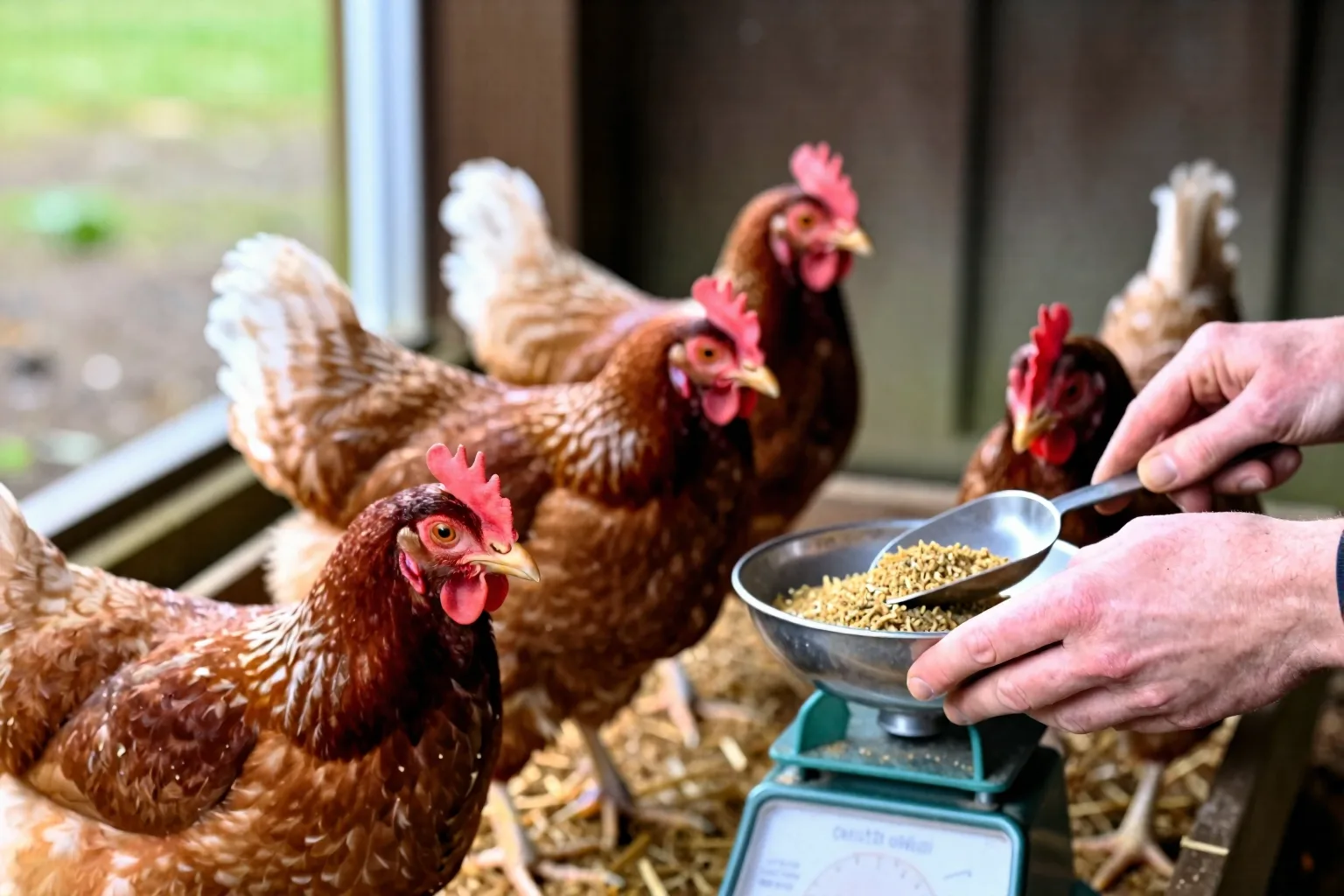
Start with 100–150 g per adult laying hen per day
For a standard-size adult layer, 110–130 g per day is a sensible place to begin. The midpoint, 125 g, makes the arithmetic easy. It also gives you a clean baseline for a seven-day check.
| Bird type | Planning range per day | Practical starting point |
|---|---|---|
| Standard-size adult layer | 100–150 g | 110–130 g |
| Bantam layer | 60–90 g | About 70 g |
| Large or heavy layer | 130–180 g | About 145 g |
These are management bands, not breed standards. Body size supplies the first adjustment. Egg production, weather, ranging, age, and feed waste supply the next ones. A small, active bantam and a large hen eating from the same feeder shouldn't be expected to consume identical amounts.
Keep the distinction clear. Feed offered is what you weigh into the feeder. Feed eaten is what disappears into the birds. Feed wasted is what lands under the feeder, sticks in damp bedding, or is taken by rodents. If you measure only what leaves the bag, you may be measuring a feeder problem rather than a hunger problem.
The most useful backyard target is the amount your birds consume while maintaining steady body condition, normal activity, and the production that is reasonable for their age and season. A chart gets you started. A simple audit beats the chart after that.
Step 1: Count the mouths and match the starting number to your flock
Use this formula:
Number of eligible laying hens × grams per hen per day = starting flock ration.
At 125 g per hen, three standard hens need 375 g per day. Six need 750 g. Twelve need 1.5 kg. Over seven days, those same flocks use about 2.625 kg, 5.25 kg, and 10.5 kg before you account for waste or other feed sources.
Count the birds that are actually sharing the ration. If six layers share one feeder, begin at 750 g. If a rooster, pullet, or chick eats from it too, you have a mixed-flock calculation, not a six-hen calculation. Deal with that separate feed question before trying to make the layer number precise.
Choose the lower end when your birds are small, weather is mild, the flock has reliable access to forage, and the audit shows little waste. Choose the upper end for larger birds, colder conditions, limited ranging, or a flock that repeatedly finishes a clean ration early. Known waste is not a good reason to keep adding feed. Fix the feeder first, then reassess how much the birds actually eat.
Step 2: Put a gram scale between you and the feeder
You don't need farm equipment. A kitchen scale that reads in grams is enough for a small flock. A postal scale works too if your container and ration exceed the kitchen scale's capacity.
- Put a clean, dry container on the scale and tare it to zero.
- Weigh the day's ration before it enters the feeder. Write down the number, even if it is only 750 g.
- Add the feed without overfilling the trough. If useful, split it into a morning and afternoon portion so you can see when the birds run out.
- At the next check, weigh clean leftovers before adding fresh feed. Keep damp or mouldy feed out of the calculation and out of the feeder.
Splitting the ration isn't required. It simply makes the pattern easier to read. If the morning portion is gone by lunch, note that. If clean feed remains the next morning, note that too. A measured ration is not permission to leave your birds without food. If hens finish early and continue searching, calling, or crowding the feeder, offer more and record the change rather than forcing the original number.
Look at the feeder while you're there. A rim around chest or back height can reduce the amount a hen flicks out with her beak, but it must still be easy for the smallest bird to reach. Overfilling increases the material available to spill. A wet feeder turns a good ration into a hygiene problem. For the storage side, use How to store chicken feed so it stays dry and pest-free as a separate checklist.
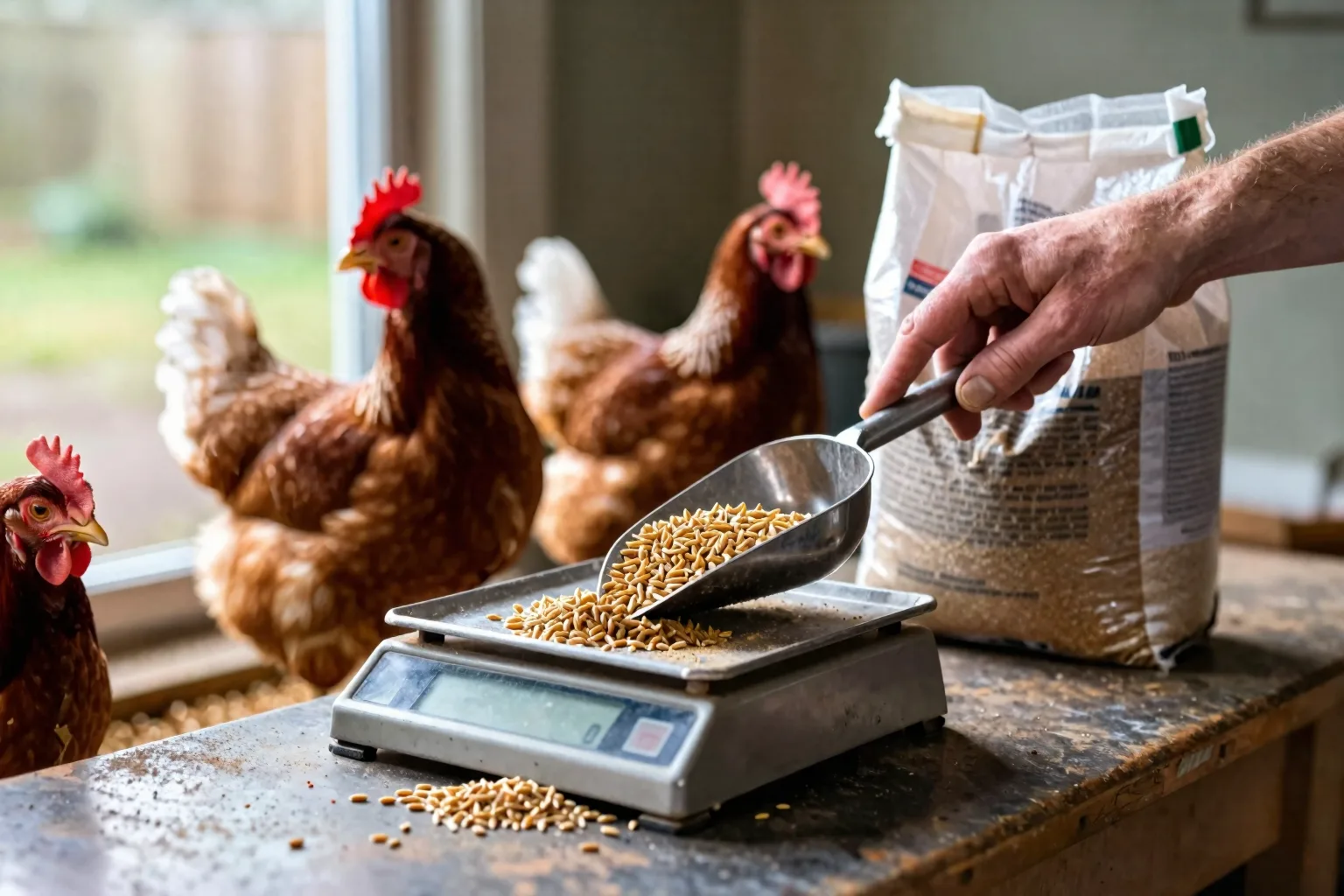
Step 3: Run a seven-day feed audit instead of guessing from one day
One refill can mislead you. A windy day, a spilled scoop, a broody hen, or an open feed bag can distort it. Seven days gives you a more useful working average.
Use this equation:
Feed added − feed remaining − separately collected spill = feed eaten.
>Feed eaten ÷ number of hens ÷ number of days = grams eaten per hen per day.
Here is a complete example. Six hens receive 6.2 kg during the week. At the end, 0.5 kg of clean feed remains in the feeder. You also collect 0.3 kg of dry spill from a tray beneath it and return that feed to storage. The estimated amount eaten is 6.2 − 0.5 − 0.3 = 5.4 kg. Divide 5.4 kg by six hens and seven days: 0.1286 kg, or about 129 g per hen per day.
If spilled feed is mixed with wet bedding and cannot be recovered, don't subtract it as though it were eaten. Record it as waste. Your first audit may tell you that the birds consume 129 g but the feeder removes 140 g from the bag. That difference is exactly the information you need.
Keep a short log with the date, feed added, feed remaining, collected spill, treats, ranging, unusual weather, molt, and any bird that was separated. If you top up the feeder without weighing, mark that day as incomplete. Either estimate openly or restart the seven-day run. False precision makes the final number look more trustworthy than it is.
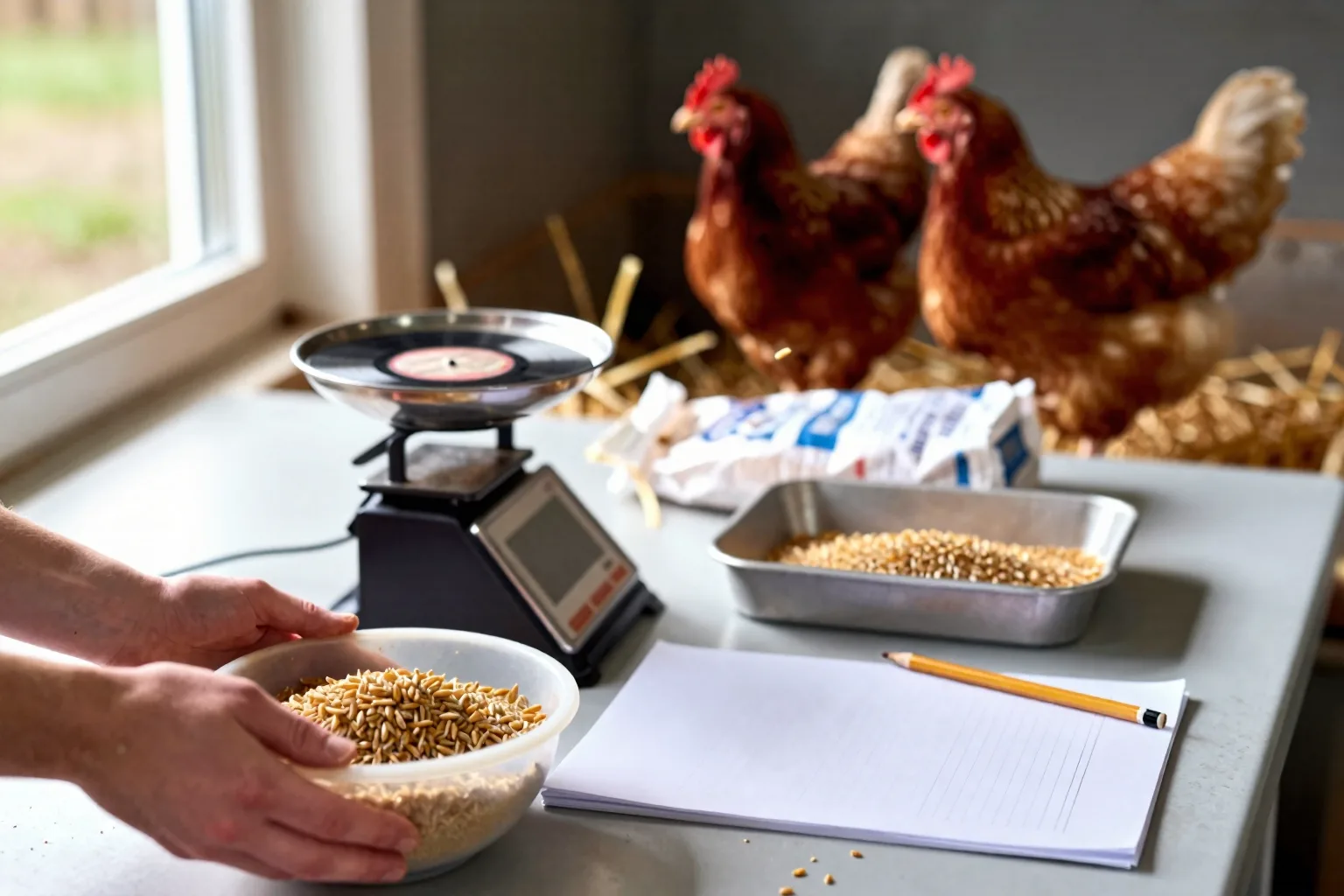
Step 4: Adjust in small increments using leftovers, body condition, and eggs
Make one change at a time. First correct obvious waste, rodent access, wet feed, and bullying at the feeder. Only then change the amount offered.
If the ration is cleanly gone well before the next feeding, your birds remain in good body condition, and water access is normal, increase the daily amount by roughly 10–15 g per hen. For six hens, that is an extra 60–90 g for the flock, not an extra 60–90 g for each bird. Run the new amount for another week before making a second adjustment.
If substantial clean feed remains, waste has been ruled out, and birds are not being prevented from reaching the feeder, reduce the offered amount modestly. A 5–10 g per hen reduction is easier to evaluate than a sudden cut of one-quarter of the ration.
Check the birds, not just the eggs. With gentle handling, feel the breast muscle on both sides of the keel. A sharp keel with declining muscle is a reason to investigate rather than trim feed. Egg count alone cannot set the ration because laying also shifts with age, daylight, molt, heat, water access, and illness. A sudden production drop plus weight loss deserves more attention than a quiet feeder.
Weather, ranging, treats, and molt can move the daily number
Cold weather changes the calculation through energy demand. A bird uses more energy to maintain body temperature in cold conditions, so a flock may eat more even when egg production is unchanged. Increase feed only when the audit, body condition, or repeated early finishing supports it. Do not use unlimited scratch as a substitute for a measured complete ration.
Heat can push intake in the opposite direction. Birds may eat less during the hottest part of the day, then eat more in the cool morning or evening. Shade, clean water, airflow, and easy feeder access matter more than trying to make a hen finish a target number.
Free-ranging is a bonus source of insects, greens, and seeds, not a dependable subtraction from the feeder ration. The amount changes with season, lawn condition, flock size, and how long birds are out. Keep the complete feed available and let the audit show whether ranging is changing intake.
Keep scratch and treats to about 10% or less of the overall diet. Treats can displace the balanced feed that supplies the intended protein, minerals, vitamins, and energy. For a practical safety list and portion ideas, see What treats can chickens eat, and how much is too much?
During molt, keep suitable complete feed available even as egg production slows. Feather growth still requires nutrients. A reduced egg count is not, by itself, a reason to ration a molting hen more tightly.
A mixed flock needs a different feed plan
Regular layer feed is designed around the needs of active laying hens. Its higher calcium level supports eggshell production, while growing chicks and pullets need a ration designed for growth rather than a layer ration by default. A rooster sharing a feeder also means the flock is no longer a hen-only feeding calculation.
For a mixed-age group, an appropriately labelled all-flock or grower ration with free-choice oyster shell in a separate dish is a practical arrangement for many backyard setups. The layers can take shell as needed. Chicks and growing birds are not forced to eat the shell mixed through their main feed.
Use the product label as the controlling instruction because formulations differ. Check When should pullets switch from grower feed to layer feed? before changing a young bird's ration. For unusual ages, poor growth, repeated thin shells, kidney concerns, or a bird with a diagnosed condition, compare the label with current extension guidance on layer-hen feed intake, energy, protein, and calcium requirements and ask a poultry veterinarian or local extension office.
Turn grams into bags, months, and a local feed budget
At the 125 g baseline, one hen uses 0.125 kg per day. Multiply by 30 days and the result is 3.75 kg, or about 8.3 lb, per month. Six hens use 22.5 kg, or about 49.6 lb, before waste, treats, or delivery. That is why a six-hen flock can appear to use one 50-lb bag a month even when the feeder is working well.
For a simple price illustration, suppose a 50-lb bag is priced locally at $20–$35. One hen's 8.3 lb share would work out to about $3.30–$5.80 per month at that baseline. This is a calculation example, not a current price claim. Check your local feed store, co-op, delivery charge, and bag size before building a budget.
A useful formula is monthly feed cost = monthly flock pounds ÷ bag pounds × bag price. Replace the 125 g baseline with the average from your audit. Then add the feed that is genuinely wasted, plus treats and delivery. Don't hide a feeder problem inside a generous waste allowance. Measure it, correct it, and let the monthly figure follow.
For the rest of the running-cost picture, use How much does it cost to feed backyard chickens per month? Your measured feed average will make that budget more useful than a generic per-hen guess.
A sudden change in feed intake is a clue, not a new ration target
If feed suddenly disappears faster, check the delivery system before increasing the ration. Work through this order:
- Water: confirm that drinkers are clean, reachable, and not frozen or blocked. Birds often change feed intake when water access changes.
- Feeder: look for a bridged clump, wet feed, a broken lip, or a feeder that is being emptied onto the ground.
- Pests: inspect beneath the feeder and around the storage bin for rodent access.
- Flock dynamics: watch for a dominant hen blocking smaller birds or a new bird being kept away.
- Conditions: note heat, cold, molt, ranging time, and any recent feed change.
- Bird-level signs: check each hen for weight loss, unusual posture, isolation, or a change in droppings.
The reverse pattern matters too. A bird that refuses feed, loses weight quickly, becomes markedly lethargic, has breathing trouble, severe diarrhea, or cannot stand needs more than a ration adjustment. Persistent refusal to eat, or a sudden change across much of the flock, is a reason to contact a poultry veterinarian or local extension office. A veterinary reference on sudden appetite loss, weight loss, and reduced egg production in hens can help you organise observations, but it shouldn't replace an examination when a bird is deteriorating.
Tomorrow, weigh 125 g for each adult standard-size layer, write the starting number on a seven-day log, and record every top-up and leftover. At the end of the week, adjust by a small amount only if the birds and the waste check point in the same direction. Then carry that measured average into How much does it cost to feed backyard chickens per month?