How Much Feed for 20 Chickens Per Day? Measure It in 2 Steps
If you’re filling a feeder for 20 birds and wondering whether 2 kg is enough or 4 kg is waste, start with 2.3–3.0 kg (5.0–6.6 lb) per day. That answer assumes 20 adult, standard-size laying hens eating a complete layer ration.
Use about 2.5 kg (5.5 lb) as your first measuring point. It isn’t a hard ration cap. Your flock’s real number comes from weighing what goes in, weighing what remains, and repeating the check for several days.
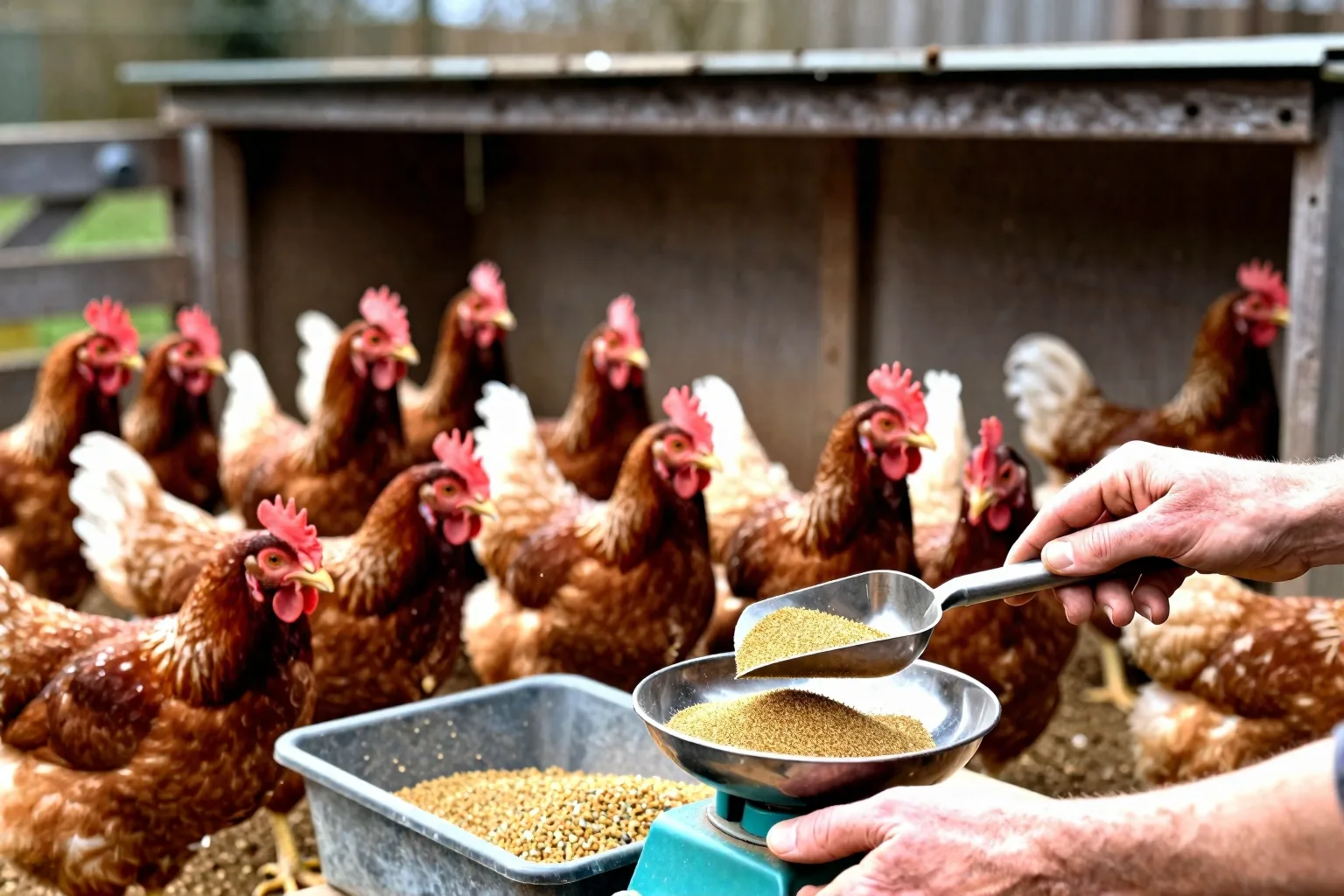
2.3–3.0 kg is the starting range for 20 adult laying hens
For planning, use roughly 110–150 g per adult standard-size layer per day. Twenty birds at the low end calculate to 2.2 kg. The practical shopping range rounds that lower edge to 2.3 kg, while 150 g per bird gives 3.0 kg.
| Planning point | 20-bird flock | Approximate pounds | Use |
|---|---|---|---|
| 110 g per bird | 2.2 kg | 4.9 lb | Exact low arithmetic point |
| 115 g per bird | 2.3 kg | 5.1 lb | Rounded lower planning point |
| 125 g per bird | 2.5 kg | 5.5 lb | Useful first test amount |
| 150 g per bird | 3.0 kg | 6.6 lb | Upper planning point |
If you’re asking how many pounds of chicken feed per day, the table gives you the working answer: about 5.0–6.6 lb for this particular flock. Don’t read 2.5 kg as a quota that your hens must not exceed. If they finish it early, check whether they have spilled feed or whether the flock genuinely needs more. If they leave feed, check whether it is clean and usable before cutting the next offering.
For 30 days, the practical estimate is roughly 68–90 kg (150–198 lb). The exact multiplication from 2.3 kg is 69 kg, so the lower monthly figure is rounded for planning. At a 50-lb bag size, that is about three to four bags. Multiply that bag count by the current local price, and check the actual bag weight, taxes, and bulk discount before building a budget. The article How Much Does It Cost to Feed Chickens Per Month? is the better place to rebuild the calculation for your own feed price.
Step 1: Weigh everything that enters the feeder over 24 hours
Choose a clear 24-hour boundary. Seven in the morning works well if you can repeat it. The goal isn’t to make feeding fussy. It’s to stop confusing a full feeder with a measured daily amount.
- Choose a scale. Use a scale that can handle the bucket and feed. A kitchen scale is handy for small top-ups. A parcel or hanging scale is more practical for a full bucket.
- Tare the container. Put the empty bucket on the scale and zero it, or weigh the empty bucket once and subtract its weight every time.
- Weigh the opening feed. At the start of the test, weigh the clean feed already in each feeder. Add the amounts together if you use more than one feeder.
- Weigh every top-up. Don’t estimate a scoop. Put the feed in the bucket, record the weight, then pour it into the feeder.
- Record the basics. Write down the date, time, feed type, opening weight, and each addition. Keep scratch, kitchen scraps, and treats on a separate line.
Your first formula is simple:
Opening feed + feed added = total feed offered.
Here’s a worked example. At 7 a.m., the flock has 2.2 kg in its feeders. You add a 0.5 kg top-up during the day. The total offered is 2.7 kg. Record 2.7 kg even if the feeder still looks nearly full. The feeder’s shape tells you very little about its weight.
If you have two feeders, weigh the feed going into each one and add the figures. Keep the same layer feed in the test if possible. Changing from pellets to mash, or mixing a large amount of scratch into the feeder, makes the comparison harder to interpret.
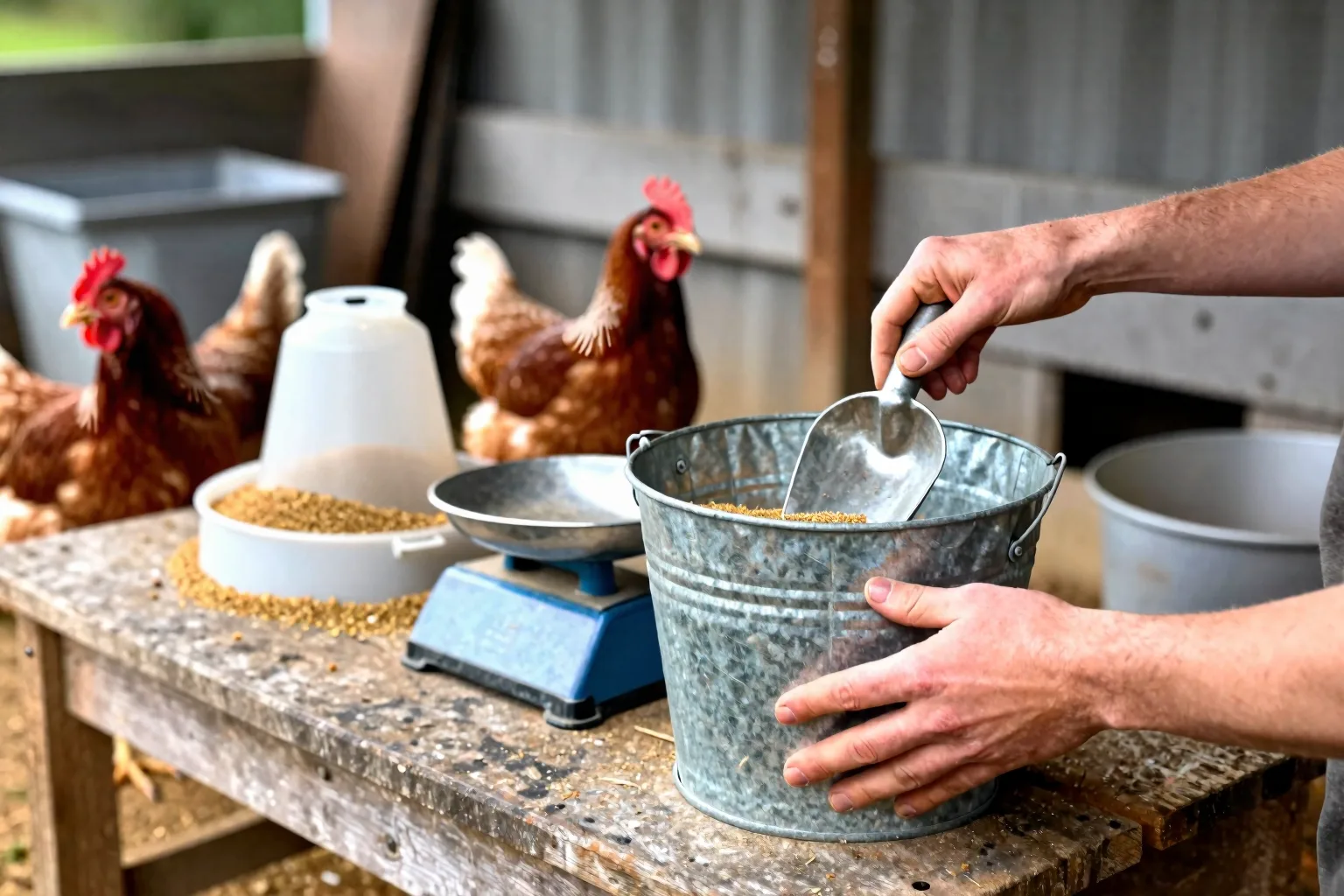
Step 2: Subtract leftovers, then average three to seven days
At the same time the next morning, weigh the feed that remains. Count only feed that is dry, clean, and usable. This is your closing usable stock.
The complete formula is:
Opening stock + additions − closing usable stock = feed disappearance.
- Clean, dry feed that can go back into the feeder counts as usable closing stock.
- Wet or moldy feed is waste. Keep it out of the leftover figure.
- Feed spilled under the feeder is not automatically feed eaten. Weigh it separately if it is clean enough to recover; otherwise record it as waste.
Suppose your three daily records look like this:
- Day 1: 2.70 kg offered − 0.40 kg usable leftover = 2.30 kg disappearance.
- Day 2: 2.55 kg offered − 0.25 kg usable leftover = 2.30 kg disappearance.
- Day 3: 2.65 kg offered − 0.30 kg usable leftover = 2.35 kg disappearance.
The three-day total is 6.95 kg. Divide by three and you get an average of about 2.32 kg per day. Divide that flock average by 20 birds: 2,320 g ÷ 20 = 116 g per bird per day.
That 116 g is a flock average, not proof that every hen ate exactly the same amount. A dominant hen may reach the feeder first. A shy bird may eat later. The number is still useful because it gives you a repeatable baseline for the group.
Three days is a workable minimum. Seven days gives you a steadier baseline because temperature, laying activity, feeder behavior, and ranging can change from one day to the next. Write a short note beside any storm, heat wave, cold snap, molt, feed change, or unusual spill. Those notes often explain a strange result better than another decimal place.
Age, weather, waste, and flock mix can move the number
Your measured result is a starting point to interpret, not a target to force. Before changing the amount, separate genuine feed use from feed that disappeared for another reason.
Find waste before changing the ration
A feeder set too low can invite scratching. A feeder filled to the brim can let birds toss feed while they search for preferred pieces. Rain can turn feed into a damp mass. Rodents and wild birds can remove feed when your flock isn’t watching. Each event makes the feeder look emptier without telling you how much your hens actually swallowed.
Here’s a useful diagnostic example. Your 20 hens receive 2.7 kg each day. You find 0.2 kg of clean, dry feed on the ground below the feeder. If you collect and weigh that spill separately, the usable-food figure is roughly 2.5 kg, or 125 g per bird, before considering ranging or treats. Raise or reposition the feeder, reduce how full it is, and repeat the test for three days. The first fix is often better feeder control, not a smaller ration.
Use the right baseline for the right birds
The 2.3–3.0 kg estimate is for adult standard-size layers. Chicks need starter guidance. Growing pullets need grower guidance. Meat birds need a strain- and age-specific plan rather than an adult-layer estimate. The weighing formula works for all of them, but the planning range does not. Read the bag label and compare it with feed-label guidance from a local feed mill or state feed-control authority before switching rations. For a mixed-age flock, Layer Feed vs All-Flock Feed for a Mixed-Age Backyard Flock covers the separate decision about feed type.
Body size, activity, egg output, and access to pasture can all move the daily figure. Cold weather can increase the energy your birds need to maintain body temperature, while hot weather can reduce appetite. In heat, check cool, clean water and easy access before trying to push more feed. Pair this log with veterinary or extension guidance on heat stress and water access if the weather is severe.
A molt can change both appetite and egg production. Free-ranging can add insects, seeds, and greens that you haven’t weighed. Scratch grains and kitchen scraps can add calories too, but their contribution is inconsistent. Keep complete feed as the main ration, and don’t subtract a guessed amount from the feeder. Use Safe Treats for Chickens: What Counts as Extra Feed? if extras are becoming a daily habit.
Know when measuring isn’t enough
Use this checking order when the number changes sharply:
- Confirm that water is clean, available, and reachable by every bird.
- Confirm that every hen can reach a feeder and that no feeder is blocked or empty for part of the day.
- Look for ground feed, wet feed, rodent access, and rain damage.
- Note heat, cold, molt, ranging, treats, or a recent feed change.
- Check the flock as a whole for body-condition changes and a marked production decline.
A sudden intake change alongside lethargy, breathing trouble, persistent diarrhea, or a clear health decline is not a weighing problem to solve at home. Separate the measurement notes from the symptom notes and contact a poultry veterinarian or a qualified local extension office.
Three quick answers before you start
How much feed do 20 chickens need for a month? For 20 adult layers at the starting range, plan roughly 68–90 kg, or 150–198 lb, over 30 days. Convert that amount using the bag weight you actually buy, then multiply by the current local price. A 50-lb bag count will not match a 40-lb bag count.
Do scratch grains and kitchen scraps reduce the complete feed? Don’t make a guessed subtraction. Keep complete feed available as the main ration, keep extras modest, and use the two-step log to see whether treats are displacing feed or simply adding to the flock’s total intake.
Can you use this method for 20 chicks or meat birds? Yes. Weighing offered feed and usable leftovers works for any flock size. Do not carry over the 2.3–3.0 kg adult-layer estimate. Use the starter, grower, or broiler guidance for the birds’ age and type.
This week’s action: choose tomorrow’s weighing time, set a bucket and scale beside the feed bin, and record the next three mornings. Continue to seven days if you can. Keep this line beside the log: measure what goes in, subtract clean leftovers, separate waste, average, then divide by 20. If hot weather is driving the question, read How Much Water Do Chickens Need in Hot Weather? alongside the feed record.
Frequently Asked Questions
How much feed do 20 chickens need for a month?
At the adult-layer starting range, 20 birds use about 68–90 kg (150–198 lb) in 30 days. Convert that to bags using the bag weight, then multiply by current local prices rather than relying on a universal cost.
Do scratch grains and kitchen scraps reduce the amount of complete feed I should offer?
Don't subtract a guessed amount. Keep complete feed as the main ration, keep extras to a small share, and use the two-step measurement to see whether treats are displacing feed or simply adding calories.
Can I use this two-step method for 20 chicks or meat birds?
Yes, the weighing formula works for any flock, but the 2.3–3.0 kg adult-layer estimate does not. Use the starter, grower, or broiler feed label for the birds' age and type.