How Much Feed Per Chicken Per Day? Grams by Flock Size
Six medium laying hens at 120 grams each use 720 grams a day—21.6 kilograms in 30 days, before a single spilled kernel is counted. That’s the practical answer to how much feed per chicken per day: start around 100–150 grams of complete feed for an adult, medium-sized layer, then replace the estimate with a seven-day measurement.
Your birds aren’t machines. One may eat less than another. A feeder can also lose feed to scratching, rain, rodents, or a bird that flings pellets onto the ground. So treat the number as a planning band, not a ration you force down every hen.
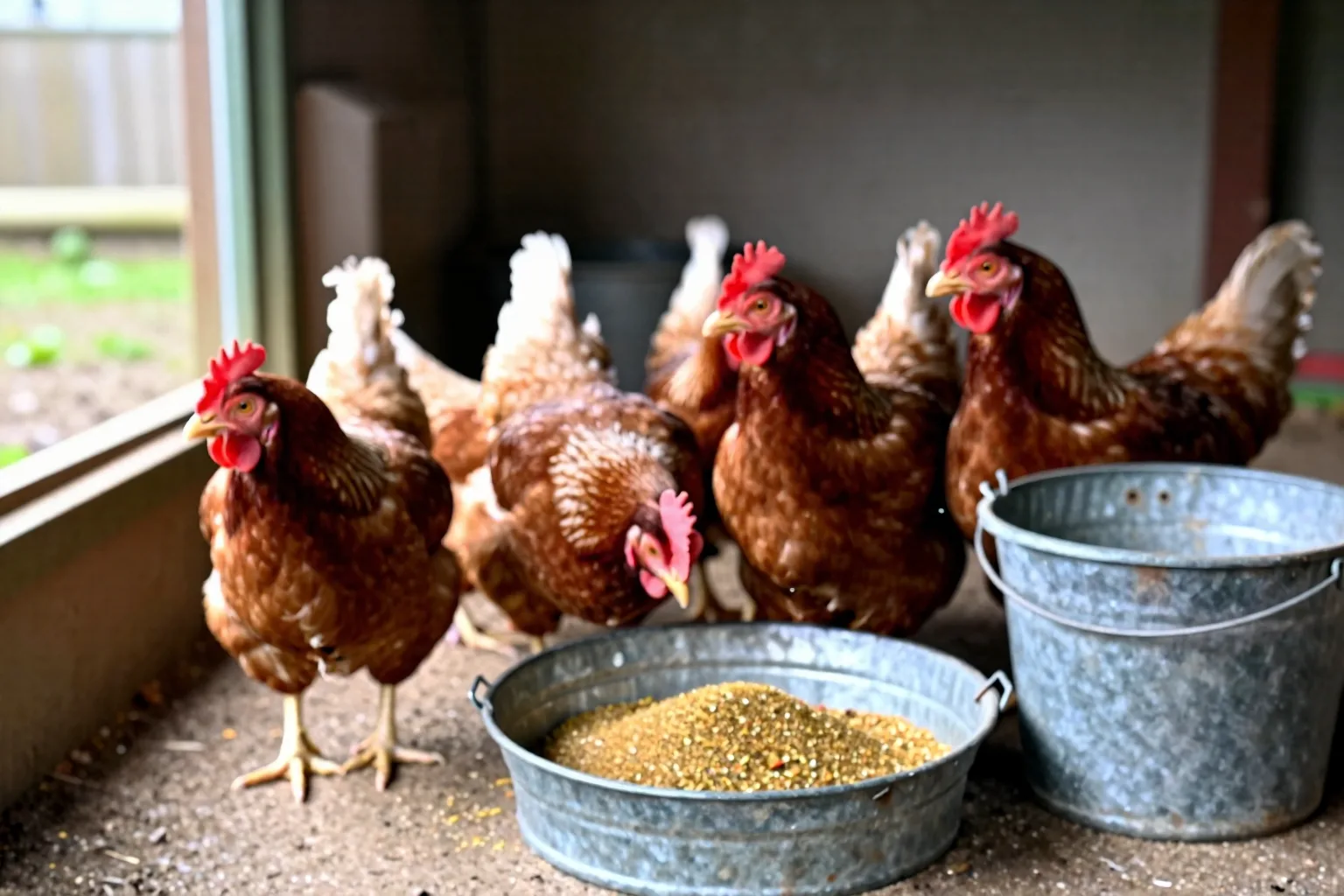
For adult laying hens, start with 100–150 grams of feed per day
For a medium-sized adult laying hen eating a complete layer ration, 100–150 grams per day is a useful starting range. For most small-flock planning, 110–120 grams per bird per day is the figure to put on the shopping list.
The lower end suits a smaller or less active bird under mild conditions. The upper end gives you room for a larger bird, colder weather, higher activity, or feed that is not being eaten cleanly. That doesn’t mean every hen in those conditions needs exactly 150 grams. It means you shouldn’t build a budget around the lowest possible number and then wonder why the bin empties early.
Keep one distinction clear: feed offered is not the same as feed eaten. If you pour 120 grams into a feeder and find it empty, some of that may be under the feeder or in a rodent’s nest. Your real intake is what was added minus usable leftovers and measurable waste.
For a backyard flock, complete feed is usually easiest to offer free-choice in a dry, secure feeder. You’re supplying the balanced base ration and allowing each bird to eat according to size, activity, and appetite. Portioning one exact scoop per hen sounds tidy, but it breaks down as soon as one bird is dominant at the feeder or another is laying, molting, or unwell.
This range is for adult layers. It is not a chick ration, a pullet-growth ration, or a meat-bird target. Compare the product’s intended stage with extension guidance on layer-hen feed intake and with commercial layer-feed labels before changing feed type.
The flock-size math: daily grams and 30-day totals
Use the table as a shopping estimate. Each row assumes the stated grams are actually eaten by every adult hen. The totals are therefore before feeder waste.
| Flock size | 100 g per bird | 120 g per bird | 150 g per bird |
|---|---|---|---|
| 3 hens | 0.30 kg/day >9 kg/30 days | 0.36 kg/day >10.8 kg/30 days | 0.45 kg/day >13.5 kg/30 days |
| 6 hens | 0.60 kg/day >18 kg/30 days | 0.72 kg/day >21.6 kg/30 days | 0.90 kg/day >27 kg/30 days |
| 9 hens | 0.90 kg/day >27 kg/30 days | 1.08 kg/day >32.4 kg/30 days | 1.35 kg/day >40.5 kg/30 days |
| 12 hens | 1.20 kg/day >36 kg/30 days | 1.44 kg/day >43.2 kg/30 days | 1.80 kg/day >54 kg/30 days |
The calculation is simple: multiply birds by grams per bird, divide by 1,000 to get kilograms, then multiply the daily total by 30. For six hens at 120 grams, that is 6 × 120 = 720 grams per day and 720 × 30 = 21,600 grams, or 21.6 kilograms.
These are not promises about what your flock will consume. They are clean starting assumptions. A 30-day total also makes comparison easier between a feed bag and your actual bin. If your flock has three hens, the low-to-high band is 9–13.5 kilograms before waste. For twelve hens, it is 36–54 kilograms.
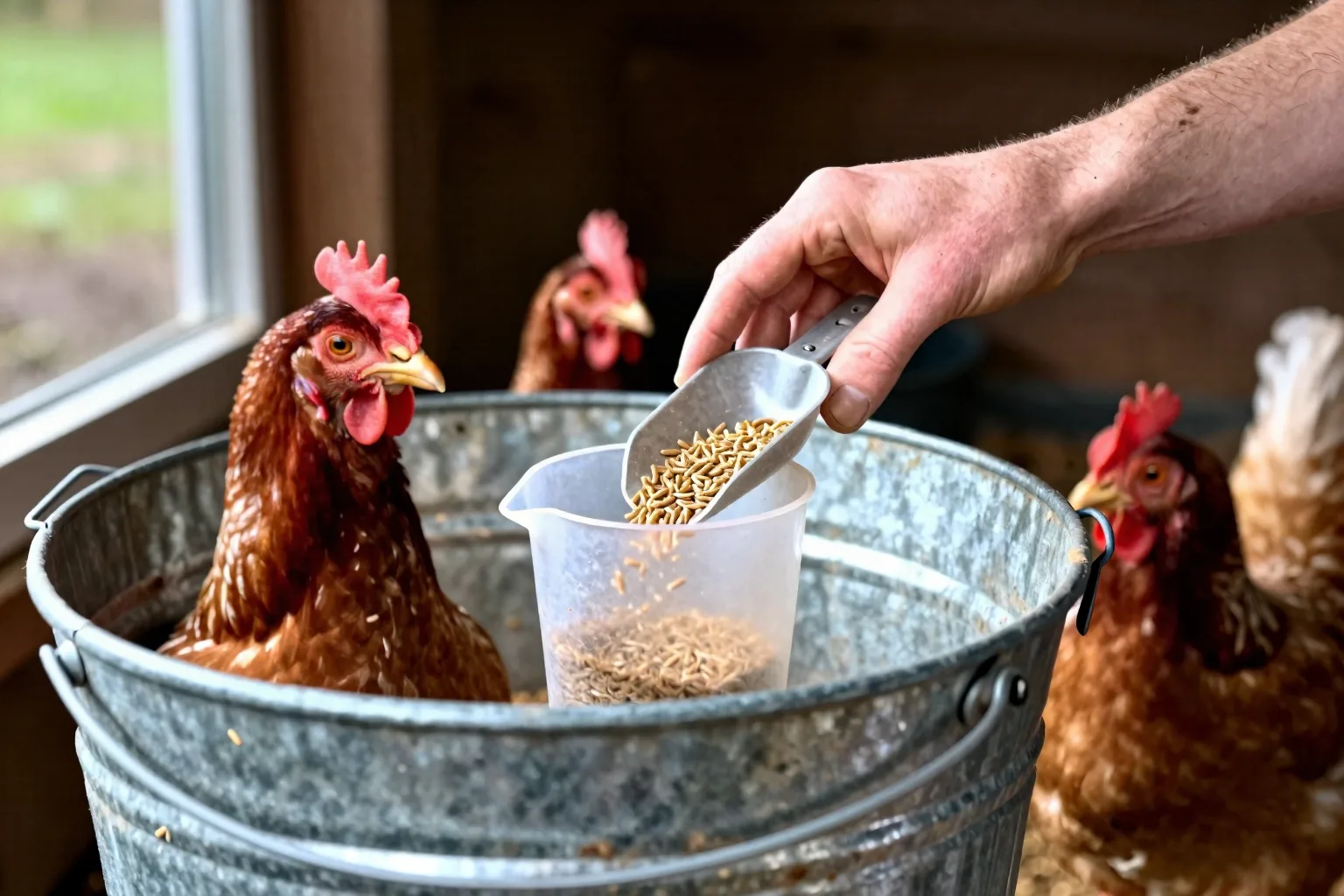
When 100 grams is not enough—or is more than your bird needs
Body size is the first adjustment. A compact bantam and a heavy dual-purpose hen do not have the same maintenance needs. More body mass and more movement require more energy to cover, so a single gram figure cannot fit both birds neatly.
Age is a firm boundary. Chicks need an age-appropriate starter. Growing pullets need a grower ration until the product label says they should move on. Adult layer feed is formulated for a different stage. Applying an adult number to a chick ignores both the chick’s rapidly changing body size and the purpose of its feed.
Laying rate and molt complicate the picture. A hen producing fewer eggs may visit the feeder less, but a bird in feather replacement still has a nutritional job to do. Don’t read a temporary egg drop as proof that the whole flock needs less food. Look at body condition, feather regrowth, appetite, and the calendar together.
Weather can move intake in either direction. A cold snap can increase the energy a bird needs to maintain body temperature. Hot weather can reduce feeding activity, especially during the warmest part of the day. Shelter, shade, ventilation, breed, and access to water all affect what you see at the feeder.
Free-ranging adds movement and may add forage, but it doesn’t give you a reliable subtraction. A bird working a large grassy yard in spring is not eating the same extras as one scratching over bare ground in late winter. If feeder use changes suddenly, inspect the feeder, feed freshness, water, droppings, flock hierarchy, and the birds themselves before changing the ration.
A bird that is persistently off feed, weak, struggling to breathe, unable to stand, or showing severe diarrhea needs more than a feed adjustment. Separate it safely if needed and contact an avian or livestock veterinarian. Feed math is useful for a stable flock. It is not a diagnosis.
Run a seven-day feeder audit before changing the amount
The cleanest way to find your flock’s real number is to measure disappearance for one ordinary week. A 5-kilogram kitchen scale, a bucket you can tare, a pencil, and a note on your phone are enough. The point is to follow the feed through the system rather than guess from how often you refill the hopper.
- Count bird-days. Six hens present for seven full days create 42 bird-days. If one hen is separated for two days, record 40 bird-days instead. Keep the bird count consistent with the feed area you are measuring.
- Weigh every addition. Tare the empty bucket, add the feed, and record the weight before it goes into the feeder. Don’t estimate a scoop by volume. Pellets, mash, and crumbles pack differently.
- Measure what remains. At the end of the week, weigh usable dry feed left in the feeder. Collect visible feed beneath it and record that separately. Wet, fouled, or moldy feed is waste, not a leftover that can be credited back to the flock.
- Do the subtraction. Use: feed consumed = feed added − usable leftovers − spilled or spoiled feed. Divide that result by bird-days, then multiply by 1,000 if you want grams per bird-day.
- Compare the result with the birds. Record egg numbers, body condition, molt, weather, and any pecking or feeder crowding. A neat number that comes from a flock with poor access to feed is not a successful target.
Here’s a concrete example. Six hens are present for all seven days, so the denominator is 42 bird-days. You add 5.50 kilograms. At the end, 0.28 kilograms is still clean in the feeder and 0.18 kilograms is collected from the floor. That leaves 5.04 kilograms consumed. Divide 5.04 by 42, and the result is 0.12 kilograms, or 120 grams per bird per day.
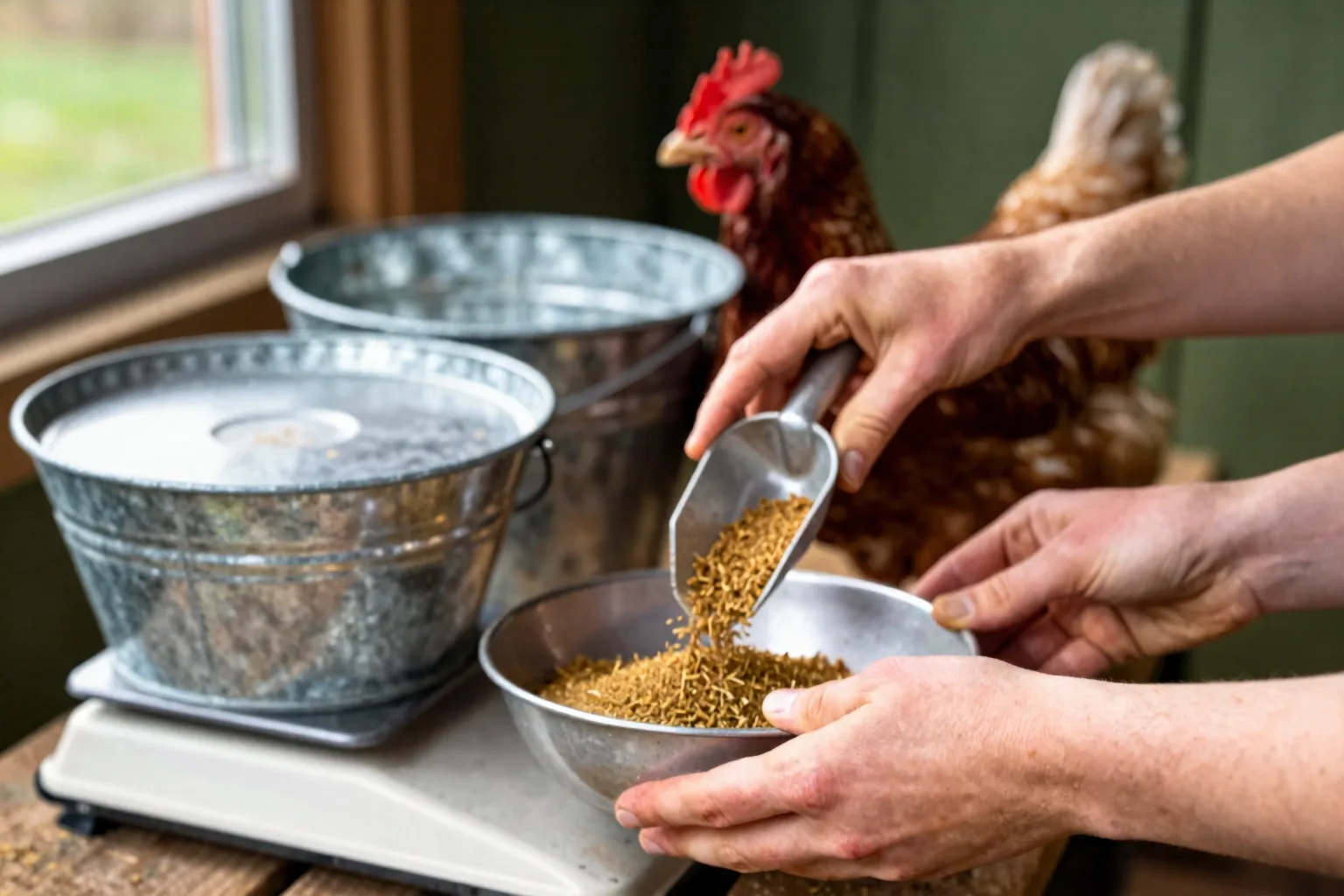
Run the audit during normal weather first. If a cold snap, heat wave, molt, or illness changes the week, write that beside the result instead of treating it as your permanent flock average. After two comparable audits, the measured figure is more useful for your birds than a generic number copied from a feed scoop.
If waste is the problem, fix the feeder before increasing the ration. A feeder filled too high invites scratching. A narrow lip, poor height, rain exposure, or rodent access can turn a reasonable daily allowance into an expensive disappearance. If the birds are eating the measured amount and still losing condition, that is a health or nutrition question, not a reason to keep adding feed blindly.
Free range changes the extras, not the complete ration
A free-ranging hen may eat grass, seeds, insects, and fallen fruit. Those extras can change how often she visits the feeder. They are too seasonal and uneven to subtract confidently from the complete-feed estimate, though. A lush yard and a dry, picked-over yard are different feeding environments.
Keep complete feed available and use the 90/10 rule as a practical ceiling for deliberate extras: aim for roughly nine-tenths of intake from complete feed and no more than roughly one-tenth from treats, scratch, and table leftovers combined. Treat that as a keeper’s guardrail, not a laboratory boundary. A handful of corn can be harmless in context and still become a poor replacement for a balanced ration if repeated all day.
For a safer treat routine, see What Treats Can Chickens Eat? A Safe 90/10 Feeding Guide. It helps you separate occasional extras from foods that displace the feed your birds need.
If your birds eat whole grains or substantial fibrous forage, offer suitable insoluble grit separately. Complete pellets may need less supplemental grit than a diet built around whole grains, so match the setup to what your birds actually swallow. For calcium, follow the feed label. Separate oyster shell or another labelled calcium source can give laying hens access without making a rooster or nonlaying bird eat a layer-level calcium ration.
If winter is also on your list, read What to Feed Laying Hens in Winter before adding a heater. The practical judgment is to check ventilation and dryness first: a heater can raise temperature, but it does not remove wet bedding or stale, humid air. If feeder crowding or muddy ranging is part of the issue, How Much Space Do Chickens Need in a Coop and Run? is the more relevant next check.
From grams to bags: build your monthly feed budget
Once you have a daily figure, the shopping calculation is straightforward:
Monthly feed in kilograms = grams per bird per day × number of birds × 30 ÷ 1,000.
Then calculate bags:
Bags needed = monthly kilograms ÷ kilograms per bag.
For six hens eating 120 grams each, the monthly requirement is 21.6 kilograms before waste. A nominal 50-pound bag weighs about 22.7 kilograms, using 453.592 grams per pound. That means one 50-pound bag is close to one month of feed for this example, but it does not leave much room for spilled feed, rodents, rain, or a flock that actually averages 130–150 grams.
If your audit finds 0.90 kilograms of waste during that month, your purchase requirement is 22.5 kilograms rather than 21.6. That is why the bag can empty sooner than the table predicts even when the birds’ eaten intake is ordinary.
For cost, multiply the kilograms you need by your local price per kilogram. If feed is sold by the bag, multiply the number of bags by the current price of that specific bag. Check current local prices at the feed store or retailer; bag size, formulation, region, and season can change the comparison. The article How Much Does It Cost to Feed Chickens Per Month? is the natural next step once you have your measured kilograms.
Store feed in a clean, dry, covered container that rodents cannot open. Keep it off a damp floor and away from rain, condensation, and spilled water. Buy an amount you can use while it remains fresh, and follow any date or storage guidance printed on the product.
Write your flock’s measured daily figure on the feed bin. For the six-hen example, that note would read 0.72 kilograms per day and 21.6 kilograms per 30 days, both before waste. When the flock changes, the weather turns, or the feeder is replaced, run the audit again rather than trusting the old note.
How much should a chick eat per day?
Do not apply the adult 100–150 gram range to chicks. Offer an age-appropriate chick starter free-choice and follow the product label for the chicks’ age and the feed’s formulation. Intake rises quickly during the first six to eight weeks as body size changes, so a single adult-style daily allowance is especially unhelpful during that period.
Does a rooster need the same amount of feed as a hen?
Not necessarily. Body size and activity matter more than sex alone. A large, active rooster may eat more than a medium hen, while a smaller rooster may eat less. In a mixed flock, a correctly labelled all-flock ration can usually be shared, with calcium offered separately to laying hens. Don’t assume a standard layer ration is the right choice for every nonlaying bird.
Should chickens be fed once or twice a day?
For a small backyard flock, complete feed can be offered free-choice in a dry, predator-resistant feeder. Scheduled servings can work too. For feed budgeting, the total that disappears after leftovers and waste are removed matters more than whether you split that amount into one serving or two.
The useful number isn’t what disappears from the feeder. It’s what your birds eat after you subtract leftovers and waste.
Your next action this week: put a scale and notebook beside the feeder, record every addition for seven days, and write the resulting grams-per-bird-day on the feed bin. Use that measured number for your next bag and monthly budget.
Frequently Asked Questions
How much should a chick eat per day?
Do not apply the adult 100–150 gram range to chicks. Offer age-appropriate chick starter free-choice, explain that intake rises quickly during the first six to eight weeks, and direct readers to the feed label for the product and age of their chicks.
Does a rooster need the same amount of feed as a hen?
A rooster's intake depends mainly on body size and activity, not sex alone. A large, active rooster may eat more than a medium hen; a mixed flock can usually share an appropriate all-flock ration with calcium offered separately to laying hens.
Should chickens be fed once or twice a day?
For a small backyard flock, complete feed is commonly offered free-choice in a dry, predator-resistant feeder. Scheduled servings can work, but weighing the total daily amount matters more than whether it is split into one or two feedings.