Do Possums Eat Chickens? The Real Risk to Your Flock
At 10 p.m., a possum under the nest box is usually shopping for an easy meal, not stalking your biggest hen. So, do possums eat chickens? Yes. But a healthy, alert adult hen is generally a less convenient target than an egg, a chick, spilled feed, or a bird that cannot get away.
That difference changes what you should fix first. You do not need to make your whole yard possum-free. You need to remove the easy food, close the easy route, and give your hens a secure place to sleep after dark.
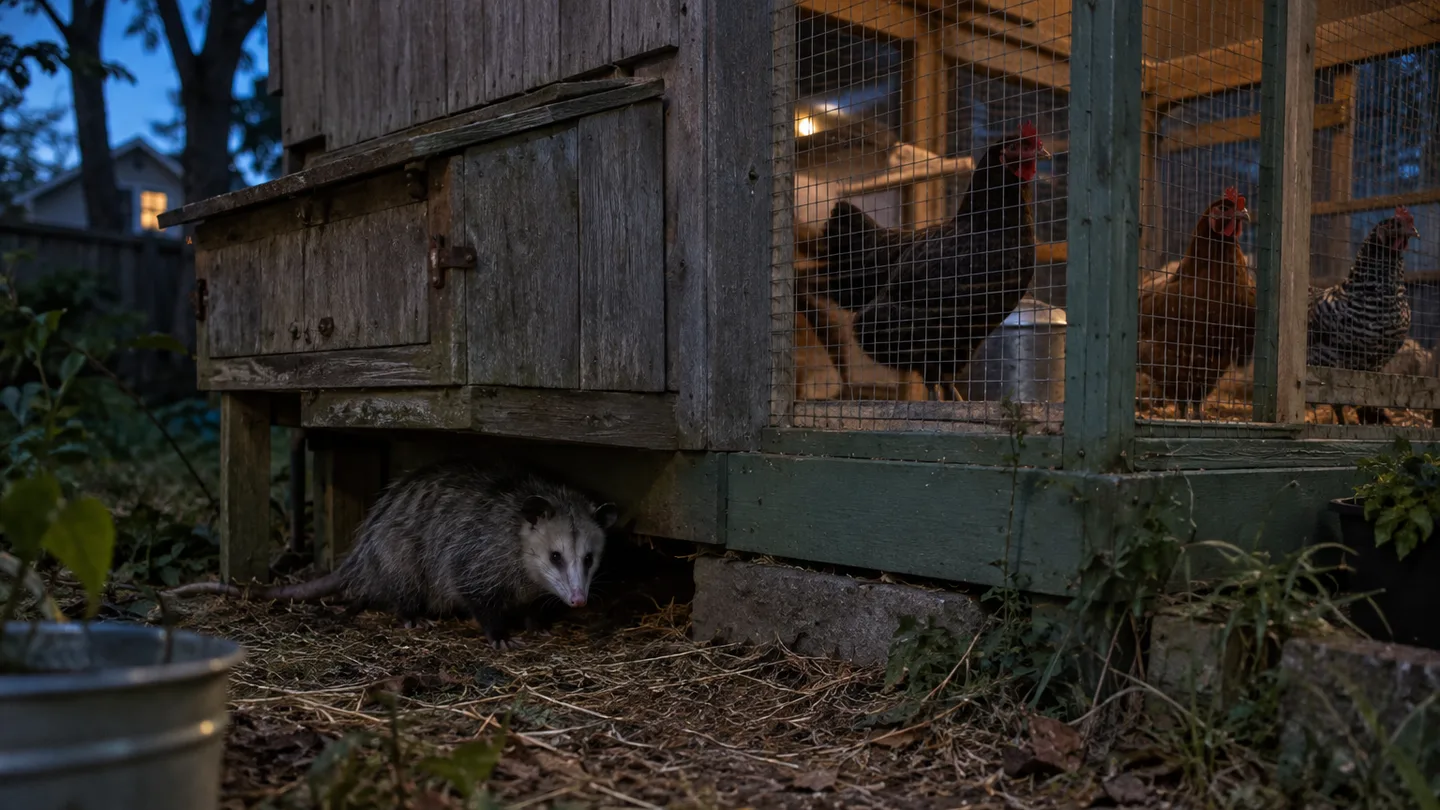
The honest answer: yes, but a healthy adult hen is not the usual meal
Possums are opportunistic feeders. In a backyard, that means they may investigate anything edible or vulnerable around your coop. Eggs are simpler to take than a moving hen. Chicks are small, slow, and unable to escape a run the way an adult bird can. A sick, broody, sleeping, cornered, or injured hen faces a different level of risk from an alert adult bird on a clear floor.
My practical risk scale for a small flock is low to moderate for a healthy adult hen in a closed, sound coop; higher for eggs and chicks; and higher again when a bird is trapped, injured, or exposed in an open run overnight. That is a decision-making scale, not a measured attack rate. It tells you where to spend your time first.
When keepers ask about possums attacking chickens, I would not begin by trying to identify the animal from one feather or a disturbed nest. I would first ask what was accessible after dark. A loose pop door, an open feeder, or a nest box with an outside gap can turn a passing visitor into a repeat visitor.
Why a backyard coop attracts possums after dark
A coop offers three things a wandering possum can use: food, water, and shelter. Layer pellets spilled beside the feeder count. So do cracked eggs, kitchen scraps, fallen fruit, pet food, and an unsecured rubbish bin near the run. The birds themselves are not always the main attraction.
Start with a dusk routine. Remove scraps before night settles. Collect eggs at least once a day, and more often if a hen tends to break them. Do not leave an open feeder beside the coop overnight if you can bring it into a secure space or use a container that closes properly. Sweep up obvious feed around the run entrance.
This will not make a residential yard unattractive to every wild animal. That is not the target. The target is removing the easy reward directly beside your birds. Exclusion works better than trying to control every fallen berry, insect, or hiding place across the whole property.
If you remove overnight food and close a sound coop, I would expect possum visits to become less rewarding and less likely to continue. That is a practical prediction, not a promise. A trail camera can tell you whether the prediction holds in your yard.
Eggs, chicks, and adult hens: a practical risk ranking
Use this table as a repair priority list rather than a claim about exact odds. The ranking changes if your birds free-range, sleep in a low nest box, or have a weak opening in the run.
| What is exposed | Practical risk | Why the risk changes |
|---|---|---|
| Uncollected eggs | Higher opportunity | They are quiet, stationary, and easy to carry or eat. |
| Chicks | Higher opportunity | They are small, less mobile, and may be unable to reach a protected corner. |
| Healthy adult hens | Lower to moderate in a secure coop | An alert adult bird is larger, mobile, and harder to handle than an egg or chick. |
| Broody, sleeping, sick, or injured hens | Higher than a normal adult | The bird may stay still, fail to retreat, or be unable to defend its space. |
That last row is the condition that flips the answer. A hen that looks safe during the day may be much less safe if she sleeps on the floor, gets trapped behind a feeder, or has an injury that slows her down. Check for those practical weaknesses before deciding that a possum is targeting adult chickens as a preferred food.
For chicks, the barrier matters more than the label on the predator. A brooder, grow-out pen, or small chick run needs openings small enough to prevent an animal from reaching through. A chick that can be seen but not reached is still exposed if the mesh can be pulled, bitten, or lifted away from its frame.
Possum clues versus raccoon, rat, snake, and hawk damage
No single clue proves that a possum was responsible. Feathers, broken eggs, and scattered bedding show that something happened. They do not identify the visitor by themselves. Start with timing, access, and the physical pattern together.
- Possum: Keepers commonly report missing or damaged eggs, disturbed bedding, tipped feed, and activity around the coop after dark. I would look for a low access point, a loose panel, or a door that was not fully shut.
- Raccoon: Keepers commonly report more forceful disturbance around lids, nest boxes, feed containers, and weak door hardware. A torn feed bag or a lid pulled out of position points me toward checking latch strength before blaming the mesh.
- Rat: Small gnaw marks, narrow access gaps, spilled feed, and damage concentrated around stored grain make rodents worth checking. Rats can also create a separate risk for chicks and eggs even when the adult hens look untouched.
- Snake: A swallowed or missing egg with little other mess makes me inspect narrow gaps, roof joins, and the route into the nest box. Snake access can be easy to miss because the opening may not be large enough for a larger mammal.
- Hawk: In a closed, covered run, hawks generally are not the daytime risk they are for open-range birds. I treat hawk exposure as an open-run and daylight problem first, then inspect the roof and upper sides if birds are still exposed.
Set a camera aimed at the pop door, nest-box side, or feeder for two or three nights if the visitor keeps returning. The point is not to create a perfect wildlife study. It is to replace a guess with a record of what approaches, when it arrives, and which opening it tests.
A camera also keeps you from making the wrong repair. If the actual visitor is a rat, a heavy latch may not address the feed spill. If the visitor is a possum testing the run door, replacing the nest-box liner will not solve the access problem.
The 1/2-inch mesh and latch details that close the easy route in
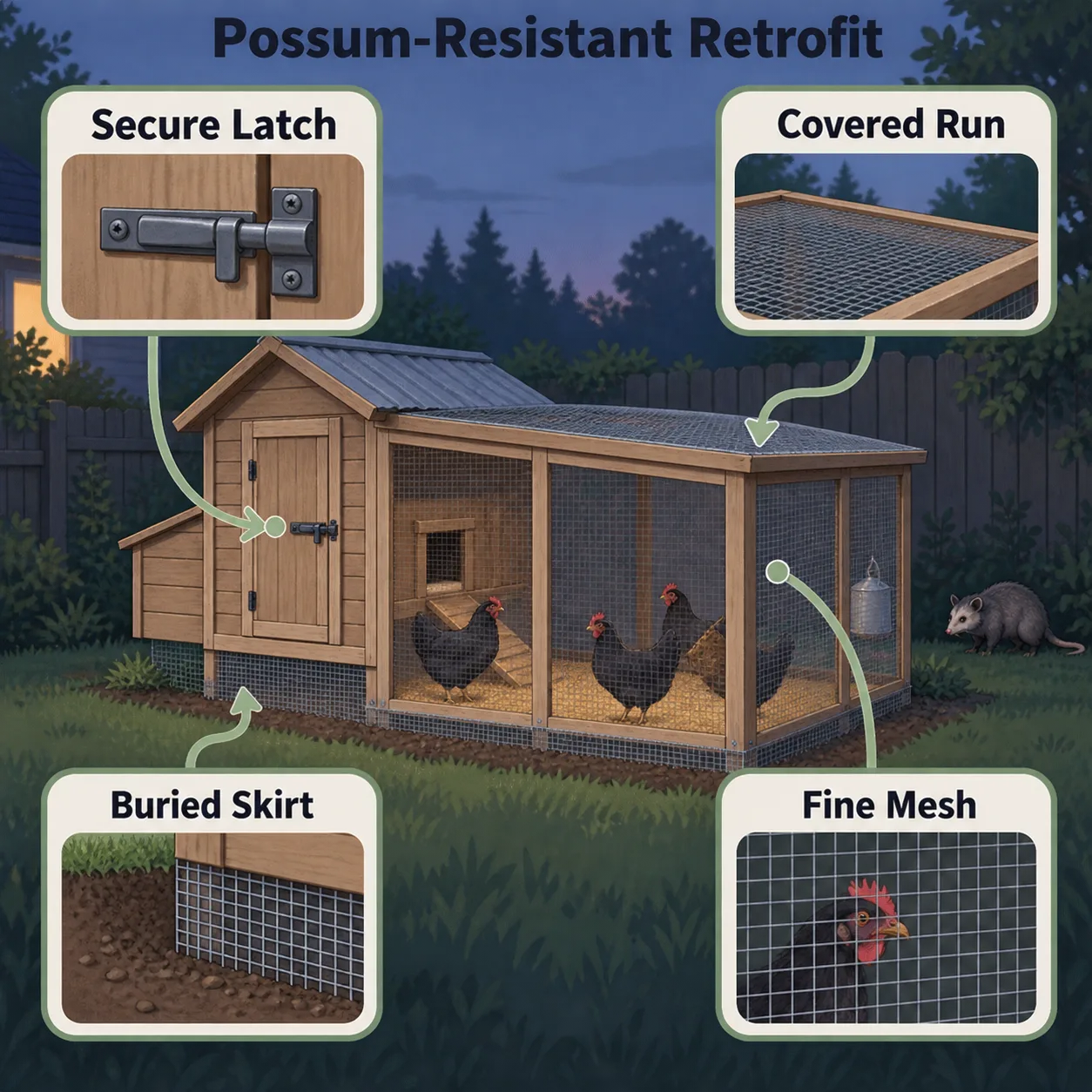
For vents, run sides, roof edges, and openings around a pop door, I prefer 1/2-inch welded hardware cloth attached firmly to a frame. The small openings make it harder for a possum to reach through, and the welded construction gives you a more dependable barrier than loose, easily distorted wire.
Chicken wire can contain hens, but I would not treat it as a complete predator barrier. The practical difference is covered in hardware cloth vs chicken wire: one is mainly a bird-containment material, while the other can be fastened as a structural screen over gaps and openings.
Look at the seams as carefully as the panels. If a gap is wider than the installed mesh opening, it is still an entry route. Cover the joint with a second piece of mesh or a timber batten. Fasten the mesh to solid wood or metal rather than relying on a few loose staples that can pull out of soft framing.
Use a latch that takes two separate motions, such as lifting and sliding, rather than a hook that can be nudged aside. Test it with one hand while standing outside the run. If you can lift the door enough to create a hand-width opening without fully operating the latch, the hardware needs work.
A ground apron laid outward from the run or buried along its edge can slow a digging animal. In a small backyard build, a roughly 12-inch apron is a useful starting point for the digging side of the problem. It does not replace a roof, a sound door, or secure upper seams because a possum can climb.
An afternoon checklist for making a 3–12-hen coop possum-resistant
A possum-resistant retrofit is a chain of small fixes. Work in this order so you do not spend an afternoon strengthening a wall while the door remains open.
- Secure the pop door. Close it, lift against it, and pull sideways. Repair a warped frame or a door that can be raised from below.
- Cover ventilation gaps. Ventilation is still necessary, but the openings need a firm mesh screen rather than an uncovered slot. This is where your broader chicken coop predator protection plan meets your ventilation plan.
- Reinforce the run connection. The joint between a store-bought coop and a homemade run is a common place to find loose mesh, short screws, or a frame that does not meet squarely.
- Move or secure feed. Keep feed in a lidded container and remove the open feeder overnight if your design allows it. Clean obvious spills rather than leaving them beneath the roost.
- Inspect nest boxes. Check the back, underside, and roofline. An egg box can look enclosed from the front while remaining open behind the wall.
- Test at dusk. Confirm every hen is inside, close the door, and walk the outside perimeter with a torch. You are looking for a route an animal could test, not just a hole large enough for your hand.
Here is a worked example from my own small-flock setup. I was checking a four-hen backyard coop at dusk when I found two eggs missing, feed scattered beside the run, and a lower seam pulled away from its frame. The hens were unharmed, and I could not honestly call the missing eggs proof of a possum; another nighttime visitor could have done it. The weak point was clear, though. I added a solid timber batten over the seam, refastened the welded mesh, changed the simple hook to a two-motion latch, and stopped leaving the feeder beside the door overnight.
The lesson was more useful than the animal label. I did not need to prove which predator had visited before closing the route it could use. That is the judgment call I would make again in an ordinary backyard: repair access first, then improve identification if the disturbance repeats.
A fully enclosed run takes more material and time than open ranging. In return, it gives you much better overnight control. If you are comparing designs, chicken run predator protection is the place to focus on the roof, door, mesh joins, and the connection between run and coop rather than only the floor area.
If you find a possum in the run tonight, do this in order
- Bring children and pets indoors. Keep the area quiet and give yourself room to move.
- Do not corner, grab, or prod the possum. A frightened wild animal may defend itself when it cannot escape.
- If the hens are on the far side of a secure barrier, leave them there. Move them only if you can do so without approaching the possum.
- If the animal is in an open run, leave a clear route out and step away. Remove food only after the animal has left.
- If it is trapped inside the coop, injured, unusually immobile, or refusing to leave, contact local wildlife control or the appropriate wildlife agency.
Before trapping or relocating anything, check your state or provincial wildlife-agency guidance. Local rules can differ, and a live trap creates a second problem if you do not know how to handle the animal safely afterward.
After a bite or scratch: what you can do now and when a vet is needed
Separate a possibly injured hen from the flock in a clean, quiet crate. This prevents pecking and lets you see whether she is standing, breathing normally, and drinking. For a superficial dirty scrape, sterile saline can be used to rinse away surface contamination. Do not turn a deep puncture into a long home-cleaning project.
If bleeding is active, hold clean gauze or cloth against the area with steady, gentle pressure for five to ten minutes. Avoid lifting the cloth every few seconds to check. Repeatedly breaking pressure can make a small bleed start again.
Make same-day veterinary advice your default for a puncture wound, an eye or neck injury, breathing trouble, heavy bleeding, collapse, inability to stand, severe weakness, or a wound that appears to enter the body cavity. Bite wounds can look smaller on the surface than they are underneath.
Do not give leftover antibiotics or human pain medicine unless a veterinarian directs you to use a specific product. The right treatment depends on the wound, the bird’s condition, and what medication is legal and appropriate where you live. If you want a second reference point, look for university extension guidance on predator-proof poultry housing and ask an avian or exotic-animal veterinarian about wound care.
If a person is scratched or bitten, avoid handling the animal again, wash the area promptly, and contact a medical professional or local public-health service for advice about that specific exposure.
Your 10-minute weekly possum check
Once a week, walk the coop before the evening rush. A short routine catches small failures before they become an open invitation.
- Perimeter: Look for fresh digging, disturbed soil, fallen branches, or rubbish that has become food.
- Mesh and seams: Press around the lower panels, roof edge, vent screens, and run connection. Repair torn mesh or a seam that flexes away from its frame.
- Door and latch: Close the pop door, pull upward, and test both parts of the latch. A door that can be lifted or pushed aside needs same-day attention.
- Feed and eggs: Remove feed spills, collect eggs, and check whether a hen is breaking eggs in a hidden corner.
- Dusk count: Confirm every bird is inside before night settles, close the coop, and remove anything edible left in the run.
For a small flock, this check is more valuable than buying a louder scare device and forgetting the door. Physical access is the problem you can inspect, repair, and test. Set a ten-minute timer this week and start at the pop door. If you find a gap, weak latch, or torn panel, fix that before adding another deterrent.
Are possums useful to have around the yard?
They may eat insects, fallen fruit, and carrion, but those possible benefits do not justify leaving a henhouse unsecured. Keep them out of the coop rather than trying to eliminate every possum from the neighborhood.
Can I trap and relocate a possum myself?
Check local rules before trapping. Requirements can vary by state, province, or municipality, and relocation may create welfare and handling problems. A wildlife agency or licensed wildlife-control operator can tell you what is permitted and appropriate in your area.
Should I worry about a possum scratch on a person?
Do not handle the animal again. Wash the scratch or bite promptly, then contact a medical professional or local public-health service for advice about the exposure and your local risks.
Frequently Asked Questions
Are possums useful to have around the yard?
They may eat insects, fallen fruit, and carrion, but those benefits do not justify leaving a coop unsecured; keep them out of the henhouse rather than trying to eliminate every possum from the neighborhood.
Can I trap and relocate a possum myself?
Rules vary by state, province, and municipality, and relocation may be restricted or harmful to the animal; check the local wildlife agency or use a licensed wildlife-control operator before trapping.
Should I worry about a possum scratch on a person?
Avoid handling the animal, wash any scratch or bite promptly, and contact a medical professional or local public-health service for advice about the specific exposure.