Chicken Coop Light in Winter: How Many Hours Hens Need
Fourteen hours of total light is a practical winter target if you want to support laying: count daylight and coop light together. You don’t have to add light for your hens to be healthy, and stretching the day to 16 hours won’t promise a particular egg count. The useful decision is whether steadier winter laying is worth a timer, a suitable light, and a protected block of darkness.
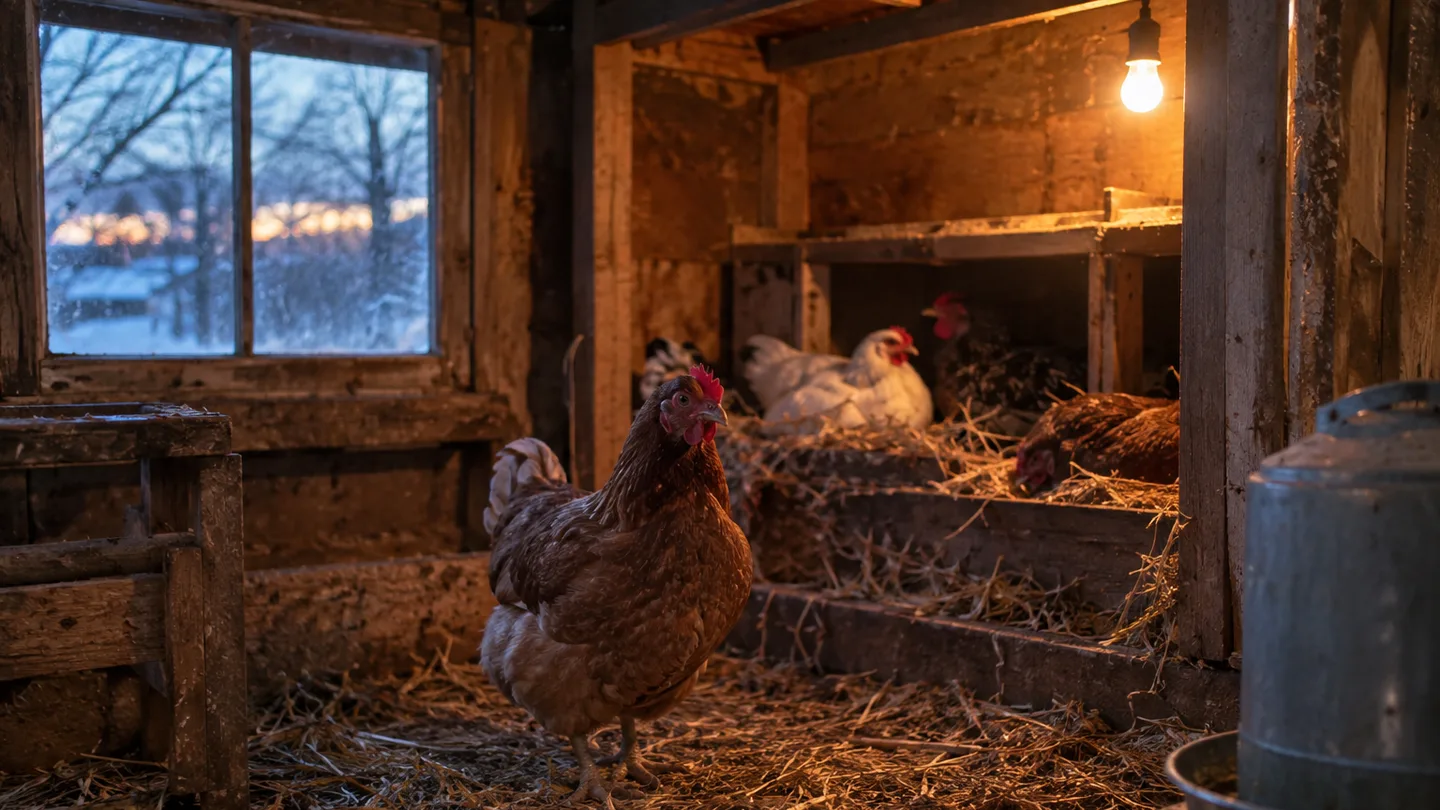
14–16 hours is the laying target—not a health requirement
For a small backyard flock, I’d treat 14 hours as a reasonable starting target and 14–16 hours as a working range for supporting winter laying. The total includes natural daylight. It isn’t 14–16 hours of artificial light on top of the sun.
That distinction matters. A hen’s laying pattern is affected by more than the coop light: age, breed, molt, feed, water, health, and the season all matter. Light is one cue you can adjust, not an egg-production switch. Some hens will lay less in winter even with a consistent schedule. That isn’t proof your timer is wrong.
Nor is winter lighting a basic health requirement. If you’re content to collect fewer eggs for a while, letting the natural season run is a sensible choice. I’d rather see a keeper accept a seasonal dip than chase a number by leaving lights on late into the night. A flock needs a dependable routine, not a promise of a certain carton count.
There’s a trade-off, too. Adding light may help maintain laying, but it asks you to manage a schedule through changing sunrise times, power interruptions, and the ordinary mess of a coop. If you’re deciding whether the eggs are worth that effort, compare your likely egg use with your winter feed costs before buying equipment. Don’t assume an extra hour automatically pays for itself.
For a concrete example, imagine five hens getting nine hours of natural daylight. To create a 14-hour total, the timer would add five hours. That gives you a clear starting schedule, not a forecast of how many eggs those five birds will lay.
Turn winter daylight into a timer setting: subtract before you add
Check the natural day length for your location and the date you’re planning around. Sunrise and sunset shift with both season and location, so a timer schedule copied from someone in another town can give your hens a different total day. Look up a local daylight calendar, then use this simple calculation:
Target hours − natural daylight hours = hours of supplemental light.
If your target is 14 hours and the calendar shows nine hours of daylight, the calculation is 14 − 9 = 5 hours of added light. If your target is 14 and the natural day is 10 hours, add four. Recheck as the season changes; don’t assume the same timer setting will produce the same total daylight all winter.
| Natural daylight | Target total | Supplemental light |
|---|---|---|
| 9 hours | 14 hours | 5 hours |
| 10 hours | 14 hours | 4 hours |
| 9 hours | 15 hours | 6 hours |
Those are arithmetic examples, not a location-specific calendar. The numbers only work if the natural-day figure is right for your place and date. A local daylight calendar gives you the input; your timer supplies the difference.
For most backyard keepers, a timer is easier to manage than switching the light by hand. Pick a schedule that adds light at the same end of the day each day, then check that the timer is actually switching on and off as planned. A clock change, a tripped outlet, or a timer reset can leave the coop on a different schedule than the one you intended.
If your hens have been on natural daylight alone, don’t make a sharp, improvised change just because you noticed fewer eggs this week. I’d choose a target first, calculate the added hours, and make the adjustment in small steps. That makes it easier to spot whether the routine is working for your flock and avoids turning the timer into a daily guessing game. For general background, you can also consult University extension poultry-lighting guidance.
The dark block is part of the schedule: protect 8 uninterrupted hours
Count darkness as deliberately as you count light. If you settle on 14 hours of light in a 24-hour day, that leaves 10 hours dark. At 16 hours of light, it leaves eight. I’d preserve at least eight consecutive hours without coop lighting rather than scattering short dark intervals through the night.
My preference for a small flock is to add light in the morning. A light that switches off in the evening can leave birds moving from the feeder toward their roost as the coop suddenly goes dark. With morning supplementation, the natural sunset still gives them a gradual cue to settle. That’s a practical scheduling choice, not a claim that every flock will struggle with evening light.
For example, if you’re adding five hours to a nine-hour natural day, you could put those five hours before sunrise. The hens then get the natural daylight period and evening sunset, while the timer fills the morning gap. Set the timing so the light is already on when birds start their active day; don’t use the timer to keep the coop bright all night.
A light left on continuously defeats the dark block you planned. So does a second light that comes on unexpectedly overnight. Keep the schedule simple: one timer, one defined lighting period, and a clear off time. If a power interruption changes the schedule, reset it rather than trying to compensate by adding a long stretch of light later.
If you’re also weighing heat, keep that question separate from the lighting decision. Read do chickens need heat in winter before treating a brighter coop as a way to make it warmer. And don’t trade airflow for a sealed, dark coop: chicken coop ventilation is a separate part of keeping the space comfortable.
At bird height, aim near 10 lux; bulb wattage alone won’t tell you enough
As a practical brightness target, I’d aim for about 10 lux where your hens eat. Think of it as a working reference, not a universal biological cutoff. The point is to give birds enough usable light to move about and find feed without turning the coop into a brightly lit room.
Wattage by itself won’t tell you how bright the feeder area will be. The result changes with the bulb’s output and beam, its distance from the floor, any shade or reflector, and how the coop surfaces distribute light. A bulb can look bright to you at the door and still leave a feeder corner dim. Check the space at bird height, especially the areas your hens use, rather than judging by the number printed on the bulb.
A basic LED and timer can be a straightforward arrangement. Aim for even, usable coverage around the feeding area, and avoid a harsh bright patch beside deep shadow if you can. A white LED is a reasonable choice for this simple schedule; a special red bulb isn’t necessary for the plan described here. Consistent timing and sensible placement matter more than changing colors to try to coax a response.
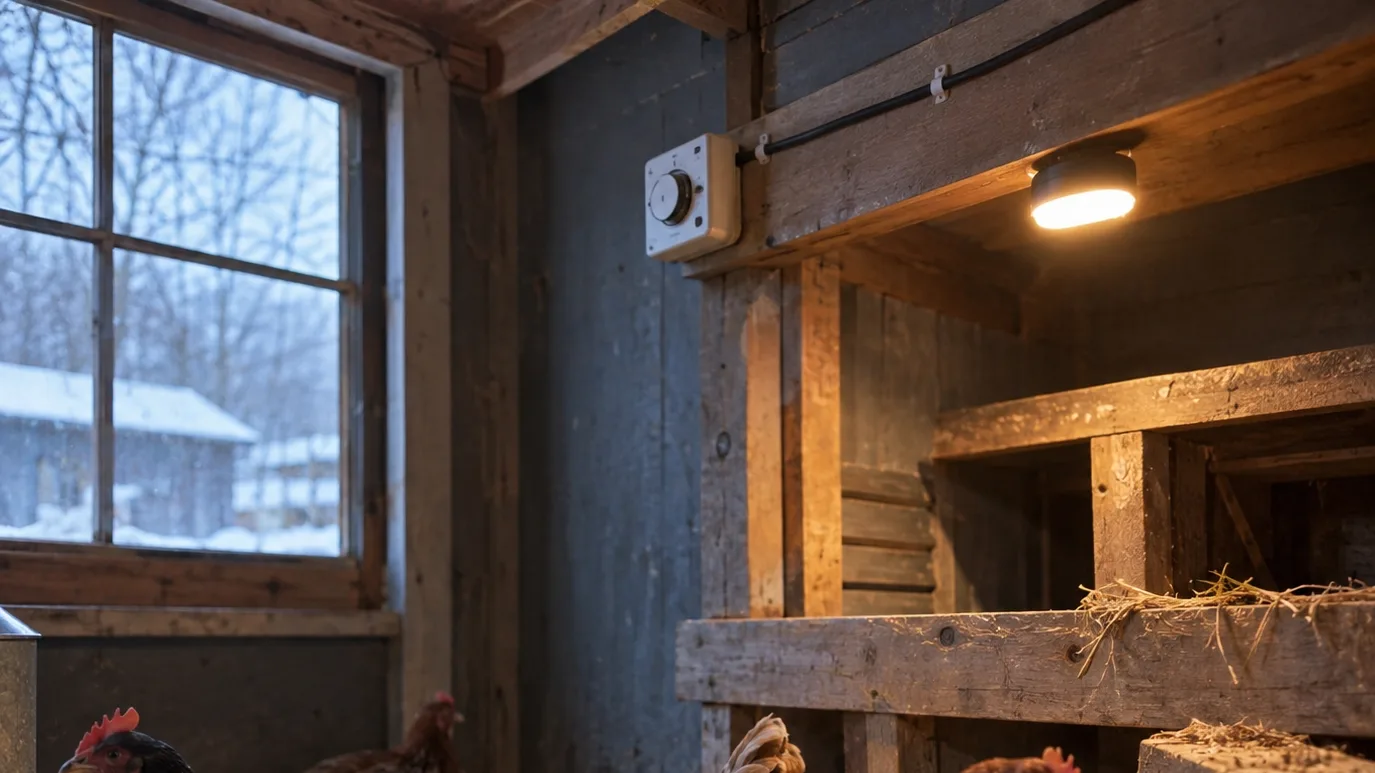
Choose lighting equipment, timers, and connections suitable for the conditions where they’ll sit. Coop air can be dusty and damp, and cords can end up within reach of beaks, feet, or bedding. Keep connections protected, route cords so birds can’t peck or snag them, and follow the equipment instructions for the location. For a qualified overview, look up electrical safety guidance for damp locations.
A coop light is not a heat lamp. Don’t substitute a heat-producing lamp for an ordinary lighting plan, and don’t let the two jobs blur together. If your aim is more winter daylight, choose a light for visibility and a timer for duration. If your real concern is cold, assess shelter, ventilation, and the condition of your birds separately.
Decide whether extra eggs are worth extending the day—and for which hens
Before changing the timer, look at the birds as well as the egg basket. A molt, a young or older hen, a change in feed or water, or a bird that seems unwell can all be reasons to investigate a slowdown rather than simply adding light. Lighting can address the length of the day; it won’t correct every other part of the setup.
I wouldn’t use extra light to push very young pullets into laying. If you need a rough planning checkpoint, about 18 weeks is a cautious marker to discuss against the breed and the birds’ development, not an automatic switch-on age. Pullets mature at different rates. If yours aren’t near point of lay, wait and use breed-specific management guidance rather than assuming more light will make them ready.
Here’s the decision I’d make for a five-hen backyard flock: if winter eggs matter to your household, record the local day length, start with a 14-hour total, and calculate the added hours instead of guessing. If fewer eggs are acceptable, leave the timer off and keep the routine simple. Either choice is reasonable; what I wouldn’t do is extend the day without deciding how much darkness you’re preserving.
Then check the birds and the schedule after the change. Are they settling normally? Is the light coming on when expected? Are you seeing another change, such as molt or a feed issue, that the timer can’t solve? Keep a brief note of the date, natural daylight, and timer setting. That record makes it easier to adjust deliberately instead of chasing each day’s egg count.
On a small flock, steady management is more useful than squeezing toward the top of a range. My call: begin at 14 hours if supporting winter laying is your goal, and only consider extending toward 16 if you have a clear reason and can keep at least eight uninterrupted dark hours. This week, check your local daylight calendar, write down the natural-day figure, and set a gradual timer plan. Then compare it with your winter feed costs before deciding whether more light is worth maintaining.
Can solar-powered coop lights keep a steady schedule through winter?
They may, but I wouldn’t assume they’ll provide a consistent run time through every stretch of winter weather. Shorter days, cloud cover, and battery performance can affect how much usable power is available. If a steady schedule matters to you, test the setup through cloudy days and have a backup plan. Check the actual run time rather than relying only on the advertised capacity.
Do hens need a red bulb, or is a white LED fine?
A white LED is fine for the simple backyard schedule described here. I’d prioritize a reliable timer, suitable brightness where hens eat, and a dependable dark period over switching bulb colors.
Does supplemental light make eggs bigger or more nutritious?
I wouldn’t use light as a dependable way to change egg size or nutrition. It’s a day-length adjustment, not a substitute for suitable feed or a way to control every factor that shapes an egg. If egg quality changes, look at the broader flock routine rather than assuming a longer day is the answer.
Frequently Asked Questions
Can solar-powered coop lights keep a steady schedule through winter?
They may work, but shorter days, cloud cover, and battery performance can make run time inconsistent. Check that the system holds its schedule through cloudy stretches and have a backup plan if consistent lighting matters to you.
Do hens need a red bulb, or is a white LED fine?
A special red bulb is not required for a backyard winter-light schedule. Prioritize consistent duration, suitable brightness at bird level, and a timer; avoid changing colors as a substitute for a sound schedule.
Does supplemental light make eggs bigger or more nutritious?
Supplemental light mainly changes the day-length cue associated with laying; it is not a reliable way to improve egg size or nutrition. Egg characteristics also depend on factors such as age and diet.