Do Raccoons Eat Chickens? The Coop Weak Spots to Fix
At 8 p.m., a coop can look closed and still have a raccoon-sized invitation: a hook it can lift, a vent it can reach through, or a run wall it can climb over. Yes—raccoons do eat chickens. They may kill or injure more birds than they consume, take eggs, and pull at anything within reach. For a backyard flock, the practical rule is simple: your birds should be behind a locked, covered barrier before dusk.
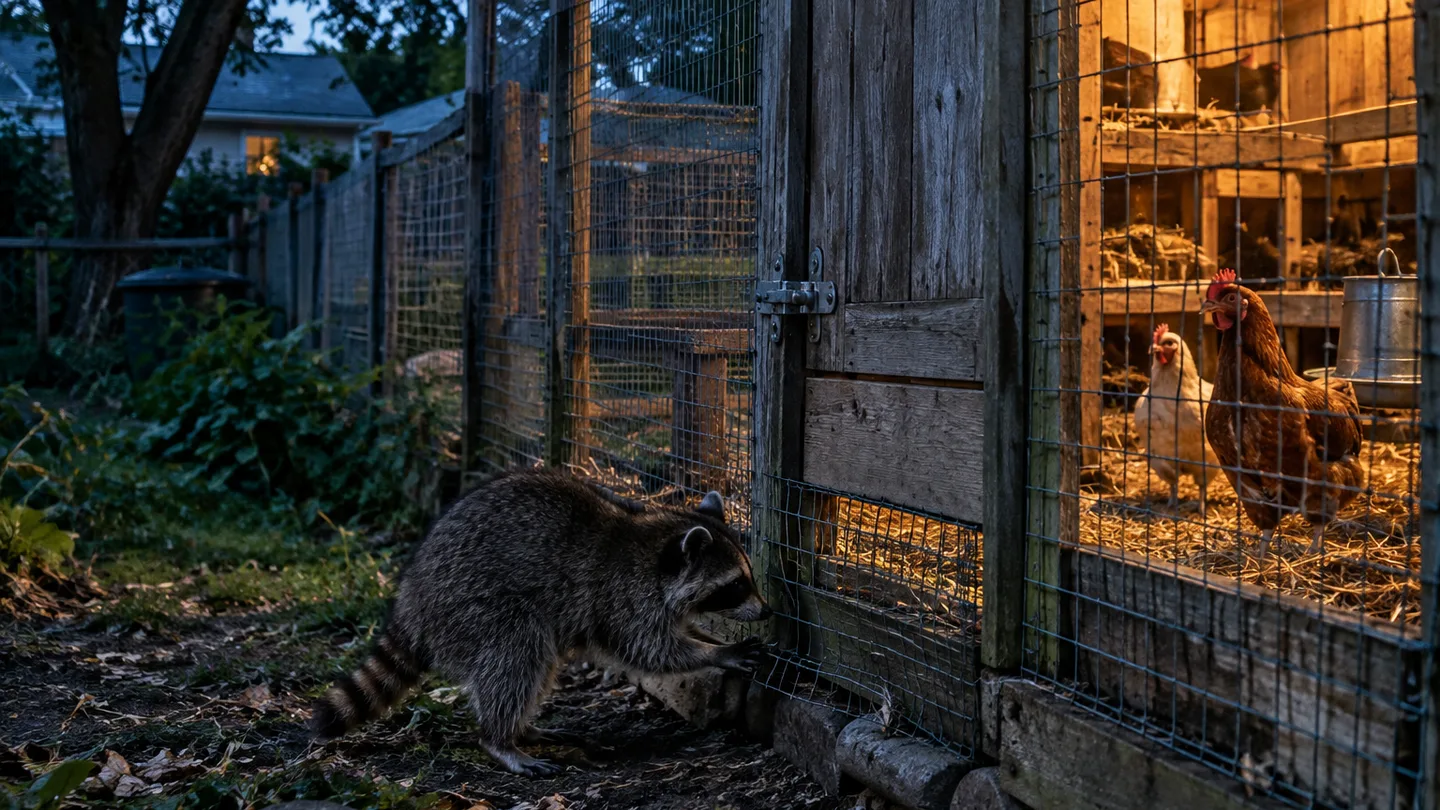
Yes—Raccoons Do Eat Chickens, Usually After Dark
Raccoons can attack adult hens, chicks, bantams, and eggs. They don’t need to carry off a whole bird to create a serious problem. A raccoon may reach through mesh, grab a head or leg, injure a bird, and leave before you see it. It may also open a nest box, raid eggs, or tear into feed.
The timing matters. Raccoons are mainly active after dark, so closing the coop before dusk is more useful than relying on a daytime patrol. Seeing one in the afternoon doesn’t prove your flock is safe overnight. It may simply mean you saw it during one part of its foraging route.
That’s why I’d treat a raccoon sighting as a prompt for a structural audit, not as a reason to buy one noisy deterrent and hope for the best.
The Five-Point Weak-Spot Audit: Door, Mesh, Roof, Floor, and Feed
Before buying materials, walk the enclosure slowly with a flashlight. Look at the places a raccoon can push, pull, climb, reach, or dig. The five-point audit below covers the common chicken coop weak spots in a small backyard setup.
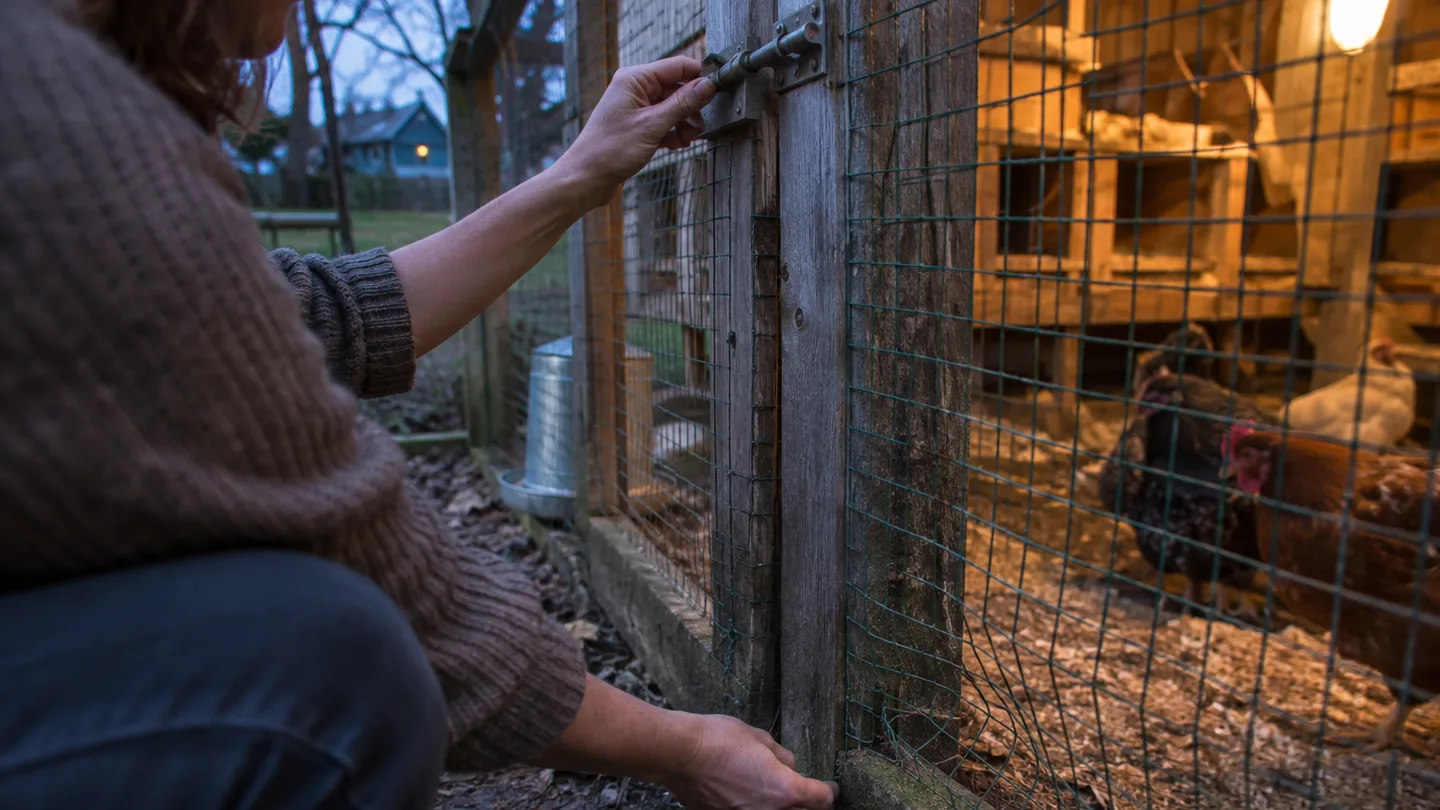
- Door and frame. Check whether the door lifts in its frame, whether the hinges have loosened, and whether the latch can move when you push or pull the door.
- Wall and vent mesh. Inspect every corner, staple line, vent cover, and place where two panels meet. A small opening beside a frame can matter more than a large intact wall.
- Run roof. Look up. An open-topped run leaves a climbing route from a fence, shed, tree, or nearby structure.
- Floor edge. Check for loose soil, washed-out corners, gaps under gates, and places where the mesh stops short of the ground.
- Feed and egg access. Remove anything that gives a raccoon a reason to test the enclosure repeatedly, including spilled grain, open feed bags, and accessible eggs.
One weak seam can defeat an otherwise sturdy run. The wider chicken run predator protection plan matters, but the last two feet of mesh at a corner may decide whether that plan works.
Chicken Wire vs. Hardware Cloth: Why 1/2-Inch Welded Mesh Is the Baseline
Chicken wire is useful for keeping chickens in. I wouldn’t use it as the main raccoon barrier. Its flexible hexagonal openings can leave enough room for a determined paw to reach through, and the wire is easier to bend away from a frame.
For an ordinary backyard flock, my baseline is 1/2-inch welded hardware cloth across run walls, vents, door openings, and other reach-through points. The small openings reduce the space available for a paw or snout. The welded construction also gives you a firmer panel to anchor to the frame.
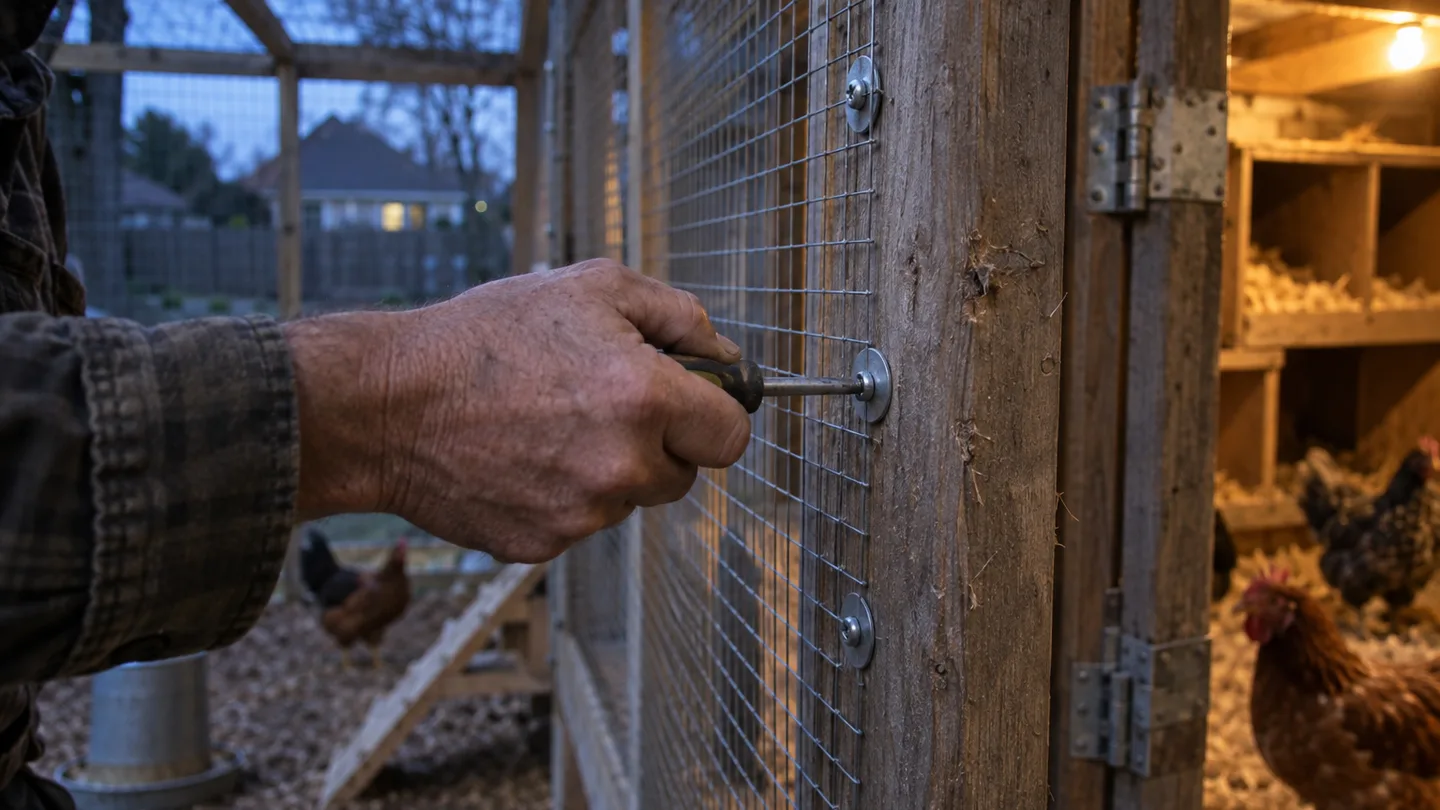
I’d choose 19-gauge or heavier material where your budget allows, especially on the lower half of a run and around doors. Fasten it with screws and washers, or with heavy staples that cannot be pulled out easily. Around corners and door frames, space fasteners about 6–8 inches apart rather than leaving long unsupported edges.
The useful takeaway from the hardware cloth vs chicken wire comparison is not that one material solves every predator problem. It’s that mesh has two jobs: contain your birds and resist an outside animal’s claws. Ordinary chicken wire is better at the first job than the second.
The Latch Test: Two-Step Hardware and No Reach-Through Gap Near 1 Inch
A hook-and-eye, turn button, or loose barrel bolt may hold a door shut against wind. I would not assume it will hold against a raccoon that can pull, lift, and work at a gap. Use a two-step closure instead: a hasp plus a carabiner, or a hasp plus a small lock.
Mount the hardware where a paw cannot reach through the mesh. Treat any frame gap approaching 1 inch as a reach-through hazard, particularly beside the latch. The door should close against a solid frame, not just rest against a flexible panel.
When I first started using a dusk tug-test on a backyard run, I treated the latch as finished because it closed with one hand. The better test was less flattering. I shut the door, pulled the top corner, then the bottom corner, and watched the bolt move in its slot. A second hasp and a washer-backed screw through the frame stopped that movement. I don’t call a door secure until it passes that test.
Close the Climb-and-Dig Route: Roof Cover and a 12–18-Inch Apron
A vertical fence leaves two routes open. A raccoon may climb over it, or it may dig under it. Address those routes separately.
A solid run roof or fully covered mesh roof blocks the direct climbing route. It also keeps your birds inside a defined barrier overnight. The roof needs to meet the side panels securely. A roof that simply rests on top can become another lift point.
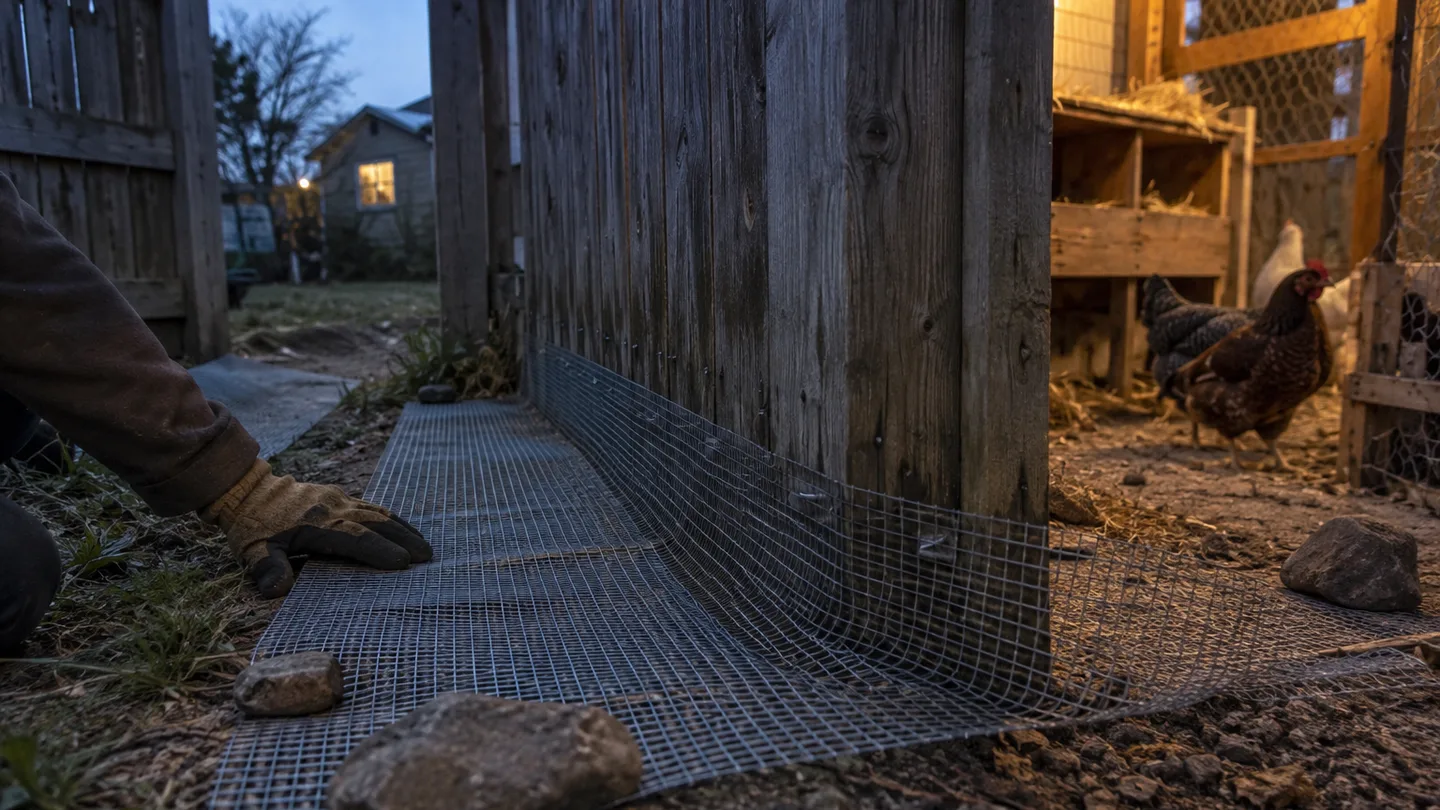
At ground level, extend hardware cloth outward from the run wall to make an apron roughly 12–18 inches wide. Lay it flat on the soil, overlap joins, and fasten the corners so the edge cannot be peeled back. Grass and leaf litter will hide it over time.
A buried vertical barrier may suit a permanent run or loose soil, while a surface apron is often easier to inspect and repair. Neither should be treated as magic. If the soil washes out, roots lift the mesh, or a gate leaves a gap, the route can reopen. A vertical fence alone is simply incomplete.
After Dusk, Remove the Buffet: Feed, Eggs, and Spilled Grain
Close adult birds inside before dusk. If an open feeder hangs in the run, bring it into the secure coop after your birds finish for the day. Store spare feed in a sealed metal container, collect eggs daily, and sweep up spilled grain instead of leaving it beneath the feeder.
These steps reduce the reward around the enclosure. They do not replace a roof, strong mesh, a ground barrier, or a reliable latch. A clean run with a weak door is still a weak run.
Read the Damage Pattern Before You Patch the Coop
Damage can point you toward the breach, but no single clue proves which predator was involved. Use the pattern to decide where to inspect first.
| Clue | Inspect first |
|---|---|
| Latch moved or door sitting open | Hasp, bolt travel, hinges, and the frame around the latch |
| Mesh bent outward or pulled from staples | Fastener spacing, corner overlaps, and unsupported panel edges |
| Feathers or injuries along one wall | Reach-through openings and the lower wall mesh |
| Fresh soil at the base | Run corners, gate gaps, and the ground apron |
| Missing eggs | Nest-box access, roof gaps, and the coop door |
| Torn feed bag | Storage container and spilled feed around the run |
A dawn inspection can show disturbed soil or a shifted latch before the flock stirs. A trail camera can help if the damage repeats but the cause remains unclear. Use those observations to patch the actual route rather than reinforcing the part that merely looks suspicious.
Contact a veterinarian for deep wounds, eye injuries, breathing trouble, severe weakness, or a bird that cannot stand. Predator-proofing the coop matters, but an injured bird needs more than a stronger latch.
Chicks, Bantams, and Broody Hens Need Tighter Protection
Small birds change the mesh decision. For brooder openings and chick-sized gaps, use 1/4-inch hardware cloth so a young bird cannot slip through or become reachable through a larger opening. The adult run can use 1/2-inch welded hardware cloth as the practical baseline.
Bantams and young birds are easier to reach through a large opening than a full-sized hen. A broody hen with eggs also needs a secure, enclosed nest overnight. Don’t leave her in a low nest box that opens directly into an exposed run just because she is sitting quietly.
A flock of three to twelve birds still needs full nighttime protection. A small flock is easier to house securely, not safe to leave exposed.
Your One-Week Repair Order: Secure the Door First, Then the Run
Use this order if you need a practical repair sequence rather than a weekend rebuild:
- Tonight: move the birds into the strongest enclosed space you have before dusk. Close and test the door by pulling every corner.
- First durable repair: add a two-step latch and close any reach-through gap around the door frame.
- Next: cover vents, corners, and low wall sections with 1/2-inch hardware cloth. Use screws and washers where a raccoon could pull the panel.
- Then: repair or add the run roof so the fence is not also a climbing ladder.
- After that: install a 12–18-inch ground apron and secure the corners.
- Finish: move feed into a sealed container and remove open food from the run overnight.
The Best predator proof chicken coop checklist is useful if you’re comparing a new structure with a repair. If you’re building the run yourself, pair it with the chicken run predator protection steps before you set the posts.
Your next action this week is simple: photograph the weakest opening, measure its width, and write down what is holding that edge in place. Buy material for that failure first. A repair chosen from a photograph and a measurement is usually more useful than a cart full of general predator products.
Questions You May Still Have
Will a rooster protect hens from raccoons?
A rooster may alert the flock, but I would not treat him as a physical defense against a raccoon. Secure housing before dusk does the protective work. A warning call is useful information, not a barrier.
Do motion lights or sprinklers keep raccoons away from a chicken coop?
They may startle a raccoon or alert you to movement, so they can be an extra layer. I wouldn’t make them the foundation. A deterrent that is ignored, loses power, or points away from the approach route leaves the coop unchanged.
Can an electric fence stop raccoons from getting into a chicken run?
An electric barrier can supplement a perimeter in some layouts, provided it follows local safety rules. It cannot close a roof gap, stop a reach-through, or fix a door that opens. Think of it as one layer outside a sound enclosure, not a substitute for one.
Should you trap and relocate a raccoon that visits the coop?
Rules vary by location, and relocation may be restricted. Check your local wildlife-agency rules for trapping and relocating raccoons before handling a trap or moving an animal. If you need general design principles, compare your plan with extension guidance on predator exclusion around poultry. In most backyard cases, fixing the access route is the more durable first move.
Frequently Asked Questions
Will a rooster protect hens from raccoons?
A rooster may alert the flock, but it is not a reliable physical defense against a raccoon; secure housing before dusk still does the real protective work.
Do motion lights or sprinklers keep raccoons away from a chicken coop?
They may startle or alert you, but raccoons can become accustomed to deterrents, so use them only as an extra layer behind mesh, a roof, and a secure latch.
Can an electric fence stop raccoons from getting into a chicken run?
An electric barrier can supplement a perimeter in some setups, but it cannot solve climbing, reach-through, roof, or door weaknesses and must follow local safety rules.
Should you trap and relocate a raccoon that visits the coop?
Rules vary by location, and relocation may be restricted; contact local animal control or a wildlife agency rather than handling or moving the animal yourself.