Do Foxes Eat Chickens? 5 Ways to Make Your Run Safer
Yes—foxes do eat chickens, and your run should protect your birds at midday as well as after dark. A six-foot fence alone isn’t the answer: you need to close the gaps at the sides, base, roof, and coop door rather than rely on a fox keeping a schedule.
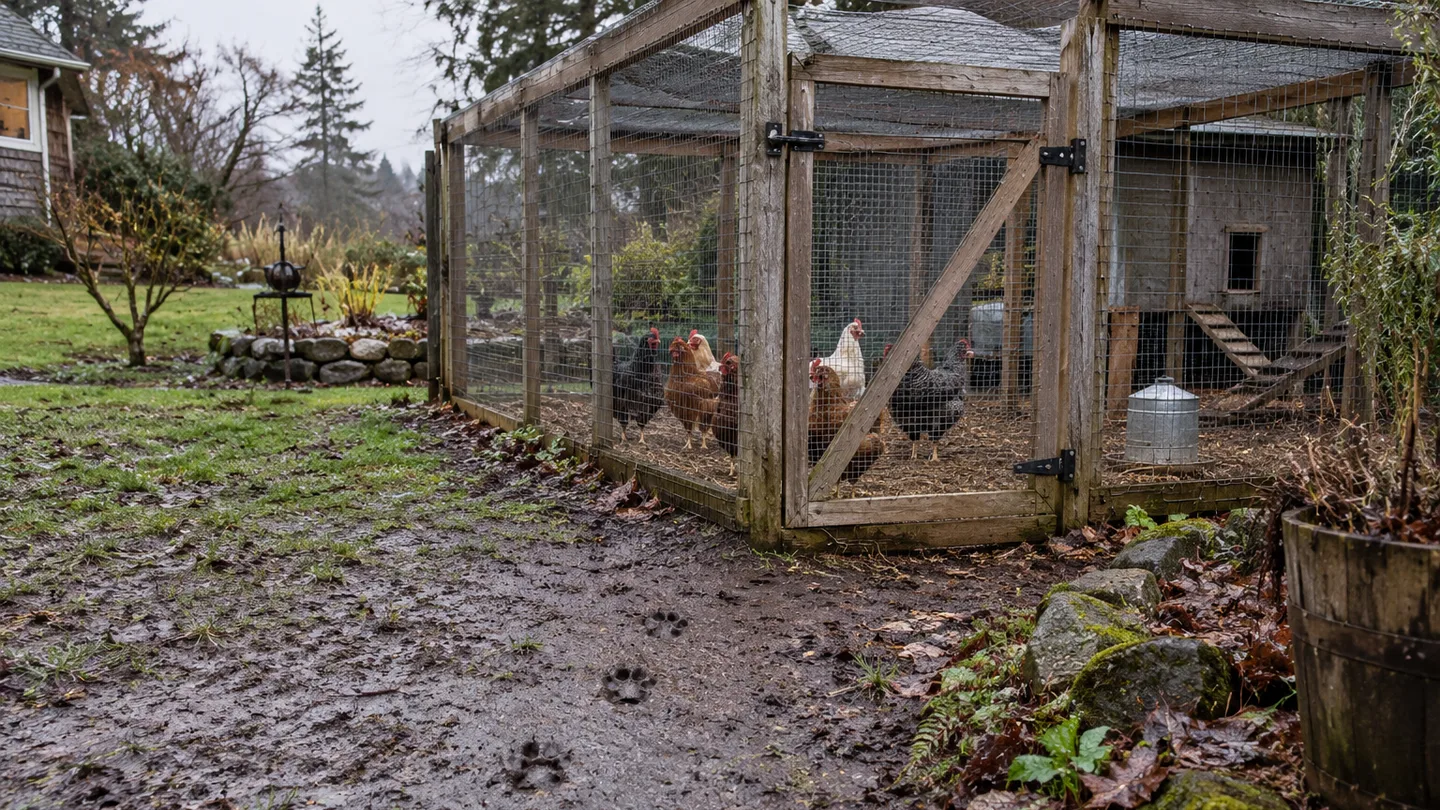
Foxes do eat chickens—so secure the run at every hour
Foxes may take chickens or eggs when they can reach them. Your local conditions matter, but it’s a mistake to treat dusk as the only risky time. A barrier that works only while you’re home or watching the yard leaves your flock depending on your attention.
Think in routes, not scare tactics. Could an animal get over the fence, through a weak panel, under the base, or in through a door that didn’t latch? Those are the questions to answer before buying a motion light or adding a decorative sign. Deterrents can be an extra layer, but the run itself should do the main work.
For a small flock, that doesn’t automatically mean rebuilding everything. Start with the enclosure you have and identify its weakest access point. The practical aim of chicken run predator protection is to make entry difficult from every direction, not to promise that any fence is impossible to breach.
Way 1: Use a 6-foot fence as a boundary, not a guarantee
A fence around six feet high can be a useful starting point for a backyard run, but height is only one part of the barrier. An open top remains an open route, and a tall fence can become easier to get past if nearby objects provide a step-up. Stacked lumber, a feed bin, a low shed roof, a sturdy branch, or a winter snowbank can change the effective height at that spot.
Walk the line with the ground in mind. On a slope, a fence that looks tall from one side may leave a shorter section on the downhill side. Look for sagging panels, a gap where the fence meets a wall, and places where a gate doesn’t meet its frame. A narrow gap at ground level can matter more than adding another foot of fence above it.
I’d treat a six-foot fence as a boundary, not a promise. If you’re choosing a new enclosure, decide at the same time how you’ll close the top and secure the base. If the fence is already built, remove climb assists where you can and note the low spots. Height buys you a stronger starting position; it doesn’t replace a complete enclosure.
Way 2: Put 1/2-inch welded mesh around vulnerable openings
For doors, lower panels, and other vulnerable openings, I’d choose firmly framed galvanized welded mesh with openings around one-half inch rather than relying on light chicken wire as the only barrier. The opening size is just one part of the choice. Mesh that flexes away from its frame, has loose corners, or is fastened with a few widely spaced staples can leave a weak edge even when the holes look small.
Fit the mesh to a solid frame. Fasten it so the edge can’t be peeled back easily; screws with washers or a continuous wood batten can hold the wire along a frame more firmly than a handful of light fasteners. Pay special attention to the bottom of a panel, corners, and the join beside a gate. Use material suited to the exposure in your yard, and check the product details rather than assuming that every roll sold as hardware cloth has the same thickness or finish.
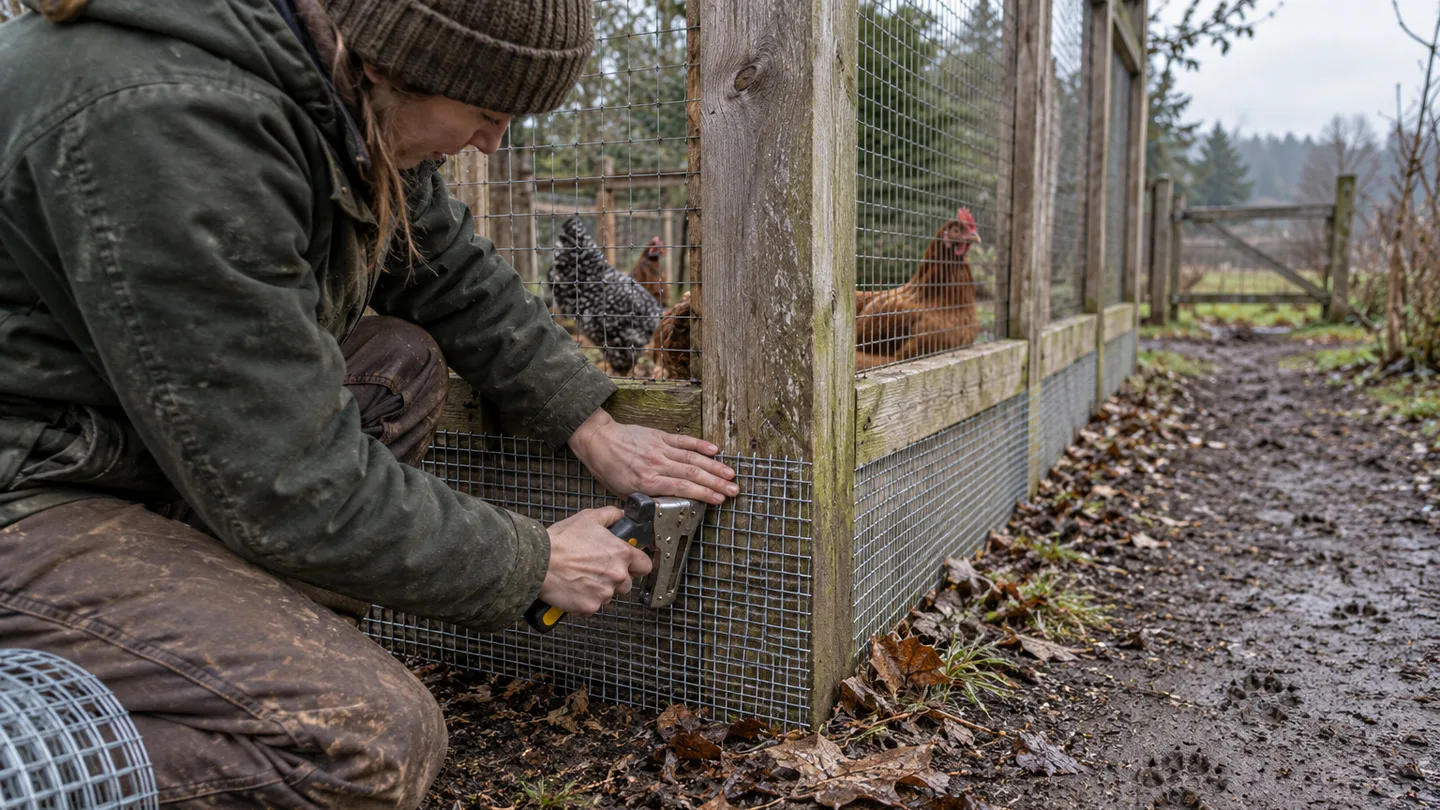
Chicken wire can help keep chickens in, but I wouldn’t treat every light poultry-wire product as a predator barrier. The weak point may be the wire, its fasteners, or the frame that carries it. If you’re planning a new build, compare the enclosure details in Best predator proof chicken coop before you buy materials. For an existing run, reinforce the openings an animal could reach first instead of replacing sound sections just because they look less tidy.
Way 3: Make an 18–24-inch apron to frustrate digging
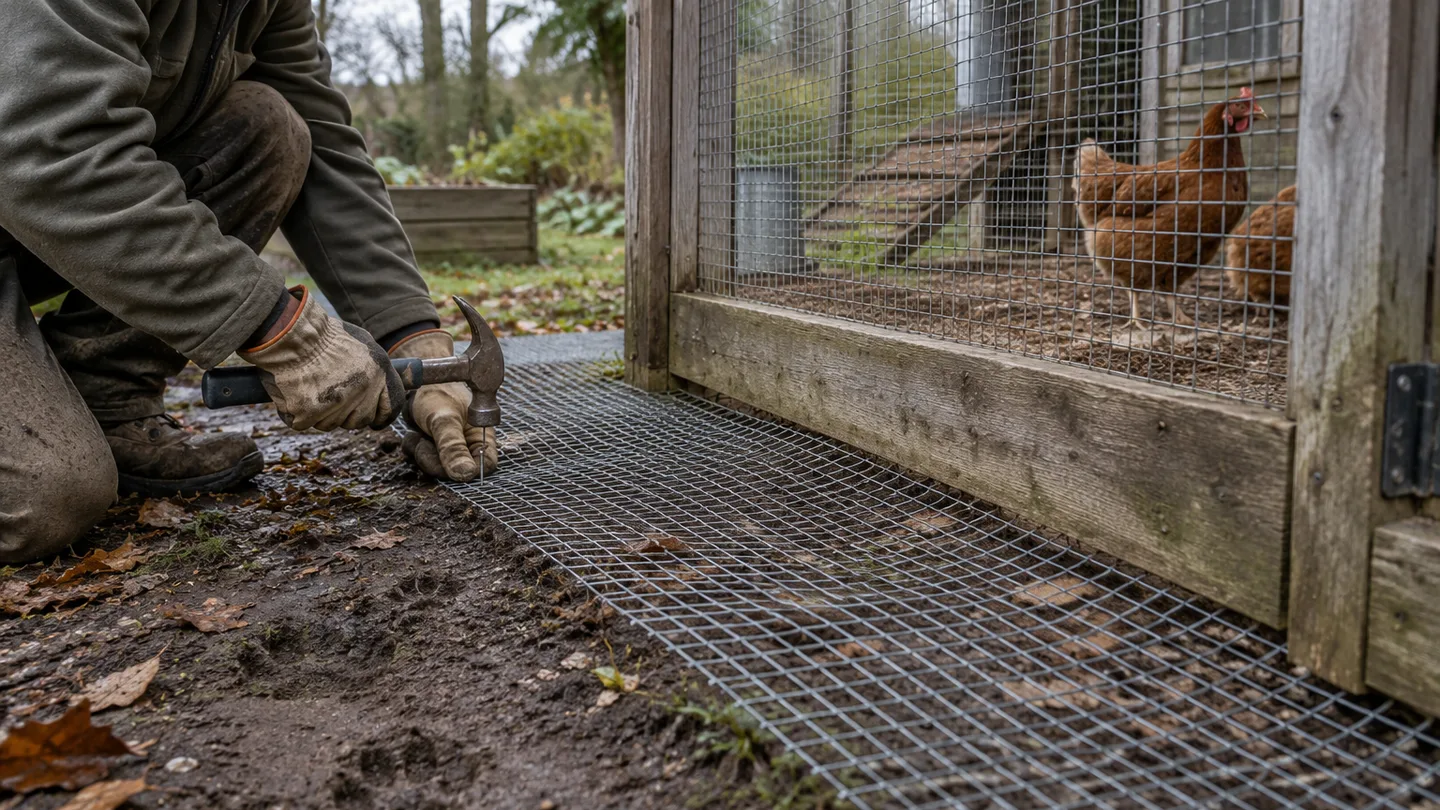
A horizontal mesh apron can make digging at the fence base harder. A practical starting point is an outward-facing strip around 18 to 24 inches wide, secured along the fence so it lies flat on the ground. Cover it with soil, mulch, or another suitable surface if that fits your run. The idea is to place a barrier where a dig started at the fence line would meet it, rather than leaving an easy seam directly beneath the fence.
Here’s the material math for a clearly hypothetical example. An 8-by-12-foot rectangular run has a 40-foot perimeter: 8 + 12 + 8 + 12. An 18-inch apron is 1.5 feet wide, so the flat apron would cover about 60 square feet before overlaps, cuts, or extra material at corners. That calculation estimates mesh area; it doesn’t tell you whether the run is large enough for your flock or guarantee that a fox won’t dig elsewhere.
You can bury mesh vertically along the fence instead, but buried material is harder to inspect and may complicate drainage, digging for repairs, or future landscaping. A flat apron is easier to see and repair, though it needs anchoring so it doesn’t curl up or become a mowing hazard. Think about your soil, how water drains through the area, and whether you can keep the strip in place while tending the run. My preference is an apron whose edge you can inspect over a hidden barrier you can’t readily check.
Way 4: Cover the run with a secured, supported roof
A roof closes the overhead route that fence height leaves open. It can be mesh or solid roofing, depending on your climate, the run’s design, and how you manage shade, rain, and airflow. Whichever material you choose, secure it at the perimeter and at every join. A roof panel that rests on top of the fence without being fixed to it can shift or lift.
Support matters. Choose framing for the span and for the snow and wind conditions where you live; don’t guess that a light frame can carry a heavy winter load. A mesh roof needs firm supports too, so it doesn’t sag into a gap or pull loose at an edge. A solid roof may provide shelter, but don’t close off ventilation around the run or coop while trying to keep weather out.
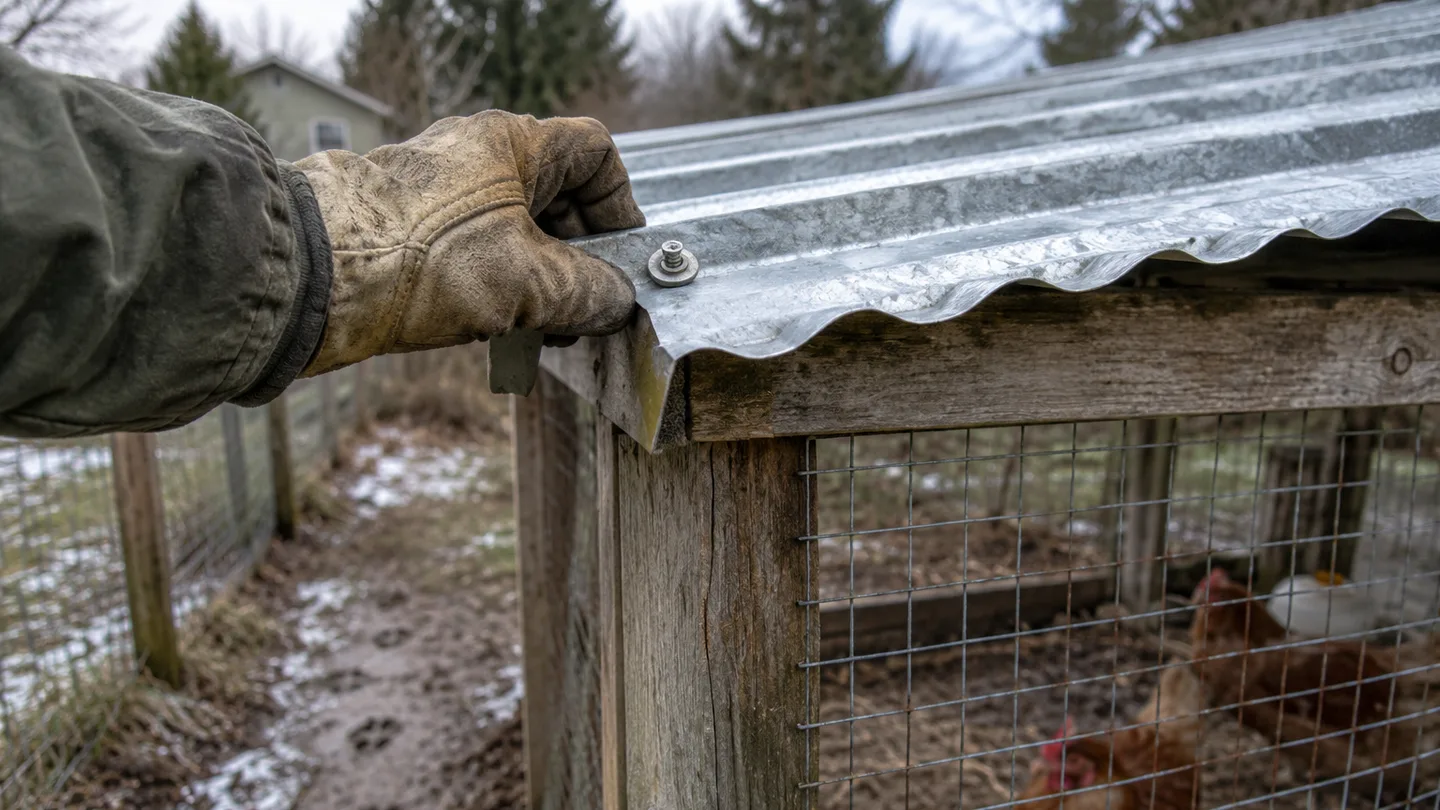
Loose netting draped over the top is not the same as a supported, secured barrier. It may be useful for other purposes, but I wouldn’t count on it as the run’s main physical closure. If you’re deciding between a roof and leaving the top open, ask what the roof will attach to, how it will handle local weather, and how you’ll keep it maintained. A well-secured roof is useful only if its edges and connections are as deliberate as the panels themselves.
Way 5: Make dusk lockup a consistent, two-step routine
Close the coop at dusk, but don’t make that your only protection if your birds spend the day in an unsecured run. The routine is simple: count your birds, then shut and latch the coop door. Counting gives you a chance to notice a bird still outside before you close up. If one is missing, pause and check the run and usual hiding spots instead of assuming the count will sort itself out in the morning.
Check that the door fits its frame closely and that the latch holds it shut without needing you to lift or press the door into place. A second clip can add a layer when the latch design or door movement calls for one. The useful question is not whether the hardware looks sturdy; it’s whether the door stays shut when you pull on it after closing.
Keep the routine short enough to repeat on busy evenings. Count, close, latch, pull once to check. That’s more dependable than an elaborate system you skip when it’s raining or you get home late. It also doesn’t excuse weak daytime fencing: a locked coop protects birds inside it, not birds still using an open run.
For a 3–12-hen flock, retrofit the weak points in order
You don’t need to replace every board at once. For a backyard flock of three to twelve hens, inspect in this order: openings you can reach through, loose or widely spaced mesh, the fence base, the open top, then the gate and coop door. Fix an obvious opening before improving a section that is already sound. This order is a practical way to close direct access routes first, not a claim that every yard has the same weakest point.
For example, imagine a six-hen flock using an 8-by-12-foot run. If the lower mesh pulls away from a corner post, tighten and secure that connection before spending the weekend adding a taller fence to the opposite side. If the sides are solid but the top is open, closing the top may be the more useful next job. The example is a planning scenario, not a record of my own run or a claim that those dimensions fit every flock.
Let the shape of your yard change the plan. A run beside a wall may have fewer exposed sides but still needs a secure wall-to-roof join. A sloped base may need more attention to gaps than a level one. Reuse sound framing where it makes sense, but don’t keep a weak panel simply because it was expensive. The best order is the one that closes the easiest route into your actual enclosure.
If you want to build rather than retrofit, Chicken predator protection diy is a useful topic to compare with your materials list. Keep your plan specific: which opening will you secure, what will hold the mesh, and how will you inspect the finished join? Those questions do more for a small run than buying an extra gadget before you know where the gap is.
Check five failure points monthly—and after storms or repairs
Set a brief inspection reminder for once a month, then check again after a storm, fallen branch, digging, or repair work. You don’t need a complicated checklist. Look at the fence line for a new climb assist or low spot; the mesh and frame for a loose edge; the apron for a lifted or exposed section; the roof joins for separation; and the coop door for a latch that no longer catches cleanly.
Change the check when something changes. Freshly moved soil can expose the edge of an apron. A new storage bin can create a step beside the fence. A repair can leave a fastener proud or a panel under tension. You’re checking the whole route around your birds, not just looking for damage in the place you repaired last time.
If a fox has already tested the run or you find a breach, keep your birds in a secure coop or another properly enclosed space while you repair it. Don’t rely on a light or a temporary scare to cover an opening. Motion-activated lights may startle an animal, but they’re not a physical barrier; I’d treat them as an optional extra, not the fix.
Electric fencing may add another layer when it’s purpose-built, installed, and maintained according to the manufacturer’s instructions. Check local requirements and follow the product’s safety guidance; don’t improvise a setup or treat it as a replacement for a secure run. If you’re considering trapping or relocating a fox, ask your local wildlife authority for its guidance before acting, because rules and appropriate responses depend on where you live.
Do motion-activated lights keep foxes away?
They may startle an animal at first, but a light doesn’t close a gap or strengthen a fence. Use it only as a possible extra layer, not as your main protection.
Can electric fencing help protect chickens?
It can be an additional deterrent when the product is designed for that purpose and installed and maintained as instructed. Check the manufacturer’s instructions and local requirements, and keep the physical run secure.
Can you trap or relocate a fox that visits your yard?
Don’t assume the same rules apply everywhere. Check your local wildlife authority’s guidance before trapping or relocating an animal.
This week, pick one weak point and fix it: secure a loose mesh edge, anchor the apron, close the roof join, or replace a latch that won’t hold. Then read do chickens need heat in winter if you’re also planning for cold-weather care; a safe enclosure and a sensible seasonal plan work together.
Frequently Asked Questions
Do motion-activated lights keep foxes away from a chicken run?
They may startle a fox temporarily, but they’re not a dependable barrier and animals can get used to repeated stimuli. Keep the physical run secure.
Can electric fencing help protect chickens from foxes?
It can add a layer of deterrence when purpose-built, installed, and maintained according to the manufacturer’s instructions. Check local rules and don’t treat it as a replacement for a secure run.
Can you trap or relocate a fox that visits your yard?
Rules vary by location, and trapping or relocation can carry safety and animal-welfare concerns. Contact your local wildlife authority before taking action.