Chicken Egg Colors Chart: Brown, Blue, Green, and More
Put six eggs from a backyard basket on the counter—white, tan, deep brown, blue, green, perhaps one with freckles—and you can usually narrow the likely genetics before you know the hen. The useful warning is that a colour chart predicts a family of shades, not a paint swatch. Breed line, individual hen, bloom, and the order in which she laid the egg all matter.
Use this guide to read the shell in layers, buy birds with honest expectations, and tell an ordinary shade change from a shell-quality problem.
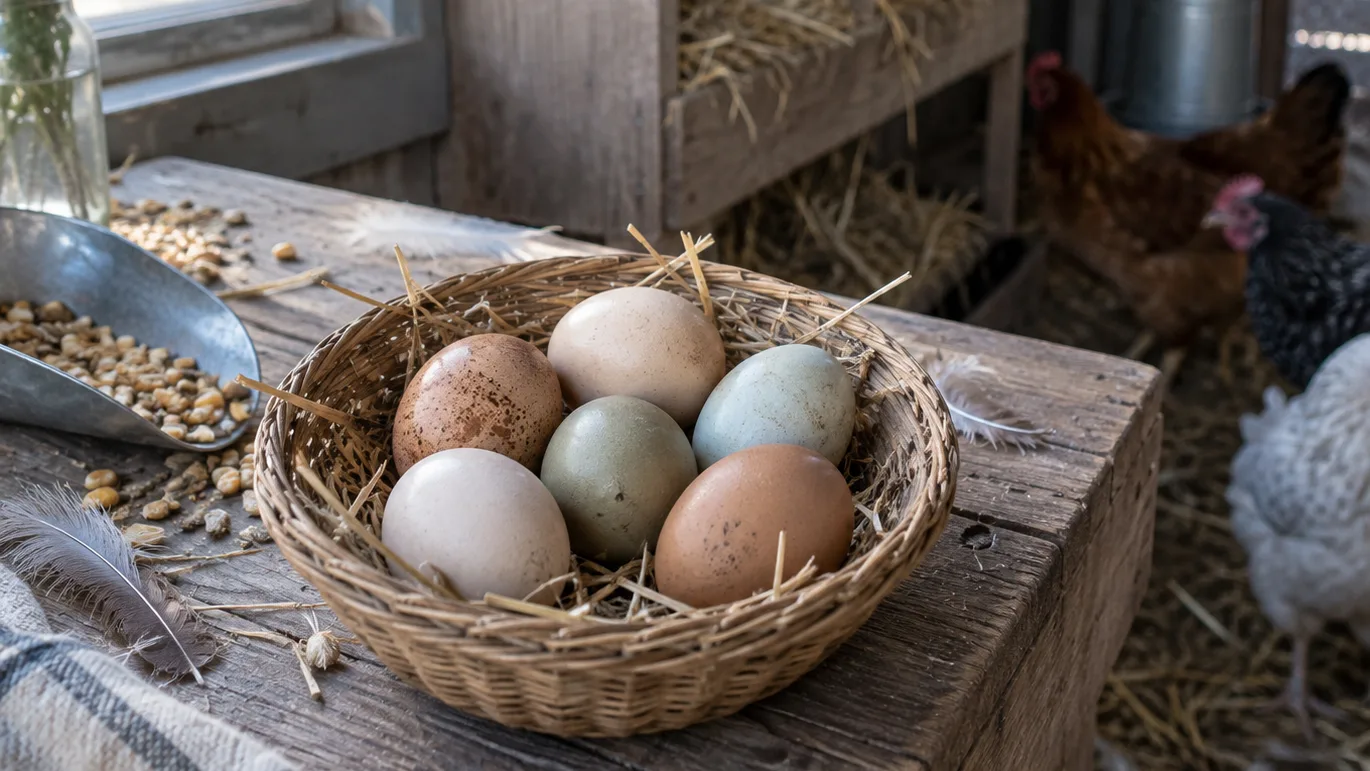
Chicken egg colors chart: six shell shades and the breeds most often behind them
Start with the broad colour family, then look at the finish. A blue egg can be pale aqua or a deeper green-blue. A brown egg can be warm terracotta, chocolate, or almost plum under a heavy bloom. Those differences do not necessarily mean you are looking at different basic pigment systems.
| Shell colour group | Breeds or lines often associated with it | How much confidence to place in the label |
|---|---|---|
| White | Leghorn, Ancona, and Hamburg lines | Often steady within an established line |
| Cream or tinted | Lighter Orpington, Sussex, and Brahma lines | Moderate; individual eggs may read off-white to tan |
| Light brown | Plymouth Rock, Wyandotte, and Australorp lines | Moderate to fairly steady, with shade differences |
| Dark brown | Marans, Welsummer, and Barnevelder lines | A good starting point, but depth and speckles vary |
| Blue | Araucana, Ameraucana, and Cream Legbar lines | Often predictable as a blue base; the exact shade still moves |
| Green or olive | Olive Eggers, Easter Eggers, and other crosses | Least predictable unless the breeder shows parent eggs |
Think of this chart as a buying map rather than a promise. A recognised breed name gives you a useful starting point, but breeder selection and individual genetics still matter. Two hens sold under the same broad label can lay eggs that look noticeably different in your basket.
Speckles belong on top of the main colour rather than in a seventh pigment category. Bloom is the soft, chalky-looking surface finish that can make a shell appear lighter, flatter, or slightly purple. Pinkish casts can come from a pale brown coating and bloom together. Plum tones often appear when a dark brown surface is softened by the bloom. In practical terms, you are reading both the shell and what has been laid over it.
The pigment map—why brown sits on the surface but blue runs through the shell
The simplest way to understand chicken egg colors is to picture the shell as a base layer with an optional outer wash. That model explains why a green egg is not usually a single green pigment, and why rubbing a brown egg can change its appearance without turning a blue egg white.
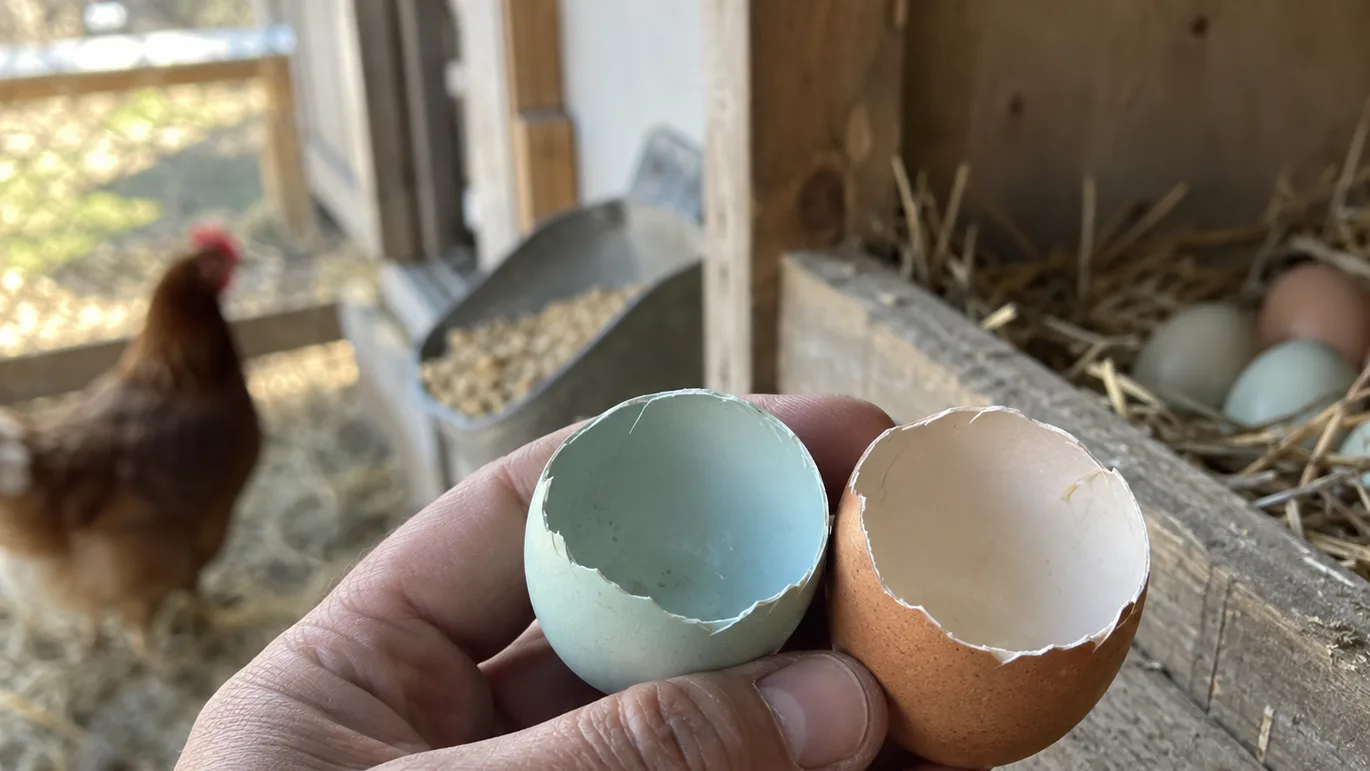
- White: the shell shows little or no visible pigment.
- Blue: biliverdin is deposited through the shell, so the colour is part of the shell rather than just a surface stain.
- Brown: protoporphyrin is concentrated mainly in the outer cuticle, creating the visible brown wash.
Green or olive usually means a blue shell base has received a brown surface coating. A light coating can produce sage or khaki. A heavier one can push the egg toward moss, olive, or a deep grey-green. That is why Olive Egger eggs can sit in a wide visual range even when the breeder uses the same cross name.
The clock helps explain some of the variation. A useful working model is a laying cycle of roughly 24–26 hours, with most shell formation taking place during about 18–20 hours in the shell gland. That is a planning approximation, not a stopwatch that every hen follows. It does explain why a hen laying repeatedly may not put the same apparent amount of outer brown pigment on every consecutive egg.
On a brown egg, some of the surface pigment can be rubbed or washed away. The shell underneath has not changed; the finish has. On a blue egg, removing surface dust or bloom does not remove the blue base. Treat that as a helpful home observation, not a substitute for checking the hen if shell quality or behaviour also changes.
Buying for a color: three confidence levels from true-breeding breeds to Easter Eggers
Colour confidence is not a yes-or-no question. For a flock of three to twelve hens, I would sort your options into three practical levels and decide how much uncertainty you actually want in the basket.
Higher confidence: a recognised blue-egg line
Ameraucana, Araucana, and Cream Legbar lines are commonly chosen when the buyer wants a blue shell base. The blue may be pale, chalky, or stronger than expected, but the broad colour family is usually easier to anticipate than the colour of a crossbred bird.
That still is not a guarantee. Hatchery wording can cover several lines, and private breeders may select for different shades. Ask whether the parent hens are laying blue eggs now, and request recent photos from the actual line rather than relying only on a catalogue photograph.
Middle confidence: established dark-brown lines
Marans, Welsummers, and Barnevelders are sensible starting points if you want brown eggs with more depth than a standard light-brown layer. The trade-off is that dark brown is not one fixed colour. One hen may lay a warm russet egg with speckles, while another from a related line may produce a smoother medium brown.
If dark brown is the part that matters most, ask about the eggs from the dam and other close relatives. A breed label tells you what the line is selected toward. It does not tell you exactly how much pigment a particular pullet will place on every shell.
Lower confidence: Easter Eggers and Olive Eggers
Easter Eggers can lay blue, green, aqua, brown, or tinted eggs because they are not one fixed breed with one fixed shell-colour result. Olive Eggers are deliberately bred toward green or olive eggs, but the depth of the olive can still vary with the blue base and the brown-egg parent.
Hatchery labels, earlobe colour, and breed names alone cannot guarantee a shade. They may help you identify a bird or understand its background, but they are weaker evidence than photos of the parent eggs. The American Poultry Association breed descriptions can help you compare recognised breed traits, but you still need the seller’s line information for a colour-specific purchase.
Use this four-part buying check:
- Choose an anchor colour. Decide whether your minimum acceptable result is white, brown, blue, or green. Do not start by demanding six different shades.
- Ask for parent-egg evidence. Find out what the dam and, where known, the sire’s female relatives produced. A current photo is more useful than a stock image.
- Buy one dependable colour first. In a small flock, one reliable blue or brown layer gives you a basket you can count on while you test a more variable cross.
- Treat the gamble as part of the plan. An Easter Egger or Olive Egger can be a fun colour experiment, but buy it because you accept the range, not because a listing promises one exact shade.
In a three-to-six-hen yard, I would rather have a calm, climate-suitable hen that lays a slightly less dramatic egg than a difficult bird chosen only for a photograph. I also would not pay a premium for an Olive Egger unless the breeder can show the parent eggs and explain the cross. The colour is enjoyable, but the flock has to live in your run every day.
If you are still comparing Backyard chickens breeds, put shell colour beside temperament, expected laying pattern, and local availability. If your main goal is a breakfast basket, the broader guide to raising backyard chickens for eggs is a better companion than a colour chart alone.
When the shade shifts: laying sequence, hen age, bloom, and genuine warning signs
An egg that looks a little lighter or darker is not automatically a health problem. Brown pigment can appear thinner during an active laying sequence. A hen’s age, the condition of the bloom, and small differences in surface pigment can all change how your eye reads the shell.
Bloom matters more than many new keepers expect. A fresh matte finish can make a brown egg look paler and a blue egg look softer. As the surface is handled, rubbed, or cleaned, the same underlying shell may look more polished or more saturated. Speckles can also be uneven. One egg may have a cluster near the blunt end while the next has almost none.
Last spring, in my small suburban flock, a young Olive Egger laid a moss-green egg with a chocolate-brown wash concentrated around the blunt end. Four days later, the next egg looked more khaki than olive and had three tiny dark specks near the wide end. Both shells were firm, and she was eating, drinking, and moving normally. I logged the change instead of treating the colour alone as a warning.
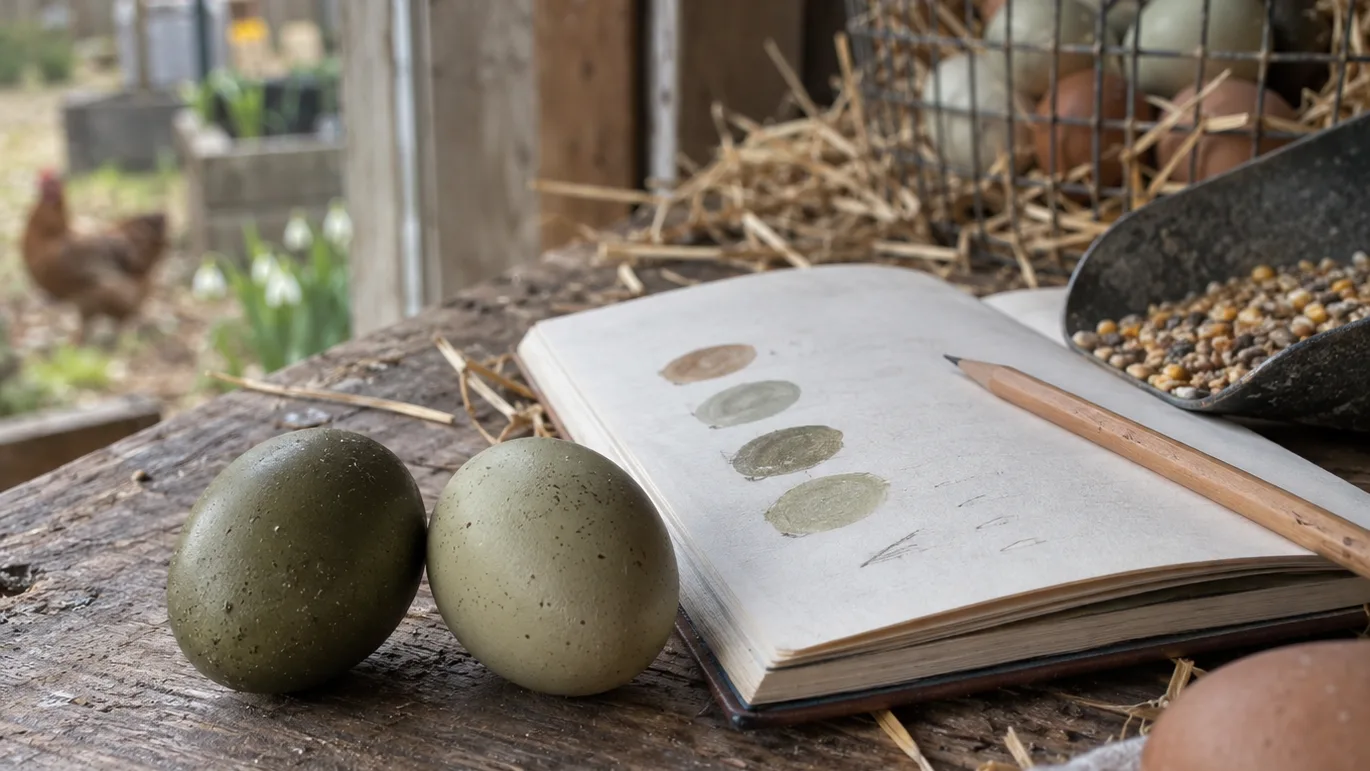
That is the useful distinction: colour by itself is a basket observation. Colour plus a change in shell quality or the hen’s condition is a health question.
Make a one-week log before you reach for a treatment
For seven days, note the hen if you know it, the broad shade, whether the surface is matte or glossy, and whether the shell feels normally firm. Add appetite, water intake, droppings, and general behaviour. You do not need a laboratory chart. A few words beside each egg can show whether you are seeing a single odd shell or a pattern.
A new layer may also settle into a different rhythm as she matures. If you are unsure whether the timing fits normal production, compare your observations with at what age do chickens start laying eggs rather than judging the egg colour in isolation.
Get veterinary advice, or contact a qualified local extension office, when a colour shift comes with repeated thin or soft shells, misshapen eggs, reduced appetite, lethargy, breathing changes, or another clear change in the hen. A shell-colour explanation is not a home diagnosis. The combination of signs changes the response.
Taste, nutrition, and the best flock plan if color matters to you
Brown, blue, and green shells do not automatically mean richer flavour or better nutrition. Shell colour is a poor shortcut for judging what is inside. If you care about eating quality, pay closer attention to freshness, feed, clean handling, and how the eggs are stored.
Feed can influence the yolk’s appearance and the overall quality of the laying diet. Freshness affects how an egg behaves in the pan. Handling and storage affect food safety. None of those questions is answered by the shell colour alone. A blue egg is not a special nutrition category, and a brown egg is not automatically more wholesome because it looks rustic.
My order of priorities for a small residential flock is temperament and climate fit first, a laying pattern that suits the household second, shell colour third, and availability fourth. You may rank them differently. The point is to make the trade-off openly. A bird that fits your yard is useful every week. A rare shade is mostly a pleasure when the rest of the setup already works.
If you want a mixed basket, one dependable colour anchor plus one variable cross is a reasonable plan. I would expect that combination to give you more visual variety than choosing one uniform line, but I would not promise six separate shades. That prediction is only as good as the breeder’s parent stock and the genetics behind the cross.
Before ordering, also check how many eggs your household actually needs. The guide how many eggs does a chicken lay can help you compare expected supply with your flock size, season, and plans for sharing. For current handling, refrigeration, and food-safety advice, use USDA's egg-handling guidance rather than an old social-media rule.
This week, make a one-page colour plan. Write down your target shell colour, your acceptable fallback, and the parent-egg evidence you require from the seller. Then compare that note with Backyard chickens breeds and your wider plan for raising backyard chickens for eggs before you place an order. That small step turns a pretty basket idea into a flock decision you can live with.