Do Minks Eat Chickens? Yes—and How to Secure Your Coop
Yes: minks can kill chickens, and the small gap you barely notice may matter more than a tall fence. Their long, slender bodies can pass through openings that would stop bulkier predators, so cover vents, windows, and other gaps with 1/2-inch hardware cloth rather than relying on chicken wire. Minks may kill several birds in one visit and leave only small bites on some; treat that pattern as a reason to inspect carefully, not as a certain identification.
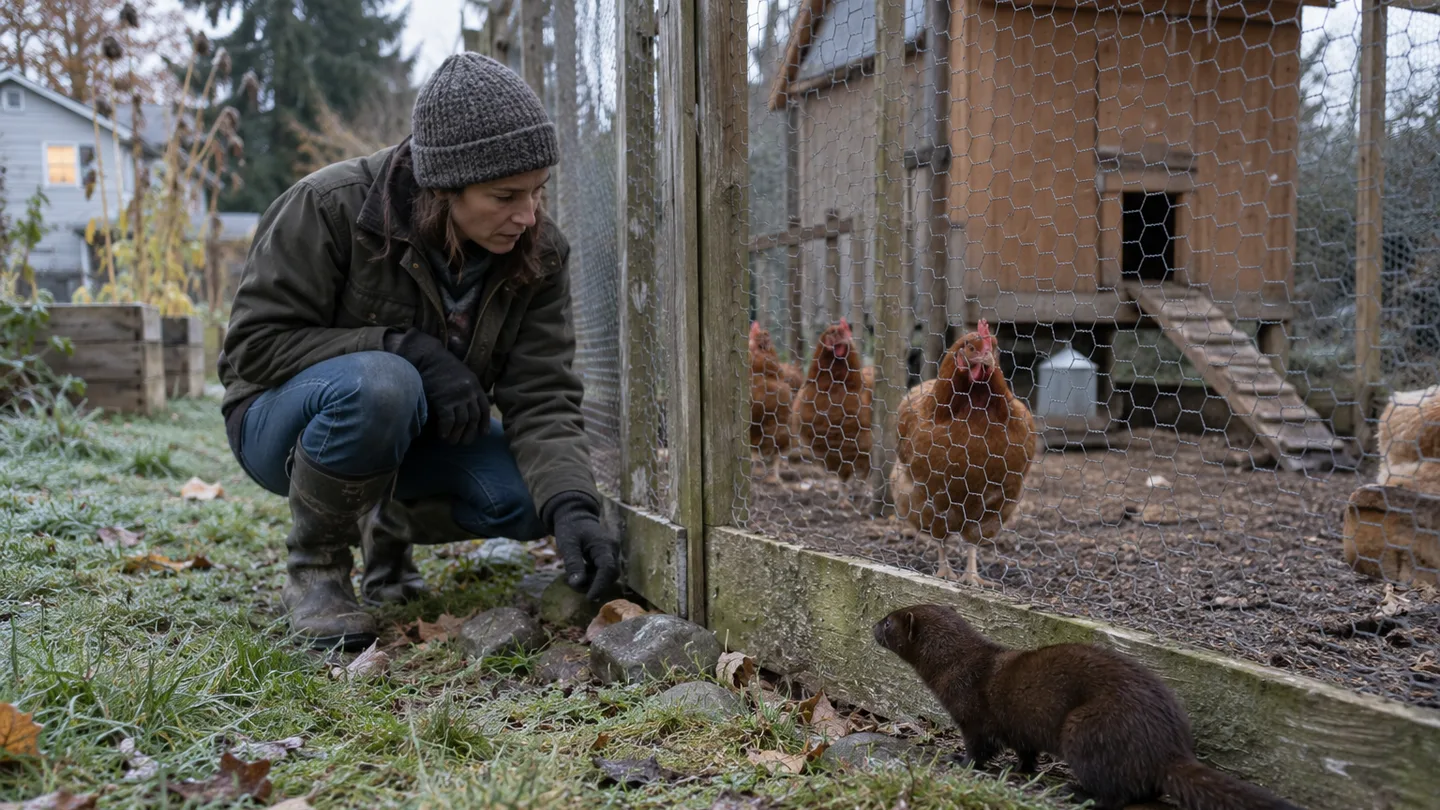
Yes—minks can kill chickens, and a gap can matter more than the fence
A fence can look sturdy from the yard and still leave a route at the bottom of a door, around a vent, or where mesh pulls away from its frame. That’s the practical problem with mink: a barrier designed only to keep chickens in may not exclude a slim, determined predator. A 1/2-inch hardware-cloth barrier over openings is a sensible starting point because it closes smaller passageways than ordinary chicken wire does.
Think of the coop as a connected shell, not just four walls. Check the run, door edges, corners, roofline, vents, and the places where different materials meet. A gap is particularly worth fixing if it opens into the birds’ sleeping area or gives an animal access to a sheltered corner. Your local wildlife and the details of your coop affect the risk; living near water can be a clue to mink habitat, but it isn’t a reliable boundary around where they may travel.
Chicken wire has a useful job: it helps contain chickens. Its wide openings and relatively light construction make it a poor choice as the sole predator barrier. Hardware cloth is stiffer and has smaller openings, but the mesh alone isn’t the whole job. If it’s attached with weak fasteners, left loose at a corner, or stopped above the ground, the weak connection can become the route in.
The number of birds found, the size of a wound, or a single missing egg can’t identify a predator by itself. A mink sighting near your property also doesn’t establish that it caused a loss. Look for a combination of clues and, most importantly, find out whether there is a physical entry route.
Neck wounds aren't an ID: check tracks, timing, and the entry point
Start with the scene as you find it. Before you repair or tidy anything, take wide and close photos of disturbed soil, feathers, droppings, damaged mesh, and the door or wall nearest the birds. Include an ordinary object for scale in a photo of a gap. Keep people and pets away from any injured bird, and contact a veterinarian promptly for an examination and treatment advice.
Then check the evidence together. Note when the coop was last secure, when you found the problem, which birds are missing or injured, and where feathers or other disturbance lie. Look around the perimeter for tracks, droppings, scuffed soil, and places where mesh or fasteners have shifted. Tracks can be hard to read in dry, stony, wet, or heavily used ground, so a footprint without other clues is weak evidence. Wounds alone are weak evidence too: different predators can leave injuries that look alike.
A gap or damaged panel may tell you more than a footprint. If you find a loose corner, test how it moves without making the opening larger. Check both sides of the frame and the ground directly below it. A trail camera aimed at the suspected route can add useful context over several nights, though a camera that records no visit doesn’t prove nothing passed through.
Here’s a worked example, not a claim about a particular real flock: a keeper with six hens finds two dead birds and one injured bird after the coop was shut for the night. There are feathers beside a low run corner, but the rest of the ground is too hard to hold clear tracks. Inspection finds that the mesh ends short of the wooden frame at that corner, leaving a narrow opening. That opening is a confirmed repair need; the bird pattern makes mink one possibility, not a diagnosis. Photograph the defect, close it, and keep checking for other signs rather than deciding from the wounds alone.
My hands-on check starts at ground level: I crouch at each corner, run a gloved hand along the mesh-to-frame seam, and look for a loose edge that can flex away from its fasteners. The repair I’d make to a small backyard run with a loose lower panel is to replace that section with 1/2-inch hardware cloth, fasten it firmly to sound framing, and continue the barrier down to the ground defense. That simple check is easier to repeat than trying to identify a predator from one confusing clue.
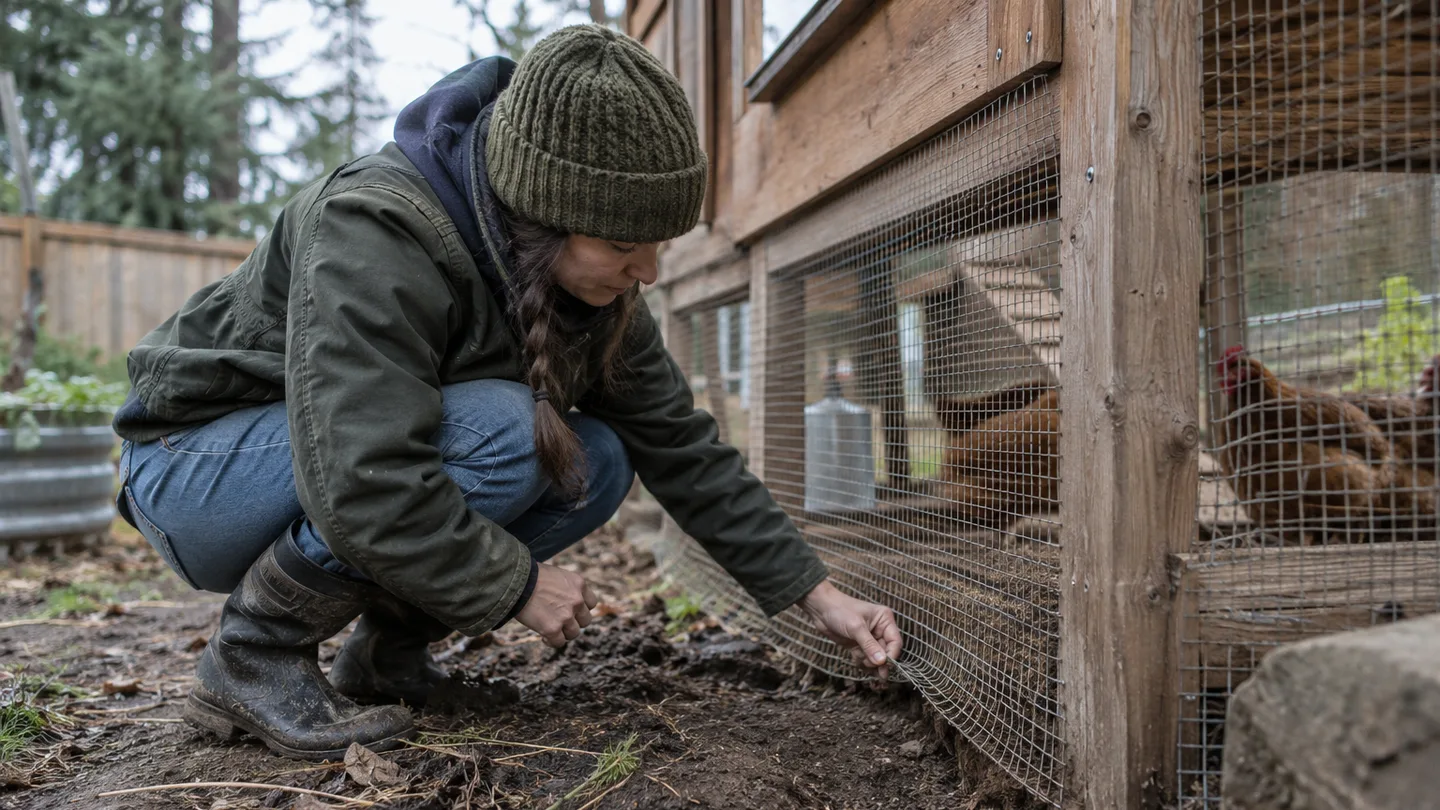
Close the route in: 1/2-inch mesh, tight doors, and a ground-level apron
Work from the smallest openings outward. Cover vents and windows with 1/2-inch hardware cloth. Secure it to solid framing with fasteners suited to the material, close gaps at door edges, and inspect corners and roof edges where two surfaces meet. A door should sit close to its frame when shut; if it sags, adjust or repair the door rather than assuming a latch alone solves the gap.
Pay attention to the mesh’s edges. A predator can push at a loose panel, while a lifted edge gives it a place to work. Fasten the cloth along the framing, not just at a few convenient points, and make joints overlap onto solid support. If the wood is soft or split, attach the repair to sound material. Replacing weak framing may be the useful part of the repair, even when the visible problem first looks like a mesh problem.
For a ground defense, you can bury mesh about 12 inches down or lay an outward-facing apron about 12–18 inches wide and secure it flush to the ground. Those are practical starting dimensions, not magic limits. The mechanism is the important part: a ground-entering predator commonly tests the base of a barrier and digs beside it or beneath it. Buried mesh makes the animal meet a barrier as it digs down; an apron makes it meet mesh when it starts at the wall and works outward. Loose soil, persistent digging, uneven ground, drainage needs, and the predators in your area can change how much reinforcement a site needs.
With an apron, extend the mesh outward from the run wall and pin it close to the ground so it can’t lift. Covering it with a thin layer of soil or ground cover can make it less of a trip edge, but keep the location visible enough that you can inspect it. At gates, make sure the apron doesn’t leave a gap where the door swings. If you bury the mesh, connect it securely to the wall’s lower edge; a buried strip that stops short of the wall doesn’t block the route you meant to close.
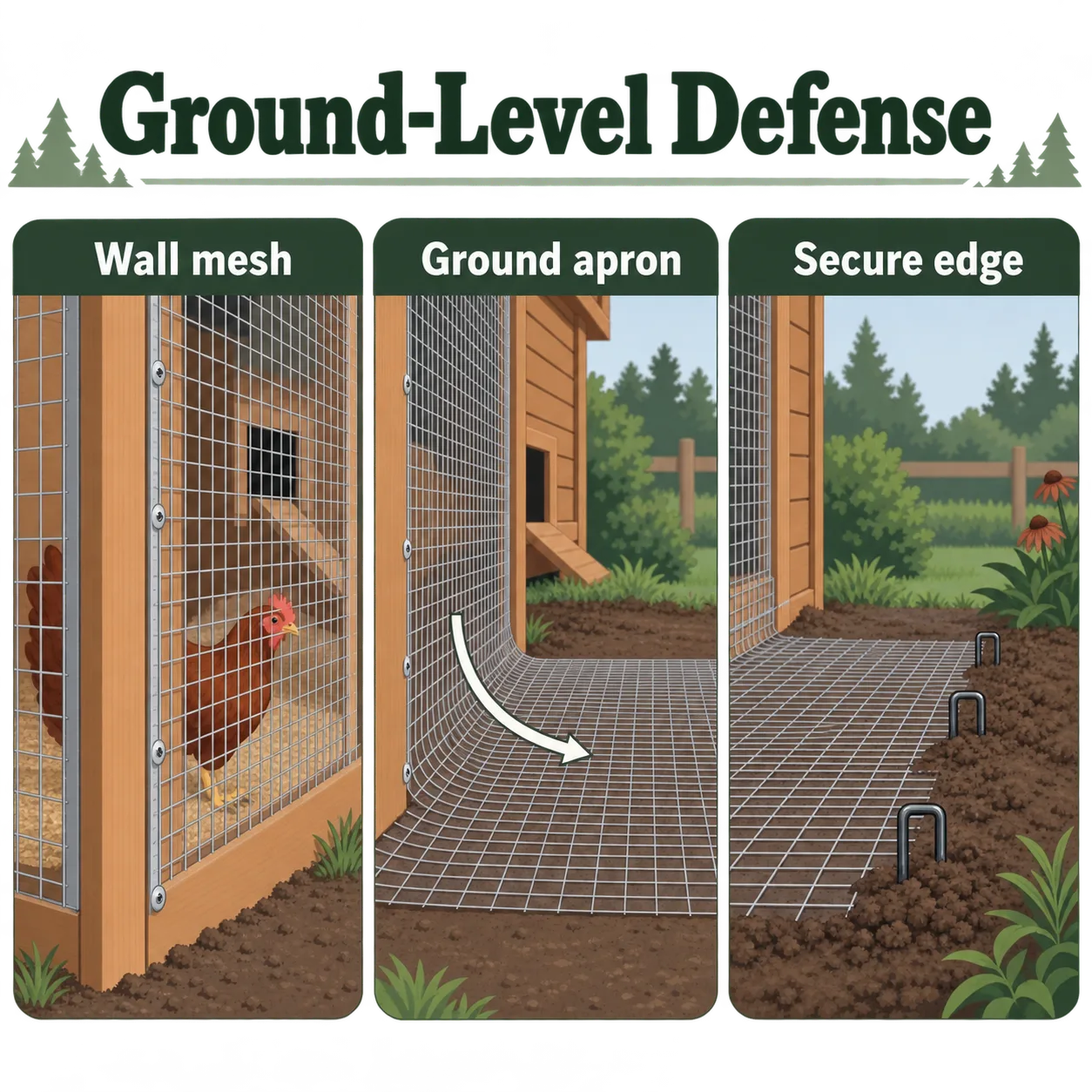
Chicken wire can remain useful for a light partition or to keep birds in an area, but don’t treat it as the primary exclusion layer for a small predator. The key decision is whether every opening, joint, and ground edge forms a continuous barrier. For more build options, compare the details in Best predator proof chicken coop and the practical notes on chicken run predator protection.
One trade-off is worth being blunt about: a tiny patch over the spot you noticed may feel like a finished repair, but it can leave the same kind of weakness at the next corner. I’d rather spend the first repair session tracing the whole lower edge and closing several modest gaps than making one heavy-looking patch and assuming the rest is sound.
After a breach: secure birds tonight, inspect weekly, and check local rules before trapping
Don’t wait for a perfect predator ID before protecting the flock. Move the birds into a fully enclosed, secure coop for the night. Temporarily cover the suspected opening with a firmly fastened piece of suitable material, then inspect the entire perimeter in daylight and make a durable repair before reopening the run. A loose board or piece of mesh that can be pushed aside is a short pause, not a reliable fix.
Use a small repeatable inspection: check mesh for bends or pulled edges, fasteners for movement, doors for new gaps, corners for disturbed soil, and the full ground edge for places where an apron has lifted or a buried section has been exposed. Do it weekly and again after storms, maintenance, or fresh digging. A phone photo of each corner can help you notice changes over time, especially when the ground is muddy or the run’s lower edge is difficult to see.
If a bird is injured, contact a veterinarian promptly instead of relying on a home treatment guess. If you’re considering trapping or relocation, check with your state or provincial wildlife agency first. Rules can depend on location, season, and method; don’t assume that a method permitted elsewhere is legal in your area. The agency can also direct you to an appropriate local wildlife professional.
This week, take ten minutes to inspect every lower corner and opening, photograph anything loose, and close the most obvious route before dusk. For broader predator-barrier planning, use the site’s best chicken predator protection guide as your next checklist.
Do minks eat chicken eggs?
They may take eggs, but a missing egg by itself doesn’t identify the animal. Secure nest-box openings and collect eggs regularly, then look for other signs before drawing a conclusion.
Are minks only a risk if you live near water?
Waterways can be a useful habitat clue, but they aren’t a dependable boundary. Check the coop and the wildlife signs around your own property rather than treating distance from a pond or stream as protection.
Can I legally trap a mink on my property?
Rules vary by location and method. Ask your wildlife agency before trapping or relocating an animal.
Frequently Asked Questions
Do minks eat chicken eggs?
Minks may eat eggs as part of a varied diet; secure nest boxes and collect eggs regularly, but don't treat missing eggs alone as proof of a mink.
Are minks only a risk if you live near water?
Waterways are useful habitat clues, not a reliable boundary; assess the coop itself and local wildlife rather than assuming a yard away from a pond is safe.
Can I legally trap a mink on my property?
Rules differ by state, province, season, and method; check the relevant wildlife agency before trapping or relocating one.